
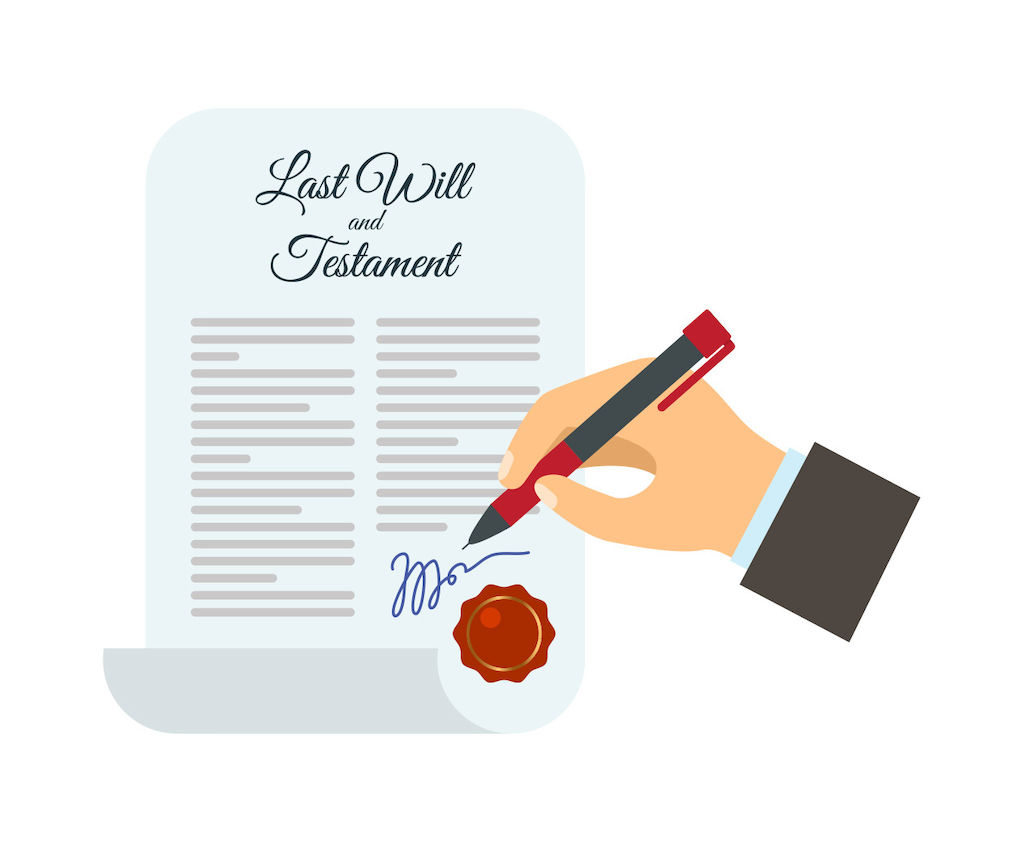
Family historians generally refer to wills rather than testaments. From the fourteenth century until 1692, there were important restrictions on what could be left in a will or testament. These days the expression a will  can now mean either a document which, strictly speaking, is a testament or one which contains both the elements of a will and also a testament.

Historically they were two different documents with differing rules applying to them. 

With the passing of years, the distinction between a will and a testament has become blurred and any document which distributes a deceased’s property after death is generally called a will.


The will

The document called a will only dealt with land holdings, called tenures, such property being called real property or realty.

Feudal land law meant that the lord of the manor wished to control his tenant. He did not want the tenant to be able to pass on the tenure without consent and intervention of the lord, usually through the Manorial Court.  Often fees were payable to the lord to permit a transfer. This process was called surrender and admittance.

In 1540 a relaxation of the feudal rules was introduced. It became possible to dispose of some real property - namely that which was held as socage.  In effect this is what we would now call freehold land  tenure.

After 1661 all other freehold tenures could be disposed of by a will.
The testament

Remember, the will only dealt with land. From the fourteenth century onwards, all other assets were capable of being distributed after death by a document called a testament. These assets comprised what was legally called the personal estate or personalty. Land or realty did not pass under a will.

The expression personal estate included every kind of possession you could imagine. For example, a purse and the cash in it, clothes and all measure of household articles. This would include furniture, beds, bedding, tables, cupboards and dressers. Even kitchen equipment was included such as ovens, spits and kitchen ranges, pots and pans, knives and forks, glasses, tankards and cups made from pewter, brass and sometimes silver. And there's more...clocks, trade and business articles, tools such as a clothier’s loom, a  blacksmith’s anvil and bellows and a farmer’s items of husbandry. And not forgetting his animals such as hens, pigs cows, sheep and horses, plus his wagons, saddles, hay and crops, bees and  hives and... even dung heaps!

Any debts due to the deceased called bonds were valuable assets of a deceased. Until the eighteenth century there were no banks as we know them, and wealthier farmers, tradesmen, lawyers etc. would lend money to neighbours secured by a bond, which was in effect an IOU or promissory note.

Leasehold or rented land DID count as personalty and could be left under a testament.

The dead's part

The dead's part? Yes, this is a recognised legal term. Basically, it refers to that portion of the personal estate of a deceased man which remained after his wife and children had received their shares.

Until 1692 only a small proportion of a deceased’s personal estate could be left by a testament. The laws of inheritance which applied were those of forced heirship, derived from Roman Law. These rules applied across England and Wales. It was only in 1725 that London fell into step with the rest of the country, permitting freedom of testamentary disposition.

Under the rules prior to 1692, a widow would automatically receive one third of the assets comprising the deceased’s personal estate. Any children of the deceased would receive another third part to be shared amongst them equally.

It was only the final third of the deceased’s personal estate that could be left freely by a testament. This was what the testamentary document dealt with; it was called the dead's part.

Prior to 1692, the wording of a testament repeated the rules I set out above.

For example, a 1634 will / testament in my possession expressly states: ...my personal estate be divided into 3 parts, one part I give to x my wife according to the custom of this Province...another third I give unto my children to be equally divided amongst them….and one other third part I give..... Then the deceased names the various individuals to whom he leaves the final third part. This third part was called the dead's part. If no testamentay disposition was made by will or testament, it effectively was given to the poor and not to members of the family. 

So it is important to appreciate that only one third of the personal estate could actually be bequeathed by testament, the remainder passed by law to predetermined beneficiaries as described above.

Do not panic!

When family researchers come up against wills, testaments and other legal stuff, they can experience a sense of horror and panic! And who can blame them! That is why I have tried to make these articles about legal matters as short and concise as possible without losing any of the meaning and effect they had on our ancestors' lives. FamilySearch and other genealogical websites have articles on legal matters too - and if in doubt, you can always Google to get a definition of a legal term.

This article was contributed by David Lambert from Family History Federation.
Website by Beachshore