



This is a terrific free website to outline some efficient ways of undertaking English research. Besides giving general advice it provides links to many other websites and projects that are major resource. It is provided by Brigham Young University whose expertise is second to none.
We will be looking at two unique features of the site:
- Finding and using pre 1858 probate records
- Understanding and locating Dade parish registers
but as you will see from the sources list below the website provides a wealth of information on valuable resources covering various subjects from the “basic” to more advanced.

Pre 1858 probate records
The format provides descriptions and local source strategies for finding information about the many different probate courts and facilities available county by county.

As an example of content, we will look at Northamptonshire, but the format is the same for each Pre 1972 historic county. The county map is enlargeable.

Each county then describes the ecclesiastical court jurisdictions and shows individual villages and towns where the jurisdiction is outside that for the county as a whole.

One of the most helpful areas of the website relates to strategies for researching a particular place or area. In the above table you will see that each place/court is suffixed by an alphabetical letter A, B, C etc. The research table shows how to search for each jurisdiction.

Within each county there is also a finding aid to indicate where on-line you are able to locate indexes to the county wills. Where the site refers to FHL film numbers these are available on FamilySearch as digital images to view either at home or through Family History Centres and Affiliate Libraries located throughout England.
Dade registers
If you are unfamiliar with Dade registers it probably means that your research does not stretch to the north of England (although other areas of the country also used them). However, those who find their ancestry in such areas will probably have come across this style of register.
They are parish registers with more information than the usual registers. William Dade was an eighteenth-century Anglican clergyman in Yorkshire and he included additional details in registers mainly relating to baptisms and burials. The registers commenced in or around 1777until the introduction of standard registers under Rose’s Act of 1812. Some registers continued to be used until the mid-1800s.
In Dade registers, baptisms often included parents and grandparents and sometimes great-grandparents, their occupations, residence and the birth date for the child. The marriage registers also included the abodes, professions, and ages of the bride and groom. Burial registers usually included information on parents or other relations, death date, burial place, cause of death and age.
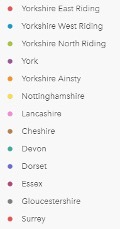
Although mainly used in Yorkshire various priests elsewhere recorded the additional information on registers they used during this time period. Such registers can also be found in areas of Cheshire, Devon, Essex, Lancashire, Nottinghamshire, Surrey, Gloucestershire, and Dorset. Alongside the Dade registers the Diocese of Durham under the direction of the then Bishop Shute Barrington developed a similar system known as Barrington Registers which began around 1798. These are not included in the current site but will be a future project.
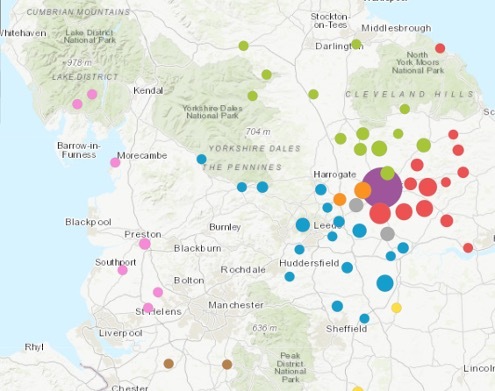
The map can be enlarged or diminished for more local viewing of parishes covered and a colour legend can be toggled to show the counties and where the parishes are located.
There is also a useful spreadsheet providing more details of dates, coverage etc.
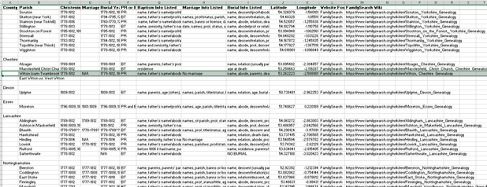
The spreadsheet is very informative giving the following information:
- County & parish
- Coverage of each type of register baptism, marriage, burial
- Whether parish registers or Bishops transcripts
- Information contained in each type of register
- Map reference
- Online website where entries, images or transcripts are found
- Where etc. find information in the FamilySearch Wiki.
Other areas are a valuable resource particularly for finding ways of tracing both migrant and emigrant ancestors.
The site does not provide direct access to data about individuals but has links to websites and on line material that does so it is a valuable research aid (all in one place) for comprehensive English research. Projects and categories will be progressively added so bookmark the site.