Finding an insolvent debtor in your ancestry may well happen by chance. It was probably a well-kept secret within the family and perhaps more prominent than we care to realise. The process sometimes led to bankruptcy but many of our ancestors would have struggled. The system of imprisoning people when they couldn’t discharge their debts dates from medieval times. Over half the population of England's prisoners in the eighteenth century served a jail term because of debt.

In Victorian England debt was closely linked to a person’s character. Credit was based on a person’s social status and adherence to moral standards as well as their financial status. Being in debt was seen as a moral failure to be punished accordingly. It wasn’t that easy for the working classes to obtain credit, but if they went into debt, the consequences were much more severe than those of the upper classes.

What does insolvent debtor mean?

Debt existed amongst all social classes so “keeping up with the Jones’s” was even the downfall of people from the higher social classes who often found themselves in debtors’ prisons, having spent more than they could afford, all for appearances' sake. Most imprisoned debtors were male but it was not uncommon for wives and children to be in prison too.

Insolvency means that a person is unable to pay their debts when they are called in. A person who is insolvent always has the liability to discharge them, even after a due period. Imprisonment was a common remedy for insolvency but very few bankrupts ever went to jail as bankrupts. Only after 1861 could insolvent debtors apply for bankruptcy.

Insolvent debtors and bankrupts are different. To qualify for bankruptcy you were supposed to be a trader, making your living by buying and selling, but by the late 1700s this also included most skilled craftsmen. Farmers were specifically excluded.

During the eighteenth and nineteenth centuries, approximately 10,000 people were imprisoned for debt annually; but it is not always clear what this achieved. Prison did not clear a person's debt yet they were required to repay the debt in full prior to release. The amount of freedom a prisoner had depended on the individual prison. Some allowed prisoners to conduct business whilst others allowed inmates to live a short time outside the prison which was known as the Liberty of the Rules. This was the case in the Fleet Prison, well known for Fleet marriages; it was a way for debtors to earn money. For those who were destitute, conditions inside a debtors' prison were intolerable. Some starved to death and it was not unusual for inmates to beg for money from passers-by.

Prisoners had to pay for their keep and some were allowed visitors, however, daily life in debtors' prisons was far from pleasant and subject to rules which today would be considered unreasonable. Some debtor prisoners, particularly in the provinces, were sent to prisons housing vicious and petty criminals but some county establishments did have a “civil” side. Charles Dickens' father was a debtor sent to Marshalsea prison. He became an advocate for debt prison reform as described by his son in Little Dorrit.

The Clink prison in London had a debtor's side accessed from Stoney Street. This prison was the origin of the phrase in the clink. Its location is also thought to be the origin of the term stoney broke.

The Debtors' Act 1869 reduced the ability of courts in sentencing insolvent debtors to prison but they were not prevented from doing so. Debtors with the means to service their debt but who did not do so or defaulted could still be sent to prison, albeit for a very limited time, usually six weeks. A year later the number of imprisoned debtors dropped from 9,759 to 6,605. However, by the start of the twentieth century, that number had again risen to almost 11,500.


Researching your insolvent debtor ancestor

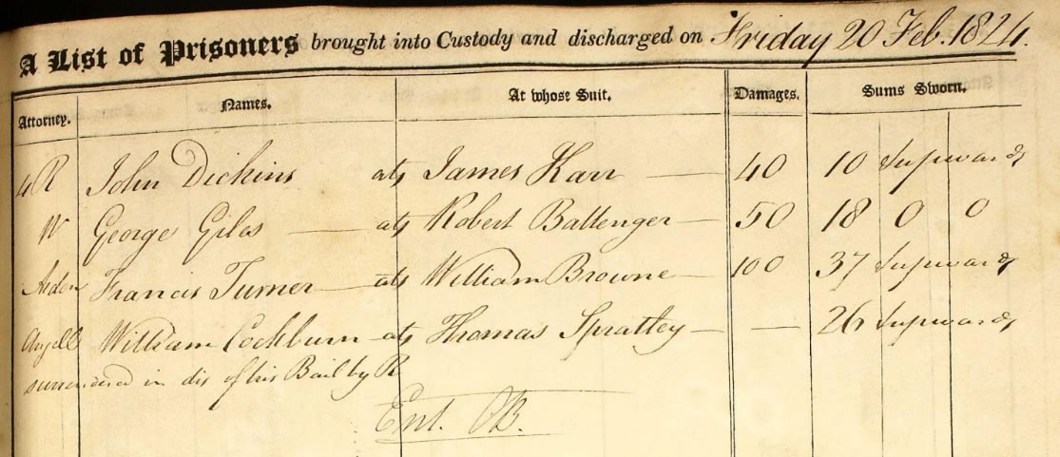
Finding information about such a person can be complex with a number of different records needing to be searched. Records of imprisoned debtors may be found in the records of the court which committed them to prison, the records of the prison where they were held or the records of the court which discharged them, if they were discharged, and listed  in the London Gazette.

The best place to begin research is with official notices in the London Gazette using the Gazette website and searching by name of the insolvent debtor. Be careful to distinguish between debtor and bankrupt when searching results.

Insolvent debtors' records, c1792-c1869, are held at The National Archives in series B6 and indexed in series B8 are the registers to documents filed in insolvency proceedings. They give brief details of insolvent debtors, the sums involved and the nature of any associated deeds. Occasionally the outcome of an action is also included which will provide information you can use to search court cases and debtors' prison records.

Declarations of insolvency and inability to pay are recorded in various pieces again in series B6. Between 1825 and 1854 they relate to the whole country, but after 1854 they relate only to London. The declarations show date of filing, name, address and occupation of the debtor and the debtor’s legal representative.

Debtors’ prison records for London are held at The National Archives in series PRIS 1 - PRIS 11 some of which are available to search using Ancestry.

The main records for the London debtors' prisons are as follows:

  • Gaolers' returns of insolvent debtors 1862-1869 series B 2
  • Court for relief of insolvent debtors – petition registers 1813-1861 series B 6
  • Fleet Prison Commitment Books 1685-1842 series PRIS 1
  • Fleet Prison Commitment Files 1758-1842 series PRIS 2
  • King's Bench Commitment Books 1719-1862 series PRIS 4
  • King's Bench Discharge Books 1776-1862 series PRIS 7
  • Marshalsea prison registers 1811 -1842 series PRIS 11
  •  
  • Some records for provincial debtors' prisons are also held at The National Archives in series PCOM 2 for Lancaster, Lincoln and Shrewsbury jails. Local record offices will hold records for the county jails but in some cases the records of the “civil” side have not been retained. Check with the local record office.

Petitions of insolvent debtors. The registers (series B6) and indexes (series B8) are either ‘town’, meaning London, or ‘country’, meaning the provinces. They cover the period 1820 to 1861. There are also petitions relating to unclaimed dividends i.e. payments to creditors which were not claimed covering 1824 to 1864 in series B6.

London Metropolitan Archives holds records of courts covering the City of London that committed debtors to prison as well as metropolitan area county courts after 1846. The records of the City of London Sessions include petitions from insolvent debtors at the Fleet Prison. Similar records for debtors held in King's Bench and Marshalsea Prisons are held by Surrey History Centre.


Applications for release as an insolvent debtor

From 1737 lists of insolvent debtors applying for release were published in the London Gazette.

In 1813, the Court for the Relief of Insolvent Debtors was established. Names of insolvent prisoners applying for release were also published in the London Gazette. These lists were also reproduced in The Times newspaper. They cover the period up to 1861.

At the beginning of the nineteenth century, the plight of those imprisoned for debt was a cause for concern. Previously, legislation had been enacted to try and reduce the pressure on the provincial prisons and to allow debtors to apply to the quarter sessions for release from imprisonment. These culminated in the appointment of a Commissioner for the Relief of Insolvent Debtors who presided at the new court.

In 1840 a Royal Commission concluded that there was a discrimination between insolvent debtors and bankrupts, particularly as many debtors had insufficient substance to bring them within the scope of the laws relating to bankruptcy. This recommendation resulted in the Insolvent Debtors Act 1842. Under the Bankruptcy Act 1861, the distinction between bankrupts and insolvent debtors was ended and the jurisdiction of the Court for the Relief of Insolvent Debtors passed to the Court of Bankruptcy.

Information about some of the prisons

In London, certain prisons were set aside as prisons for debtors, but in the provinces most insolvent debtors were housed in the county jails, albeit in separate wings away from the criminal element.

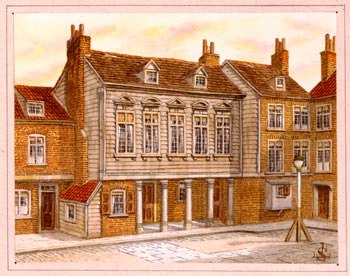
The Fleet Prison

This was originally built in 1197 and was rebuilt several times in the ensuing years. It was demolished in 1846. It is identified in some records by its address - 9, Fleet Market; workhouses often did the same thing, identifying their place as an address and not using the words born in the workhouse

The Fleet Prison became prominent as a place of reception for persons committed by the Star Chamber, then as a debtors' prison and for persons imprisoned for contempt of the Court of Chancery.

Prison cells ranged from luxurious private rooms to inmates sleeping two or more to a bed in a common area. The very poor debtors were allowed to beg through a grate of the prison. During the eighteenth century, Fleet Prison was used for debtors and usually housed about 300 prisoners, some with their families.

Whitecross Street Prison

This prison was in Islington and could hold up to 500 prisoners but it was usually less than half full. It was built between 1813–15 and closed in 1870 when prisoners were transferred to Holloway Prison.

The prisoners were held in five male wards, and one female ward.  At Christmas each year Nell Gwynne's bounty of £20, was given to inmates. Nell Gwynne was, of course, the mistress of King Charles II.


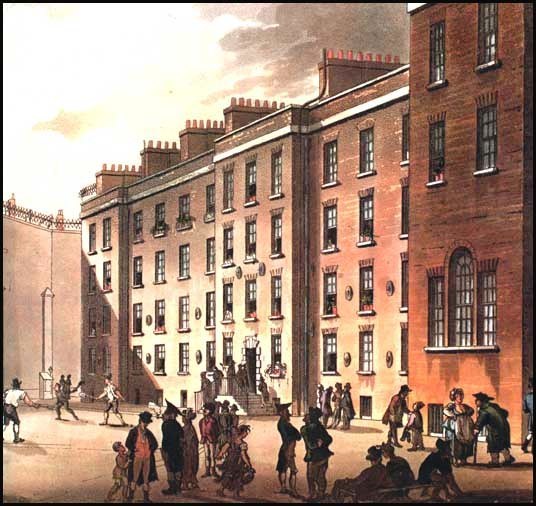
The Marshalsea Prison

This jail existed from 1373 until 1841 and was a notorious prison in Southwark. It housed the poorest of London's debtors. The prison was built to hold those brought before the Marshalsea court and the Court of the King's Bench because Marshalsea rulings could be appealed there.

The prison was where Charles Dicken's father was sent in 1824. Much of the prison was demolished in the 1870s.

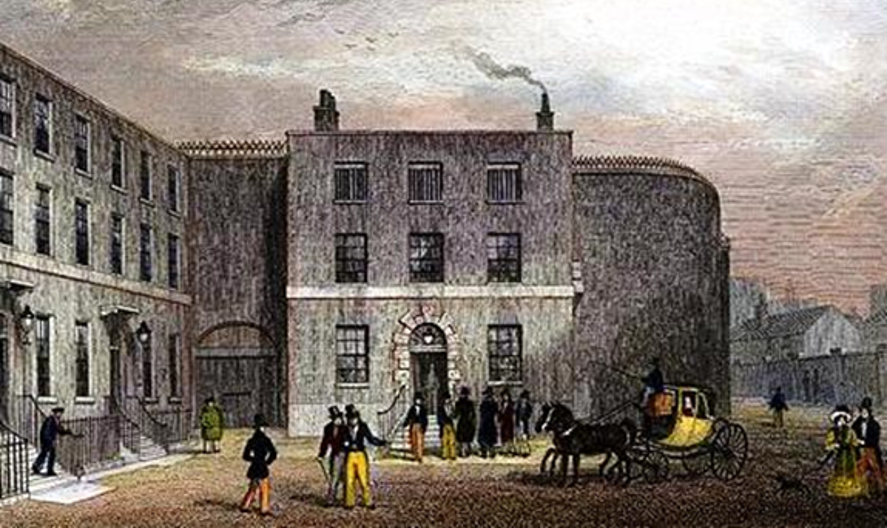
King's Bench Prison

Records of the courts of the King's Bench encompass an area within a twelve-mile radius of the Palace of Westminster - except for the City of London and its liberties.

Both the Fleet and Marshalsea Prisons were abolished in 1842 and the Queen's Bench Prison, which itself closed in 1862, became the only prison for all debtors.

The real Little Dorrit

Little Dorrit by Charles Dickens is story about Amy Dorrit, youngest child of her family; she was born and raised in the Marshalsea Prison for debtors in London. Dickens often wrote about charcters who had money problems and were incarcerated for debt, but what he doesn't mention is the large extent to which prisoners were helped by charities, even in those days. From the 1750s, the Craven Street Society was working successfully with Saint Thomas’ hospital in London to secure the release of many poor debtors. 

So if you discover that your ancestor was an insolvent debtor, there are plenty of records to help you find out more about the circumstances surrounding your ancestor's insolvency.  But a word of warning...there is a difference between an insolvent debtor and a bankrupt.  If your ancestor was a bankrupt, then you will have to research an entirely different series of documents.

This article was contributed by Ian Waller from Family History Federation.
Website by Beachshore