



Many things associated with a trip to the seaside have their roots in the Victorian summer holiday including fish and chips, promenades and pleasure piers which were revolutionary at the time. So how did our Victorian ancestors spend their holidays?

The growth of the seaside resort

As public access to the seaside resorts increased, many organisations such as churches, societies and the Temperance Movement provided opportunities to the lower social classes of society to experience this new pleasure. In 1871 the Bank Holidays Act set aside four days each year as official holidays for everyone. These days were not paid but with improving transport links and the cost of an excursion subsidised by the groups and organisations, the seaside holiday excursion began to become commonplace.

The growth of the railways transformed small communities which were originally fishing villages into popular seaside resorts and this  attracted day trippers and holiday makers of all social classes in growing numbers. For example, by the middle of the nineteenth century, resorts such as Brighton, Blackpool and Llandudno had become popular seaside venues because of their proximity to London, Manchester and the Midlands, thus becoming the go to places for a few hours of fun.

Some holidaymakers wanted to stay for a couple of nights so accommodation was in high demand. Boarding houses and hotels were established to cater for every budget. Resorts like Brighton regarded themselves as catering for the upper classes and tended to have large, grand hotels on the seafront. Blackpool and other similar destinations, virtually started from scratch. So wherever it was, boarding houses and small hotels shot up in significant numbers. The closer they were to the seafront, the higher the price.

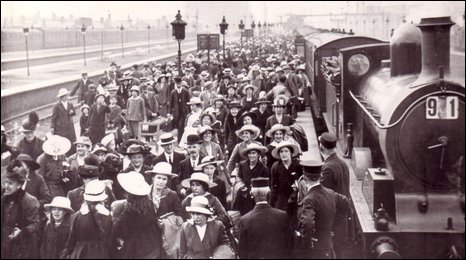
The popularity of the seaside would not have existed without the expanding railway network. Between the 1840s and 1870s, the rail network turned the distant seaside into popular day-trip destinations. Special excursion tickets made it possible for entire working-class families to visit the resorts which were once only reserved for the upper classes. Leisure was no longer a privilege of the elite but became accessible fun for all classes.

Health benefits

Taking the waters at the seaside was nothing new for the Victorian upper classes as it had become a popular pastime during the Georgian period in places like Lyme Regis and Brighton, as well as the spa towns around the country. Although the trips were supposedly about fresh air and exercise, they were also an excuse to mingle and show off, prove they could stay in the grand hotels, attend social events such as the theatre, and exhibit the latest fashions at parties.

The Victorian seaside was originally pitched as a health cure not just a fun place. Doctors prescribed the saltwater and sea air as a cure for everything from simple anxiety to the more serious diseases like tuberculosis, giving clean lungs and clear minds, far from the smoke and sin of the industrialised towns and cities. However, people raised concerns about the value of entertainment in the arcades, sideshows and frivolous amusements that appered which they felt distracted rather than healed.

Seaside entertainment

When at the seaside the Victorians stepped into the world of amusements. Children rode donkeys on the beach, or watched the Punch and Judy shows where the puppets slapped each other before the laughing audiences. Penny arcades, fortune-telling machines and the like offered escapist thrills. The seaside was not all based on amusements though.

Promenading on esplanades and piers

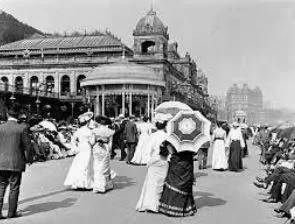
Promenading, which was a stroll along the wide seafronts, the long, level ‘prom’ or esplanade described as a public catwalk where you could enjoy admiring glances from your peers as you strolled along wearing your best attire.  

Promenades were where ladies could flaunt new outfits and flirt with parasols. The popularity of promenading grew significantly during the Victorian era. The first piers, extensions to the esplanade, were built in the 1850s which enabled tourists to stroll and see the resort from a different angle, as well as to moor the visiting pleasure steamers and ferries.

Piers could once be found at virtually every seaside resort with the first opened at Ryde, Isle of White in 1814 although most were built after the 1860s. Early piers were built as landing stages for boats and as promenades where visitors could enjoy the sea air without the danger of getting wet. Most charged an admission fee. However, as competition increased, piers became places of amusement to draw more visitors playing host to refreshment rooms, concerts, bands, dances, sideshows, and in some cases funfair rides.

In an era of rapid industrialisation of the towns and cities, it was the coastal resorts that offered a welcome break from the smog, noise and choking pollution that workers encountered daily. Without the Industrial Revolution we would not have had the railways which could whisk families across the country in a matter of hours opening a whole new world of opportunities for people to spend their leisure time.
Donkey rides

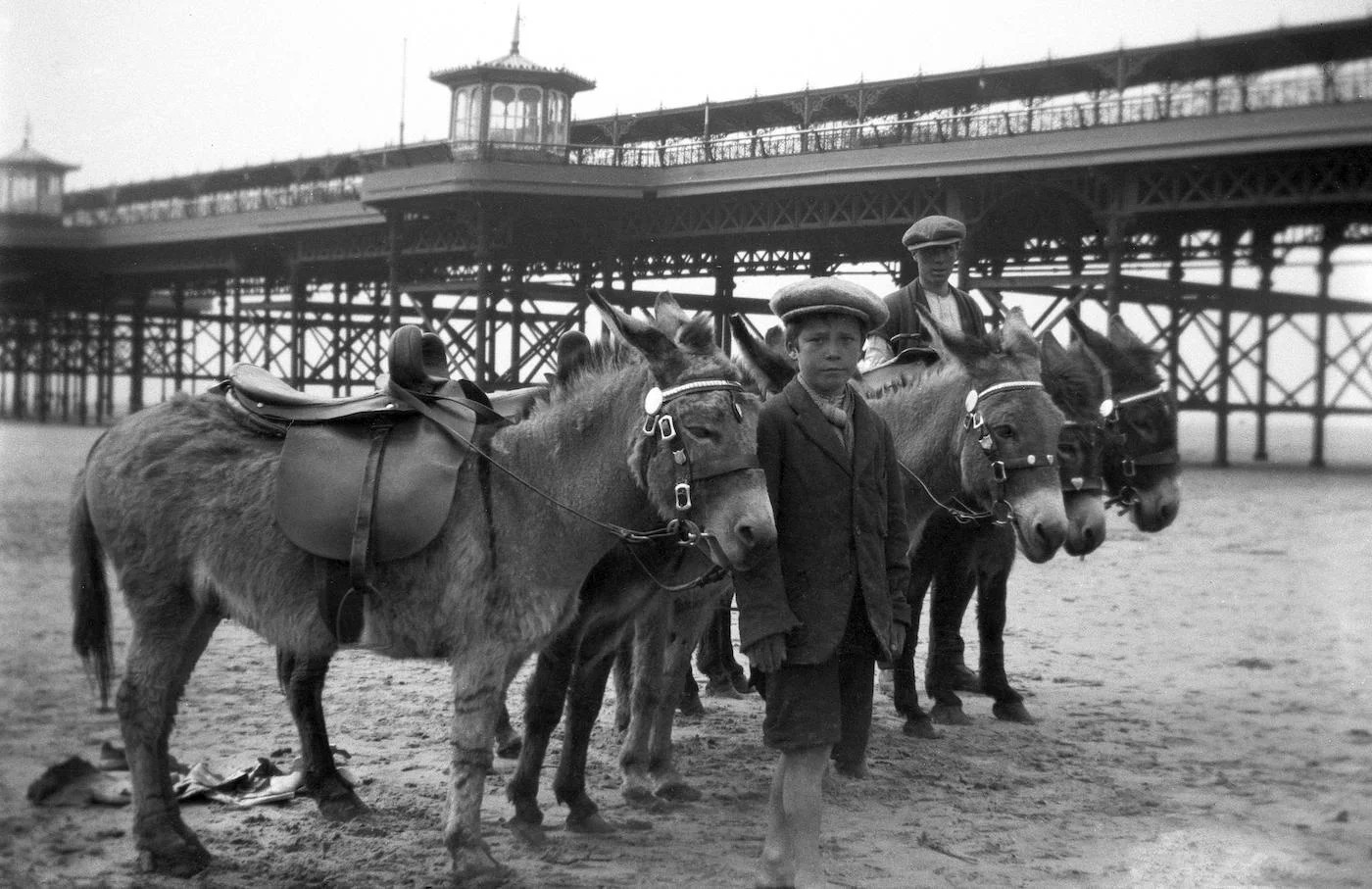
The earliest record of donkey rides on the beaches is around 1780. They were popular animals because of their quiet disposition and gentle nature and were initially ridden side saddle. They became very popular as seaside holidays became more affordable to working-class people around the 1880s. Often the provision of donkey rides was by the same family for generations.

Donkey rides became a traditional feature of seaside resorts where children were allowed to ride donkeys on the sandy beach for a small fee while on holiday. The donkeys used to have their names on their harnesses so they could be identified by children and parents alike.

Fish and chips

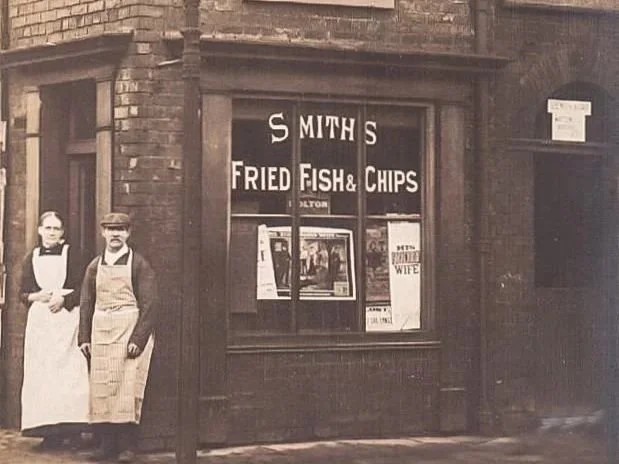
Fish and chips as a staple seaside meal existed as early as 1780, brought to popularity by Sephardic Jews immigrating to Britain from Portugal. By the nineteenth century, fried fish was a popular dish in London. This translated to the seaside, where the portability and freshness of fish and chips quickly made the dish a favourite amongst holidaying Victorians and helped to cement it as a national dish.

Amusements

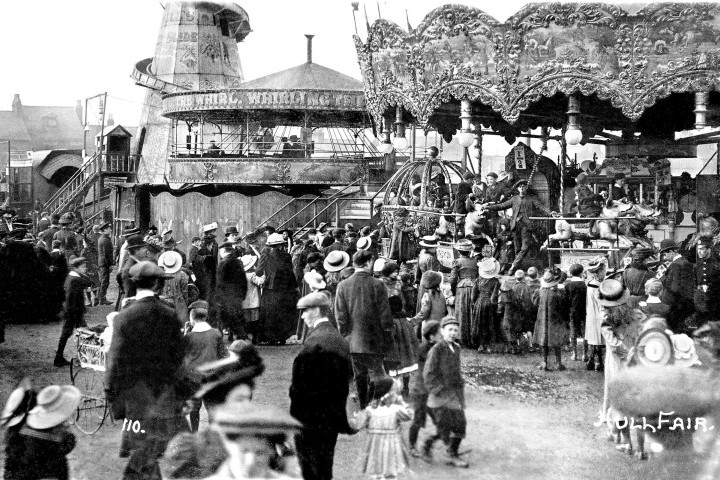
A whole host of attractions developed on the piers and along sea fronts after the holiday craze took hold including penny arcades, theatres, food kiosks and fairground rides. Mutoscopes and What the Butler Saw Machines evolved into cinema. The smell of candyfloss and toffee apples, and later sticks of rock all added to the atmosphere. These symbols of the British summertime were always at its heart.

Sticks of rock, a traditional British confectionery, are believed to have originated in the nineteenth century, initially sold at fairgrounds as "Fair Rock." The concept of lettered rock was popularized in 1887 inspired by its maker during a holiday in Blackpool, leading to its association with seaside resorts throughout the UK.

End-of-pier shows had their roots in the Victorian era and were a staple of British seaside culture that flourished through to the mid-twentieth centuryl they offered a unique form of entertainment in purpose-built theatres positioned at the end of pleasure piers.

Originating in the early nineteenth century, they evolved into key entertainment hubs featuring comedians, magicians and singers, with few remaining today - perhaps the best known being at Cromer in Norfolk. Originally designed for sea air and walking, piers developed into venues for entertainment during the boom of seaside holidays. The term "end of the pier show" has come to describe any light, traditional, and slightly old-fashioned music hall type entertainment.

Punch and Judy shows

Within the amusements there was much for younger visitors to enjoy. Though Punch and Judy puppet shows had been popular in Britain since the eighteenth century, they found new audiences at Victorian coastal resorts where they became enduring icons of seaside culture.

Those who ran these shows were often itinerant performers who travelled from town to town following the crowds. This was seasonal work, and performers would often take other jobs in the winter months, coming to the coast in the summer.

The Punch character had existed since the sixteenth century, originating in Italian street theatre. The first puppet play featuring Punch in England was in May 1662 when string puppets were initially used but these were very expensive and by the end of the eighteenth century, glove puppets were used in small portable booths. By 1825 Punch's wife, originally called Joan, went by the name of Judy.

Sea bathing

Swimming in the sea was considered good for a person’s health and was one of the reasons why seaside holidays became popular. However, getting in and out of the water in a suitably modest way could be tricky.

Until the 1850s, it was not unusual for men to bathe or swim in the sea in the nude, but this tradition was not in keeping with the popularity of the seaside holiday. Victorian values and moral correctness meant that proper etiquette had to be observed.

This became a bit of a nightmare for Victorian decency on the beach especially when it came to bathing in the sea. Sea bathing was popular with both Victorian men and women. Bathing in the sea was a draw and swimming in open water was quite novel. Paddling and dipping were both thought to invigorate health, but the question was how would men and women benefit from such pursuits while maintaining the essential Victorian decorum?

The solution appeared straightforward because men and women could bathe in separate areas of the beach. In 1847, local authorities were given new powers to set out how far apart the sexes had to be when bathing. Regulations required women wore sufficient dress to prevent indecent exposure of the body. This swimwear could be extremely cumbersome so that dresses did not float to the surface, but these costumes also prevented ladies getting sunburnt. Until the 1920s, having a suntan was only for agricultural workers. On the beaches, parasols would be used to shade females from the sun. As modest as Victorian swimwear was, women were forced to use a bathing machine.

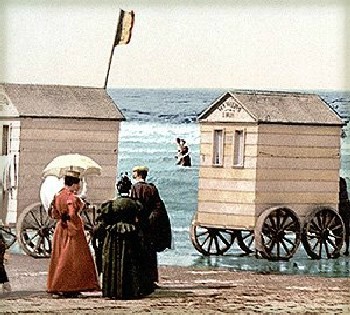
Bathing machines were not a Victorian invention as they dated back to the 1750s as a beach hut on four wheels, which was rolled into the sea pulled by horses and lowered to the water giving the bather privacy. Once deep enough in the water the bather would then exit the machine using a door that faced away from the crowds on the beach. Some resorts employed ‘dippers’, woman who would escort the bather out to sea in the machine and lift them into and out of the water. Bathing machines were only for the women; men did not have to use them as they just strolled into the water wearing a tighter swimsuit.

Development of seaside resorts

With the expansion of the resorts came wealth and innovative ways of offering entertainment for the holidaymakers. In many resorts the local pier became the focal point offering a variety of entertainment. Some resorts built them on a grand scale, with the creation of indoor entertainment facilities such as aquariums, ballrooms and even circuses to keep the public entertained and to keep holiday makers spending.

Victorian enterprise, invention, technology and mechanisation all had their parts to play. Electric lights illuminated the promenade and steam engines drove the fairground rides. From sedate beginnings at the start of the Victorian era, by the turn of the twentieth century the resorts looked different. As the Victorian era progressed, so did the resorts. People from all classes shared the experience, attitudes and standards which over time had started to change where the sexes mixed openly on the prom and bawdy entertainment evolved. However, the upper classes began to abandon the traditional resorts in favour of foreign holidays.

It was the working-class families who had taken possession of the seaside holiday resorts. With improving working conditions, the popularity of the resorts continued to rise. Seaside visitors brought more than crowds to the resorts which reoriented around tourism.

Most working people who visited the beach took a blanket to sit on and would remain fully dressed even suits and hats and many would avoid the sun if possible. Many would use a deckchair to sit on. These were a Victorian invention, patented in 1886, originally made of olive-green canvas. Brightly coloured striped material became popular in the late nineteenth century when local authorities began to hire out beach deckchairs. Deck chairs were advertised as adjustable and portable folding chairs There were initially two types: the Waverley, which was described as ‘the best ship or lawn tennis chair’, and the Hygienic, which was useful for those with sluggish and constipated bowels!

Wakes weeks

The Wakes Week is a holiday break in various areas of England. Originally a religious celebration or feast, the tradition of the Wakes Week developed into a secular holiday during the Industrial Revolution.

Many Christian churches at their consecration took the name of a patron saint, and that saint's feast day became a church festival. In England it was traditional for church services to begin at sunset on Saturday and the night of prayer was called the "wake". Each parish held a wake followed by church services and then sports, games, dancing and drinking. Wakes became more secular reserved for public entertainments such as bands, games and funfairs.

During the Industrial Revolution, the tradition of the wakes was adapted into a regular summer holiday in the North of England and industrialised areas of the Midlands. Each locality nominated a wakes week during which all the local factories, collieries and other industry closed for a week.

The wakes weeks were initially unpaid holidays and gave the mills and factories the opportunity for maintenance. Each town in a particular place chose their wakes week, so from around June to September, each town was on holiday in a different week. In 1907 there was a guaranteed twelve-day annual holiday, including bank holidays which was extended to fifteen days in 1915.

To illustrate the popularity of wakes weeks the railway to Blackpool from the mill towns around Manchester meant that by 1860, 23,000 holidaymakers travelled on excursion trains to the resort during Wakes Week.

This article was contributed by Ian Waller from Family History Federation.
Website by Beachshore