The surviving petitions given to the Society of Genealogists begin in 1787 and continue until 1854. Unfortunately the earlier petitions were destroyed by fires at Trinity House in 1666 and 1714. Some other records of Trinity House were destroyed by enemy bombing during World War II.
The Society of Genealogists bound these petitions into 113 alphabetical volumes. Most of the petitions can be viewed online via FamilySearch Centres or affiliated libraries; indexes are available on FindmyPast. The example below is taken from the Society of Genealogists indexes. There are around 8,000 petitions.
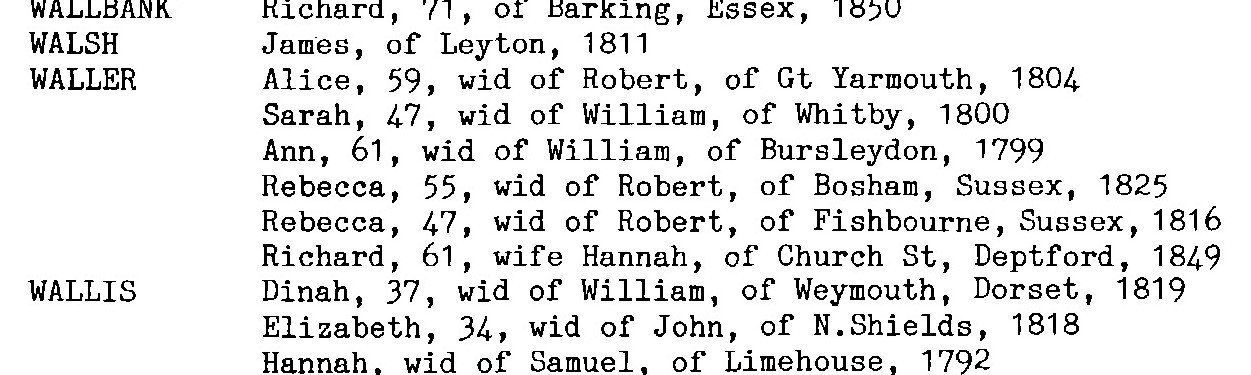
The records provide the following information:
Name of the petitioner
Age
Name of spouse (although “married” is often used without a name given)
Residence
Date of application/petition
Circumstances of petitioner
Akin to these records are the Pension Papers; these contain the baptism and marriage certificates which were removed from the pension application files made to Trinity House between about 1790 and 1890 (note the later date), although most relate to the applications made between c1830 and 1880.
The petitioner was usually the wife or widow but sometimes it was the seaman himself. In nearly every case, the petitions follow a standardised format because each form comprised a printed set of questions to which the applicant provided handwritten answers.
Information included on the front of the application form:
A brief history of service of the merchant seaman with details of the ships in which he served and his rank while on board. (Ship details would include year, name, tonnage, port of registration and quality.)
Death date (if applicable) and circumstances of death
Children's names date of children's birth
Income (if any) or other means of support
Date of petition
Information on the rear of the form likely includes:
Certificate signed by the owner of the ship in which the seaman last served.
Certificate of a Medical Practitioner indicating the capacity of the petitioner to earn a living.
Certificate by two respectable Persons confirming the truth and validity of the Petition.
Certificates of baptism of any children signed by the incumbent and/or birth certificates.
Certificate of the marriage
Petition endorsement showing the amount of grant (usually paid monthly) and the date of commencement.
The amount of information and the number of supporting documents attached varied.
In the eighteenth century the first petitions had the letter A prefix and all details were entered into pension pay books. The actual petitions in this series no longer survive, but the pay books survive after 1775 with details from Petition A2547. However, many were subsequently destroyed in the bombing of World War Two. All the petitions in series B dated after 1 February 1787 until 1854 still exist.