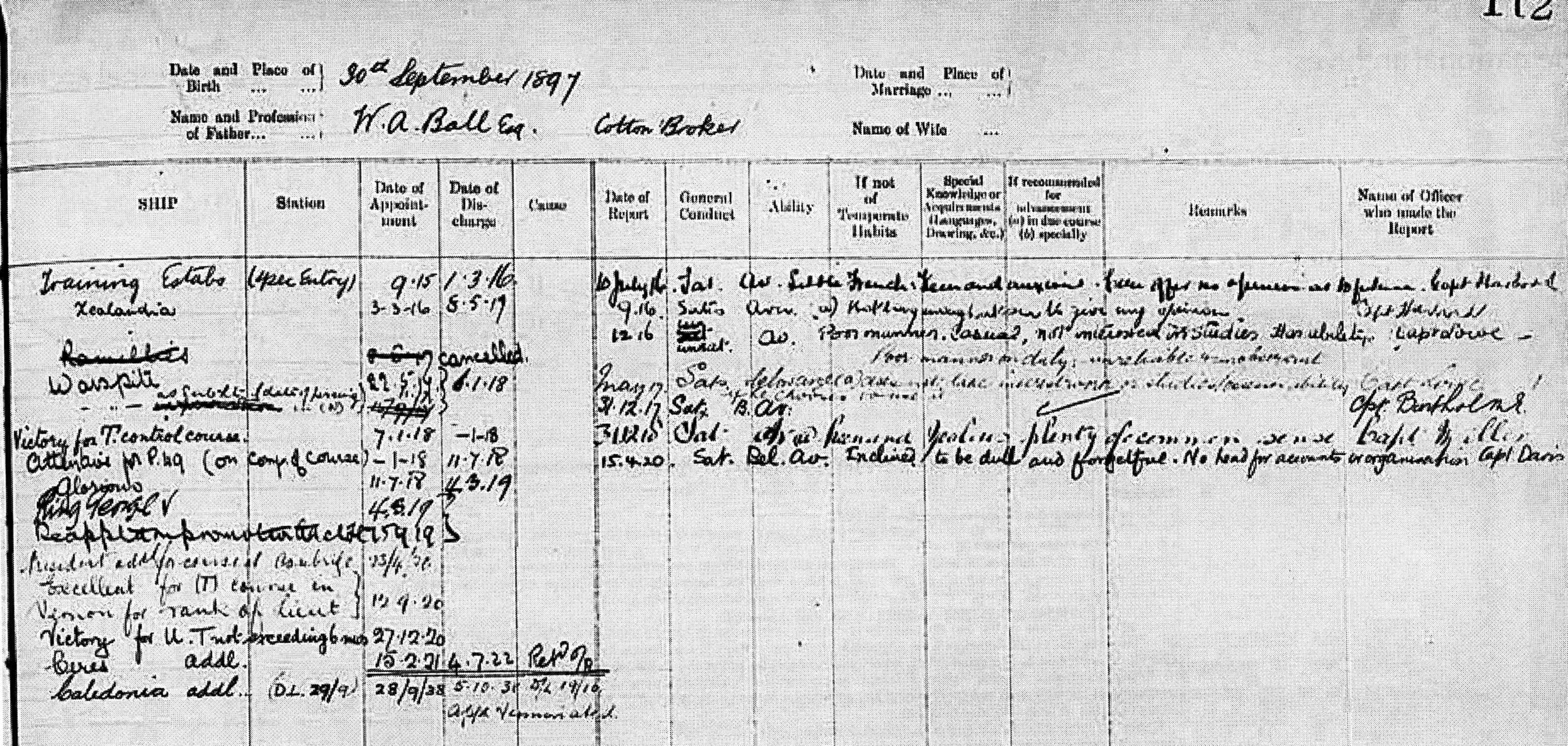
Embarking upon research for an ancestor who was an officer in the Royal Navy or any of its branches is rewarding but needs to be undertaken with extreme care and attention to detail because it is easy to miss vital clues. Understanding how the structure of the navy affected every officer is as important as understanding the records which contain information.

The Royal Navy officer structure

The Royal Navy officer structure is complex with various records found in a different series; these need to be taken together so that important elements of a career are note missed. To understand where to find the records, you will need to understand of the officer structure which in simple terms consist of:

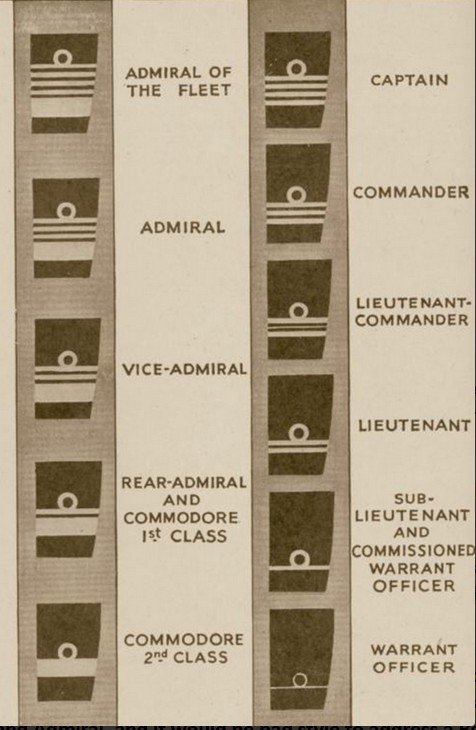
FLAG OFFICERS: Admiral of the Fleet, Admiral, Vice Admiral, Rear Admiral, Commodore.

COMMISSIONED OFFICERS: Captain, Commander, Lieutenant Commander, Lieutenant, Sub Lieutenant, Midshipman, Chaplain

WARRANT OFFICERS:  Master, Surgeon, Purser, Boatswain, Carpenter, Gunner, Engineer (see Researching Royal Navy Warrant Officers)

Advancement to Commissioned Officer from Warrant Officer normally required ten years serving as a Warrant Officer. Because of demand, there was an increase in the number of Warrant Officers promoted to Lieutenant during the Second World War and afterwards.

Commissioned Officers

For all the Royal Navy’s existence, the rank of lieutenant was the basic commissioned rank. Every commissioned officer had to pass an examination in seamanship to qualify for a commission. They also had to prove that they had previously served a minimum period at sea.

From 1677 this was three years, of which one year had to have been spent as a midshipman. In 1703 this was increased to four years with two years as a midshipman or master’s mate. In 1729 the time at sea was increased to six years, which remains in force today.

A midshipman was never a commissioned rank. He was a senior petty officer wanting to become a commissioned officer. The status (rating) of the ship determined the number of midshipmen. During the period as midshipmen, they undertook instruction in seamanship and were able to wear a uniform. The first use of the term midshipman was in 1662.

Because of an ambiguity relating to whether time served in the Merchant Navy would count towards sea service, the Admiralty stated the following in 1745 ‘that service in merchant ships was acceptable for the four years of ‘non-rated’ time’.

The qualifying age for a lieutenant’s commission was normally twenty but evidence suggests that where men had an ancestral history of navy officers, some received their commissions at a younger age. The Admiralty was inconsistent in its record keeping so, you may find an important element missing for assessing their careers particularly pre-commission service.

Two other ranks appear as commissioned officers, when in fact this was not necessarily the case. ‘Lieutenant-commander’ up to 1914 simply meant a lieutenant in command who was the captain of a ship which was too small to be under the control of a commander. They were sometimes referred to as captain in the same way as other commanding officers, but they were still only commissioned lieutenants. The official rank of lieutenant commander was created at the start of the First World War for lieutenants of eight years or more seniority.

You may also come across the term sub-lieutenant which was only used for a short period around the times of the Napoleonic wars for a midshipmen or a master’s mate who had passed the lieutenant’s examination but had not yet been promoted to such. They normally served as watch-keeping officers on small vessels which only had a lieutenant in command. A. sub lieutenant was not a commissioned rank until 1860.

Seniority

The key to understanding the career of a commissioned officer concerns the application of the seniority rules and the half pay set up within the Navy. The Navy always relied upon the authority of officers. It was all to do with successive appointments and their permanent status. Up until recently, it was possible for an officer to serve in various capacities perhaps as a lieutenant, then captain, then second lieutenant, first lieutenant, master, commander, etc. In such a situation it was difficult to establish who had the authority and seniority.

Samuel Pepys (of diary fame, a member of the Admiralty Board at the time) assembled the first seniority list, but even after his efforts, it was still unclear who had seniority. So in 1691 the Admiralty made a further attempt to compile an official seniority list, but disputes between captains continued to occur, hindering the process. Eventually seniority was clear-cut and was dependent upon when an officer was promoted to that rank. Separate records of seniority exist.

Sometimes your ancestor may be referred to as a post-captain. The term post-captain was used by those given the substantive rank and once an officer had been promoted to post-captain his further promotion was strictly by seniority.

The whole system of officer promotion was based on seniority within their rank and lists were published for sea officers and those on half pay between 1717 and 1846.

Although there is not much information contained in the seniority lists, they are worth searching because as a minimum they provide name and date of seniority to a particular rank. They can be found in series ADM118 at the National Archives.

Half pay

Half pay came into existence in 1668 and was fully instituted in 1674 as a reward to admirals, commodores and captains who had served in the preceding wars. In 1694 half pay was given to all post-captains, first lieutenants and masters of the first three rates (ships), who had served during the duration of the wars. By 1700 it was clear that the Navy wanted to keep an establishment of experienced sea officers, who did not have a command at the time but who would be available to return to service should the need arise. Officers in receipt of half pay were not allowed to go abroad or accept any other public employment.

Half pay was originally only granted to the first fifty captains and the first hundred lieutenants listed on the first printed seniority list. This was a retainer for future services and the Navy List showed those on half pay in a separate listing.  

Half pay was a sliding scale descending with seniority which in practice meant the elements of retainer and reward were totally mixed throughout the whole of the eighteenth century. Officers were retained on the half-pay list even if they were incapable of further service because there was no other support for them in old age. Though pensions for wounds and good service might be granted by the Admiralty to more senior officers, no regular superannuation scheme for any commissioned officers existed until 1738 and even then, this was severely restricted.

Half-pay registers in series ADM25 cover the period 1693-1924. They are searchable by date. They list date of allowance, name, rank, ships served on, with dates of entry and discharge, total time served, to whom the pay was made which is sometimes next of kin and whether they were ever reemployed. Some of the later registers include death dates.

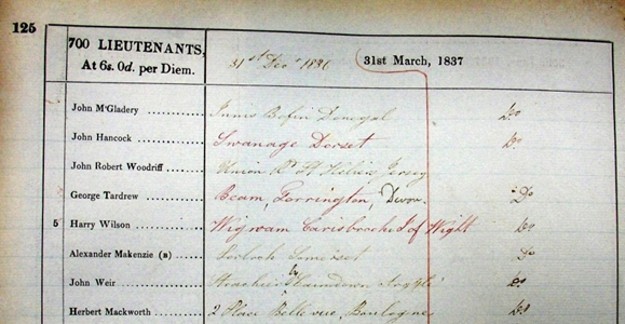
Earlier half-pay registers to c1689 are in series ADM18 and are much less informative providing only basic information of name, rank and pay. There is also a register for 1837 (the start of the superannuation) in class PMG73/2 which lists all officers on half pay and gives their addresses at the time.

The Navy lists

The amount of information contained in the navy lists from 1814 to date varies with time and circumstances. Besides recording officer details they also include pay scales, and uniform regulations. They were published up to twelve times a year depending upon operational circumstances. Some were “confidential” in times of war.

The navy list includes officers in all the branches of the Royal Navy including Queen Alexandra’s Royal Nursing Service, Women’s Royal Naval Service, the Coastguard, and the Reserve Forces, and civil departments and enable researchers to determine names, rank, seniority, decorations, and other career details. It is also possible to see different groupings by rank for both commissioned officers by ship with their officers and current locations and stations, and separate lists of pensioners and retired officers.

Before the publication of the official navy lis,t there were earlier reference publications which are useful in determining basic information about your officer ancestor.

Steel’s navy list

This was the first list with publications between 1787 and 1816. Publication was sometimes erratic, but they were printed as frequently as monthly. Steel’s list incudes officers, ships and establishments and includes officers of Sea Fencibles before 1810, miscellaneous intelligence reports, vessels captured. Prize money awards are also noted in the publication.

Lean’s navy list

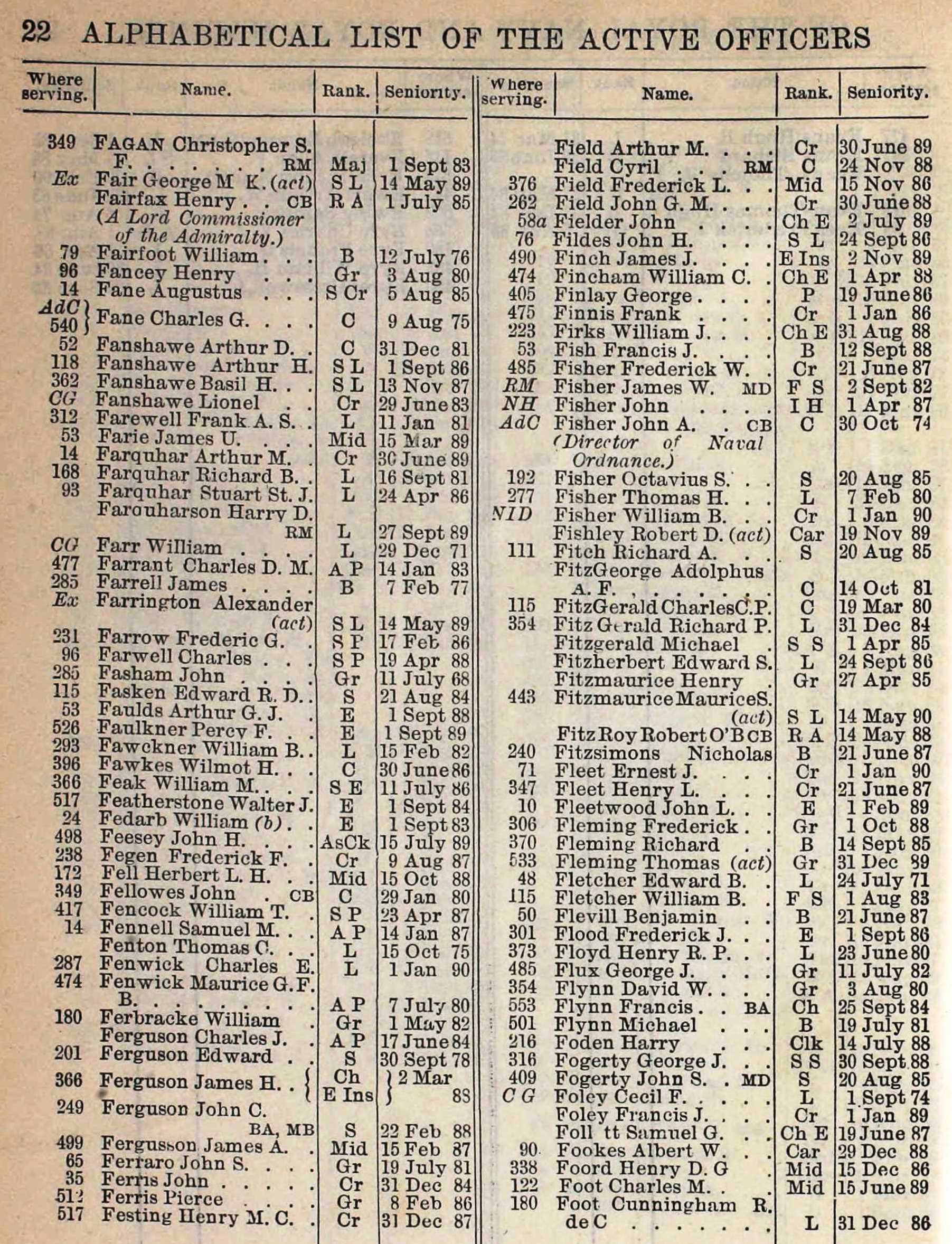
This covers 1878 to 1916 often duplicating information in the official navy list. This list records Information on officers both alphabetically and by seniority. Lean’s list is particularly useful in providing dates of birth of officers and short biographies of their service and decorations. Like the main navy list it also gives lists of ships and establishments with serving officers.

The official navy list

These commenced publication in 1814.

They give information on seniority and disposition of officers each year including commissioned officers, some warrant officers and officers associated with the coastguard services. Certain officer categories were not included until much later. The following shows the earliest date at which certain officers appear:

  • 1838 Naval Instructors and Schoolmasters.
  • 1842 Mates.
  • 1852 Chief Engineers.
  • 1862 RNR Officers.
  • 1884 Naval nursing sisters. 
  • 1890 All other officers of the establishment.

The official navy list has other useful information that can help identify your ancestor and put ‘flesh on their bones’. Within each edition, the tables and regulations in use at the date of publication are included which relate to details of the full and half-pay rates granted to each rank, the uniform regulations for commissioned officers, pension entitlement of widows of officers, the examination regulations relating to officers and naval cadets, information on prize money and the conveyance of treasure and salvage, the entry regulations for seamen and the regulations for the wearing of medals. Content does vary from time to time and if you are aware of when an officer began or ended their service, you should be able to find some information about their navy career.

The UK navy lists from 1888-1970 can be searched on ancestry.co.uk although not every edition is available. Other online data providers also have a search faciliy for various editions including The Genealogist’ and Family Relatives, the latter being particularly useful for the navy lists editions published in both world wars, though they do not appear to be the confidential navy lists.

The confidential editions of the navy list contained the complete information on officers and ships which was omitted from the generally available and published edition in wartime. The confidential navy list was for official use only which indicated where individual officers were serving, with the names of ships and establishments. A complete list of all ships in the Royal Navy was included, together with details of tonnage and armament. The confidential editions can only be seen at The National Archives and are listed in series ADM177.

The confidential list was published quarterly in January, April, July, October during the First World War, but bi-monthly during the Second World War, namely, February, April, June, August, October, December.

There is a particularly useful online research facility for around 120 navy lists covering various periods from 1766 to the present at www.navylistresearch.co.uk. The database is progressively being updated to include both the current lists and lists from earlier years.

There are distinct advantages in using online navy list research tools as older editions can sometimes be difficult to find and travel to The National Archives, Society of Genealogists or National Maritime Museum, which all have good runs of lists can be inconvenient.


Commissioned sea officers of the Royal Navy

For those with ancestors who served as commissioned officers for the period 1660 to 1815, there is a searchable database available at ancestry.co.uk This is a listing of each officer and alongside the name of each officer are his rank and the first year in which he served at that rank. Before using this database or searching the published books, the introduction should be consulted as this contains information relating to the scope and nature of the list as well as providing the source information and an explanation of abbreviations used.

Officer biographies

Officer biographies exist in various published sources, the most comprehensive being Biographia Navalis and gives details of service of 2,200 naval officers covering 1660 to 1794. It can be searched using Google Books. The ‘Original and Correct List of the Royal Navy’ is useful from the end of the 1700s when it started to list many officers together with their ships. Between 1780, when it was first published and 1799, it normally listed only ships.

If researching at The National Archives, you can of course use seniority lists. If you find a name crossed out in this series this usually means that the officer concerned was not in receipt of peacetime wages. It does not indicate death.

Admiralty List Books in series ADM 8 cover the period 1673 to 1909 and are monthly returns showing the disposition of ships together with the names of officers. None are indexed but these were used to compile the three volumes of ‘Commissioned Sea Officers, 1660-1815’.

For the mid-Victorian period use ‘A Naval Biographical Dictionary’ published in 1849 and searchable on ancestry.co.uk This is useful for identifying the careers and detailed biographies of all naval officers still living in 1845.

Officers' service records

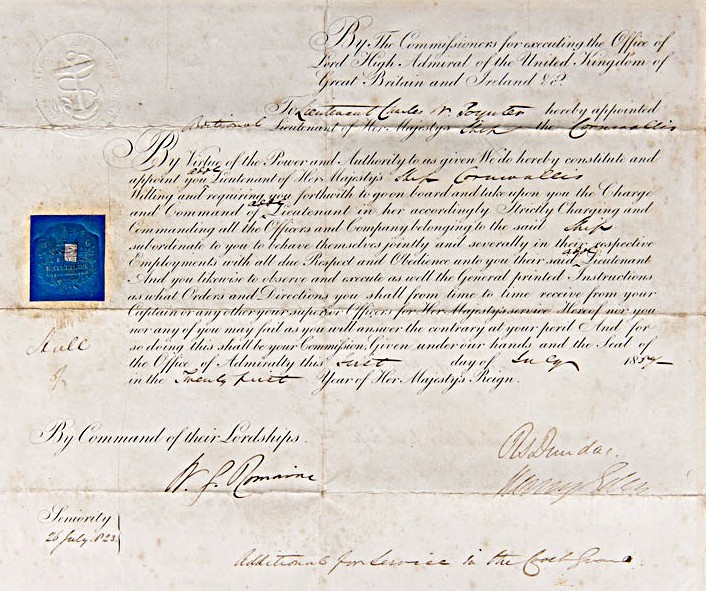
You may be lucky enough to locate within a family archive the actual certificate issued to an officer on admission to a particular commission, but you will still need to search the official records for further details of an officers’ career.

Once a career pattern has been established, it is then straightforward to search the official records for more information. Some of these records are available digitally through “Discovery”. The records of commissioned officers are both comprehensive and sometimes complicated to use. Records for the eighteenth and early nineteenth century are sparse, but for the later periods appear reasonably complete.

Records in ADM196 cover records of commissioned officers who joined the Royal Navy between 1756 and 1917.

Before the late 1800s, the records of service tended to be basic in content revealing:

  • • name
  • • rank or quality
  • • the ships on which they served together with date of entry and discharge
  • • some may include a date of death, particularly if this was in service.
  •  
  • From the late nineteenth century, additional information is included:
  •  
  • - birthdate and place
  • - immediate next of kin.
  •  

Because of the way the navy was organised and administered, it is possible for an officer to have more than one service record but fortunately, in undertaking a name search on ‘Discovery’, if more than one record is in existence then it will show in the catalogue entry. A research challenge may occur in finding service records which may be attributable to the fact that an officer died or left service before records were systematically kept or an officer served with the reserves. If you cannot find a record of officer service, then a search should be in the records of ratings as he may not have been an officer at all. You will be surprised how often someone enhanced their status or family stories handed down have been enhanced or corrupted - keep an open mind.

Lieutenants' passing certificates

Examinations for lieutenants were introduced in 1677 and were originally held at the Navy Board Offices in London. All prospective lieutenants were interviewed by three senior captains and the interview related to seamanship and the theory of navigation. The questions asked were made up by the captains and there were no set examination questions. This was the only way of entry to a commission, and the candidates who passed were not guaranteed an immediate commission. Some had to wait a few years for such. In times of war commissions were often granted quicker.

The certificates are a valuable genealogical source of information as they frequently give age, although some will state above twenty one years, the names of the ships on which they served as ratings prior to passing their examination, together with the name of the captain they served under, their rating on each ship, the names of the examining officers and the date of examination. Between 1744 and 1819 there could be two certificates, each containing slightly different data. There is a gap in the passing certificates between 1677 and 1690 and between 1833 and 1853.

The List and Index Society has published an alphabetical listing of Royal Navy Lieutenants’ Passing Certificates 1691-1902 giving the name of the candidate, year of passing and the ADM reference including the page/folio number in that piece. There is also a short synopsis at the front of volume one which outlines the procedures employed in obtaining the certificate.

The certificates are contained in three series ADM6, ADM106 and ADM13 the latter specifically for engineers. If you are searching for masters and surgeons, you will need to restrict your search to ADM106.

Other records

Commission books

Until 1860 commission documentation was the only official method of appointing an officer to a specific ship. The books are in series ADM6 covering 1695 to 1849. Commissions were issued for each different appointment. They are not the easiest documents to search as they are organised by date but give basic information including officers' name, the name of the ship to which the appointment relates, rank and sometimes why the appointment was made.

Returns of officers' surveys

Between 1817 and 1861, surveys were conducted by the Admiralty to make their records more comprehensive. This was haphazard because some officers claim they never received the forms and others did not bother to return them. Those that have survived are extremely useful, supplementing official career information. Surveys which survive are in series ADM9 and there is a printed index to the surveys between 1817 and 1846. The index to ADM9/1-9 can be searched using Discovery.  You will need to note the folio number alongside the name because many surveys are organised by folio numbers.

Full pay registers

These registers supplement other records of officers. They record the wages paid to both commissioned officers when on active service. Alongside the half-pay registers it is possible to piece together any gaps in an officers’ career. They are in series ADM24 and cover the period 1795 to 1905. Before 1829, the registers are compiled by rank, all with separate name indexes. After 1830 all ranks are combined into one general register indexed by volume.

These registers provide the officer's name, the amount of their wage and the name of the ship on which he served. From c1830 you may find the reason that officer left the ship. In some instances the address of the officer where pay was sent and a death date are also given.

Officer obituary book

This record is not as the title suggests because it records details of officers who were dismissed the service or resigned as opposed to those who died, although deaths in service may be recorded. The entries relate to those who are no longer in active full time service. Many entries also relate to alterations in seniority because of disciplinary actions. The books are arranged chronologically in series ADM6.

Pensions granted to naval officers.

Because there was no pension entitlement for officers up to the mid-nineteenth century, the Admiralty had the task of deciding what to do with officers, who because of age, were unsuitable for further deployment. To some extent this was addressed by half pay. After the mid-nineteenth century, the Admiralty established a method of retiring officers based on seniority. By 1837 good service pensions were introduced for flag officers and captains. Up until then the pension system was for widows of those killed or wounded.

Retirement pensions (Superannuation) were established for different ranks at different times, but it did not apply across the board until 1836.

  • 1666 yard officers and some captains
  • 1737 senior lieutenants
  • 1747 yellow admirals (superannuated rear admirals - retired captains)
  • 1786 captains
  • 1836 all commissioned officers.
  •  

Registers of officer pensions and allowances

These cover the period 1830 -1934 in series ADM23 which contains the registers of pensions to commissioned officers, half-pay officers, coastguard, artificers and widows of naval officers.

It is also necessary to search in records of the Paymaster General. If these records are not searched then some vital information will be missed. Classes of importance are:

- PMG15 covering 1836-1920 Naval Officers’ half and retired pay

• PMG16 covering 1836-1920 pensions and allowances to commissioned officers, pensions and allowances to relatives of naval officers killed or dying in service, retired flag officers’ pensions awarded between 12 July 1837 and 25 June 1851 and compassionate allowances to late officers

- PMG 18 covering 1837-1921 compassionate allowances to children and relatives of both commissioned officers. These must also be cross referenced to registers of pensions in series ADM22 particularly for the earlier period as these records commence in 1734.

- PMG19 covering 1836-1929 Pensions to widows of commissioned officers.

This article was contributed by Ian Waller from Family History Federation.
Website by Beachshore