

Prior to 1870, education was actually a matter of social class; basically, children of parents who had sufficient wealth would be able to have an education whereas children of poor parents received no education at all. The education revolution really began with William Forster's Elementary Education Act 1870.

The system changed with many different kinds of schools being established and eventually education became compulsory but even then, many children escaped the system. At best children may have attended Sunday schools or Bluecoat schools

Prior to the nineteenth century, most schools were run by church authorities and there were only a few options open to parents who both chose or could afford to educate their children.

Charity schools

Ragged schools

Sunday schools

Grammar schools

Public schools

Dissenting (nonconformist) academies

Charity schools

Charity schools were an important part of education in England. The majority of charity schools in the country, which existed for both boys and girls, were administered by either the Bluecoat Schools or the Society for Promoting Christian Knowledge. The Bluecoat schools, named because of the colour of their uniforms, educated both orphan and pauper children. The colour blue was traditionally the colour of charity and was a common colour for clothing at the time.

The schools administered by religious organisations were normally attached to Anglican parishes; their operation depended on voluntary contributions. Their aim was to teach poorer children to read and write, as well as providing a basic education. The SPCK was primarily an Anglican missionary society established in 1699 which set up schools as part of its remit.

Ragged schools

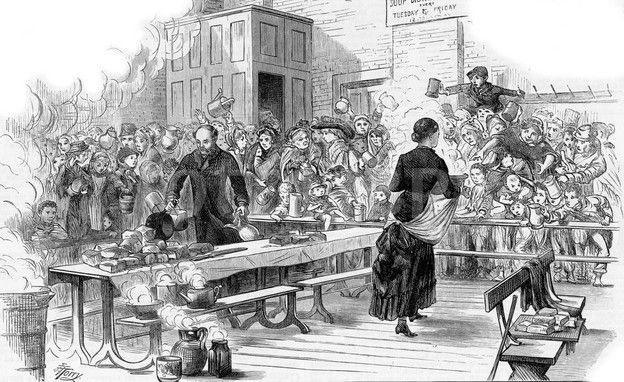
Ragged schools were also charitable schools dedicated to providing free education to destitute children. They were established in many working-class areas for society's most destitute children who, in some areas, were even excluded from Sunday schools.

Although some schools were established in the early nineteenth century, the main thrust of the Ragged School movement happened in 1844. Their aim was to provide free education, food, clothing, sometimes lodgings and other missionary services. The union produced pamphlets which were distributed nationally and these were instrumental in spreading the idea of a ragged school around the country.

The volunteer teachers, most of whom were local working people, placed an emphasis on reading, writing, arithmetic and study of the bible, but as time progressed, many schools also taught subjects connected with industry and commerce.

John Pounds, a Portsmouth shoemaker, was the first inspirational person to establish a school. Whilst serving an apprenticeship as a shipwright, he suffered a crippling accident after falling into a dry dock, so he became a shoemaker. In 1818, he began teaching poor children without charging a fee. He taught the children reading, writing, and arithmetic, and also educated them in cookery, carpentry and shoemaking. He became the figurehead for the ragged schools' movement.

In 1840, London City described its five schools which catered for 570 children. The schools were formed exclusively for raggedly clothed children who only wore worn-out clothes and possessed no shoes.

By 1844 there were over twenty free schools maintained by philanthropists, local churches and the London City Mission.

There was a massive growth in the numbers of schools, teachers and students. By 1867, 226 Sunday Ragged Schools, 204 day schools and 207 evening schools provided a free education for about 26,000 students. All the schools were reliant on volunteers and continually faced staffing challenges. The most valuable teachers in ragged schools were female.
Sunday schools

Robert Raikes, proprietor of the Gloucester Journal, started the Sunday School Movement with a school for boys in the slums. Prevention was better than a cure for children especially affected by some of the wicked ways of the world; these could lead to imprisonment or an appearance before the courts, so Raikes considered schooling as the best alternative. He chose a Sunday because children worked on the other days of the week. His teachers were usually ordinary people and his main resource was the bible. His idea was that he would start with teaching children to read and then having them learn the catechism.

Being the owner of the newspaper, he was able to advertise the schools and the movement began in 1780. Initially only boys attended but girls began to attend later on. Several schools opened in the Gloucester area. The original timetable for the day began at 10.00am, lessons until noon, an hour's break for lunch followed by further lessons in the afternoon. The day ended with a church service and the children then went home at 5.00pm. 

Grammar schools

Grammar schools have been part of the English education system since medieval times. Most of these grammar schools were situated in regional market towns. The purpose of the medieval grammar schools was to teach Latin, but their curriculum developed and included ancient Greek, English, sciences, mathematics, history, geography and art. During the Victorian era grammar schools provided secondary education.

From the time of Henry VIII, wealthy philanthropists founded grammar schools which mainly catered for the education of boys from the farming, minor gentry and the middle classes. Grammar school education allowed students to follow a profession or go to university.

By the mid-1750s demand for the knowledge of Latin and Greek significantly declined so they began teaching modern languages and more commercial subjects. Urban middle-class pressure for a commercial curriculum was often resisted by the schoolmasters. The Grammar Schools Act 1840 made it lawful to apply the income of grammar schools to purposes other than the teaching of classical languages. There was a series of reforms to grammar schools, resulting in the Endowed Schools Act 1869. Grammar schools became academically oriented secondary schools mainly following a scientific curriculum.

Public schools

The Public Schools Act 1868 restructured nine leading schools including Charterhouse, Westminster, Eton, Harrow and Shrewsbury. The Act gave the seven schools independence from direct jurisdiction or responsibility of the Crown, the established Church, or the government. Henceforth, each of these schools was to be managed by a board of governors.

A commission was appointed to look at the remaining grammar schools and this concluded  that the location of the schools did not always match the current population, and that for girls it was limited. The commission subsequently suggested the creation of a national secondary education system; this meant the restructuring of the endowments of these schools which resulted in the Endowed Schools Act 1869. In the late Victorian era there was a great emphasis on the importance of self-improvement. Many schools established at that time imitated the public schools.

Public schools appear to have emerged from grammar schools. Access to a public school was not restricted because of location, occupation or status but were subject to public management whereas private schools were for the financial benefit of the owners.

The origins of public schools were largely religious, although in 1640, Parliament established an agency for the promotion of learning, ensuring that universal books would be published along with the establishing of schools for both boys and girls. However, the English Civil War impeded progress and almost prevented the reforms.

Dissenting academies

Dissenting academies were schools run by nonconformist organisations, the most prominent being the Quakers (Society of Friends). The pupils received a classical education and lessons in bookkeeping, science, natural history and so on. They formed a significant part of England's educational system from the mid-seventeenth to the nineteenth centuries.

For two hundred years or so after the Uniformity Act 1662, it was almost impossible for anyone who was not a Church of England member to study at university, particularly Oxford or Cambridge. Both universities required a religious admission test to be undertaken by candidates.

As nonconformists were barred from attending universities, they went to the dissenting academies with increasing numbers going on to the universities of Leyden, Utrecht, Glasgow or Edinburgh. Edinburgh was the university known for its medical training and subsequent qualification. Tutors in the dissenting academies were initially ejected ministers who had left the Church of England after the passing of the Uniformity Act, many holding degrees from the English universities.

The academies were accommodated in large boarding-house establishments and funded by tuition fees and philanthropic dissenters.

The Independent or Congregational Fund and the King's Head Society also provided funding. During the nineteenth century the original purpose of the academies was superseded by the founding of the University of London and various provincial universities which were open to nonconformists.

National board schools

During the nineteenth century, there was a complete change in elementary education when two church-based societies started a national education system aimed at children from ordinary families.

The two organisations were:

Church of England National Society

British and Foreign Schools Society

These two societies ran approximately 3500 schools using the monitorial teaching system where older pupils were teaching the younger pupils.

A national school was a school providing elementary education, in accordance with the teaching of the Church of England; this together with the schools of the British and Foreign School Society created the first universal elementary education system in England and Wales. These schools were eventually absorbed into a state system.

The aim was to establish a national school in every parish of England and Wales; these schools were normally situated next to the parish church and were usually named after the parish. After 1833 the state paid annual grants to the societies but they were subject to inspections and state regulation, so much so that the monitorial system of teaching eventually collapsed.

The Elementary Education Act 1870 set the framework for schooling of all children between the ages between five and twelve years. It allowed board schools to work alongside the schools run by the two societies and provided state funding up to fifty per cent of the running costs. The National Society (combining both societies) responded by almost doubling the number of its schools to around 12,000. However, these schools struggled to meet their maintenance costs because they suffered from board school competition, the consequence of which was school closures or absorption into the school board system.

The above Act was one of several Elementary Education Acts between 1870 and 1893. By 1874, 5,000 Board Schools were operating. The Act established the foundations of English elementary education although it was not taken up in all areas and would be more firmly enforced through later reforms.

So what made Board Schools successful? They were able to do the following:

  • - raise funds from a local rate
  • - build and run non-denominational schools if voluntary provision was inadequate
  • - subsidise church schools where appropriate
  • - pay school fees of the poorest of children
  • - make attendance compulsory for children aged five to thirteen yrs (although this required a local byelaw)
  • - religious education was not imposed other than simple bible reading
  • - impose standardisation to the curriculum.
  •  

The 1833 Factory Act had already imposed a duty on factory owners to provide part‐time education for children employed under the age of thirteen years, but this was often ignored. The Education Act of 1880 saw the provision of elementary schooling for both boys and girls made compulsory. The Act also required that every child should be taught in a reasonable building led by a qualified teacher.

School boards in rural parishes only managed one or two schools but boards in industrial towns and cities had many more. Rural boards were allowed to release of children for agricultural work like the harvest, but in the towns the boards were more rigorous and maintained compulsory education provision where possible. Initially, factory owners were worried about the removal of children affecting their source of cheap labour but soon realised that the education being acquired was beneficial because they began to see a labour force who could read and understand measurement.

This article was contributed by Ian Waller from Family History Federation.
Website by Beachshore