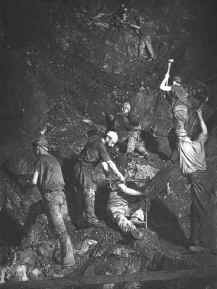
Miners, including the women and children who worked on the surface, worked a ten-hour day, six days a week. Despite many mining families living in cottages that were rented from the mining companies, some would still have to endure a walk of several miles to and from work, in uncomfortable clothes due to sweat from hours underground. Some miners used to carry a lantern - a candle placed in a treacle-tin pierced with holes - while others stumbled home in the dark as best they could. On winter nights the women would be out on the cliffs with lanterns, waiting for their husbands to come home.
The term ‘miner’ relates to all who worked underground which included many different jobs. Besides those breaking ground, other jobs were as trammers, kibble fillers, pitmen, sump men, carpenters and binders. Most of these jobs related to building and clearing the structures of the mine. The mining for tin (and earlier for copper) was a gruelling job for anyone to undertake. Working underground was specifically a man’s job.
Mining was modernised during the nineteenth century and was at the forefront of the Industrial Revolution but remained a dangerous and arduous job. Some miners who suffered accidents were able to go back to work; others recovered but had to seek work elsewhere and some suffering greatly needing to rely on a sick and hurt fund to live.
The conditions underground often resulted in general health problems over the long term. Everyday events included croust time which usually took place at 11am. Miners would take a break to eat food sitting at benches built underground for the miners while they ate. Their normal meal consisted of a pastie because the conent of the pastie was protected from the dust and dirt by the crust. The rest of the working day was manually breaking ground and collecting the ores.
Miners worked in cramped tunnels and stopes (galleries) where temperatures would often become unbearable. Some mines in Cornwall were between 1,000 and 2,000 ft deep which together with the high temperatures made working conditions generally appalling. Temperatures could become so high that mines had to be left to cool for a few weeks before they could be worked again.
For many miners thery had to walk to work, often about five or six miles across rough country to reach the mine following which there was a long descent to the face. After a gruelling eight to ten hours work, that journey was repeated to reach home. This was one of the hardest aspects of Cornish mining which affected their health.
Bad air was another daily problem that miners had to endure, caused mainly by the burning of candles and blasting. Candles were the only source of light underground, and as they burned constantly, they filled the atmosphere with smoke so there was not enough pure oxygen within the mine, so miners still had fight for breath. In the earlier days of the century, hempen candles were used and they were so smoky that only a few candles burning was sufficient to make the air suffocating. Blasting powder had the same effect as candles.
When pneumatic rock drills (widow makers) were introduced in the late nineteenth century, mineral dust became a further problem These drills meant that miners had an average life expectancy of four years underground, but employers were not at all keen to acknowledge the long-term damage that these drills had on the health of their workers.
Explosions in the mines were another common hazard. The earliest fuses used were quills or lengths of straw and these were dangerous. Safety fuses were invented in the 1830s which helped to minimise the risk of unwanted explosions, and although the new fuses saved lives, misfires still occurred which could be deadly.