



Many of us will be unaware of any criminals in our ancestry until we come across that fact. Discovering your criminal ancestor, usually by accident, comes from looking in local newspapers or putting an ancestor's name in a search field on a genealogical website and seeing his or her name in the list of results! The Police Gazette is an invaluable resource for tracing your ancestors who were involved with the police - either as a policeman or as a criminal.


Brief history and purpose

The Police Gazette was established in 1772 as the Quarterly Pursuit and later named the Hue and Cry. It became the Police Gazette in April 1839 and ceased publication in 2017. The phrase "hue and cry" dates from the thirteenth century and refers to a common-law process when members of the public were summoned to assist in the apprehension of criminals. The journal was originally published weekly by Bow Street Police and later the Home Office and the Metropolitan Police. Its primary purpose was to publish details of wanted criminals with requests for information. Sometimes it offered rewards for the apprehension of offenders. In 1884 the publication was transferred from Bow Street to the Criminal Record Office. It was published daily and circulated to all police forces in Great Britain and contained details of persons and articles connected with current crime.

By its sheer nature, this publication is full of names, an excellent resource and offers an insight on the following:

  • The history of crime
  • The role of the police
  • Transportation to Australia
  • Deserters from the military and navy
  •  
  • For family historians, this useful resource gives names of missing persons, criminals, deportees and prisoners; it provides information about offences committed and covers topics such as changes of identity, public morality and censorship.
  •  

In the early part of the nineteenth century, basic registers of criminals in the London area were kept by the Bow Street Police Department. The 1871 Prevention of Crimes Act required a single register to be kept of all those convicted of a crime and sent to prison, provided the sentence was longer than one month. Prison governors had to notify the Commissioner of Police of the Metropolis of details and personal descriptions of their prisoners.

The regulations of the Police Gazette

The stated purpose of the original publication was included on the front page as follows:

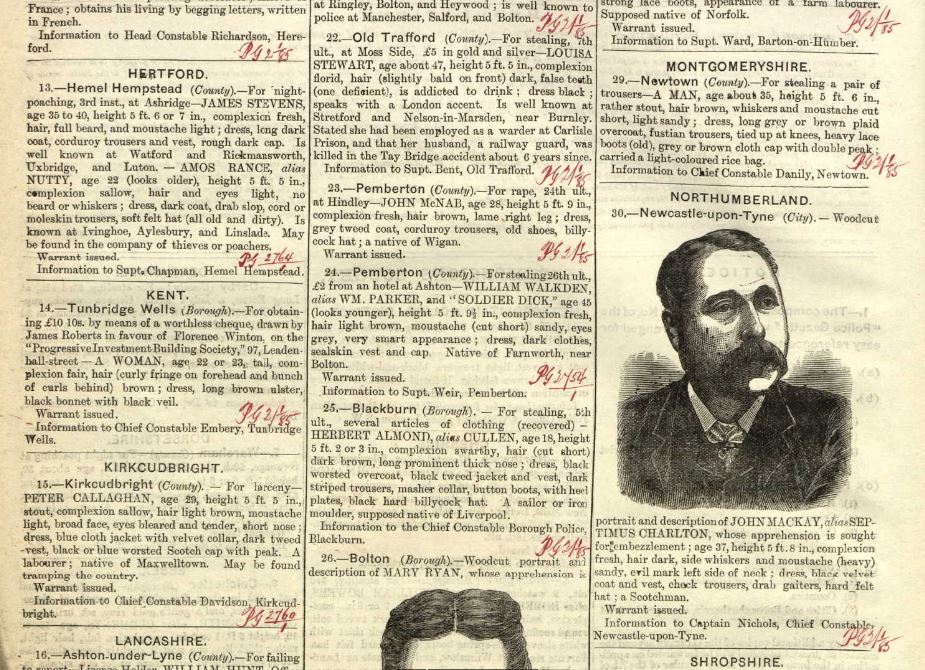
Containing the Substance of all Informations received in Cases of Felonies, and Misdemeanors of an aggravated nature, and against Receivers [sic] of Stolen Goods, reputed Thieves and Offenders escaped from Custody, with the time, the place, and every particular circumstance marking the Offence. The Names of Persons charged, who are known but not in Custody, and of those who are not known, their Appearance, Dress, and every other mark of identity that can be described. The Names of Accomplices and Accessories, with every other particular that may lead to their Apprehension. The Names of all Persons brought before the Magistrates, charged with any of the Offences mentioned, and whether committed for Trial, Re-examination, or how otherwise disposed of. Also a Description of Property that has been Stolen, and particularly of Stolen Horses, with as much particularity as can be given, with every circumstance that may be useful for the purpose of Tracing and Recovering it.

This statement was subsequently replaced in the new series by regulations of which there were fourteen printed at the start of each publication.


The format of the Police Gazette

Main Magazine published weekly with details of crimes committed and information wanted.

  • Supplement A published fortnightly with details of active travelling criminals.
  • Supplement B published weekly with particulars of convicts on licence, persons under police supervision and other wanted people.
  • Supplement C believed to have been published fortnightly with details of wanted aliens.
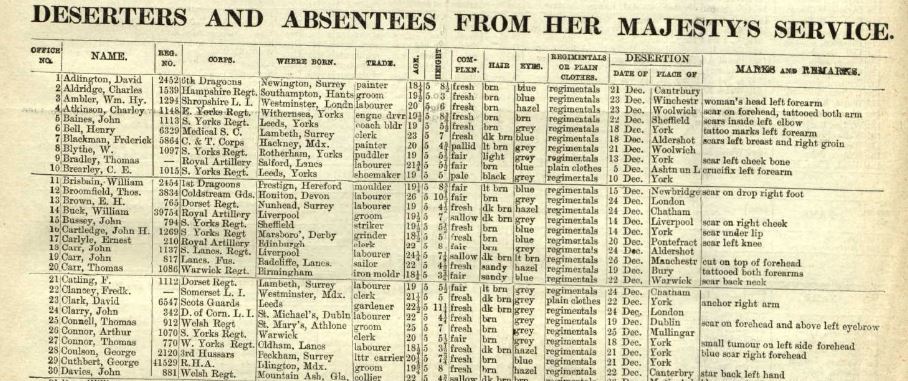
  • Supplement D published fortnightly but alternating with Supplement A with details of deserters from military and navy service.
  • Supplement E published as needed with photographs of active criminals.
  • Supplement G was a daily report of deaths of people who had previously appeared in the Police Gazette.

Supplement F appears to have never been assigned or used.

Why is the Police Gazette important for family history research?

If you discover a black sheep in your family, the Police Gazette becomes a valuable research tool. It could provide you with the only detailed physical description of your criminal ancestor, reveal any alias names and indicate why the police were interested in them. After the 1890s, you might even find a photograph of your ancestor included.

A regular feature of the Police Gazette was the lists of deserters. Before the 1870s, desertion from the army was common and a bounty up to twenty shillings was an incentive for the police to find them. The Police Gazette has the only comprehensive list of military deserters or details of those who refused to enlist after conscription was introduced during the First World War.

However...a word of caution! Not every criminal will have featured in the various publications, but if you don’t look, you will never know.

Where to locate the Police Gazette

Despite a circulation throughout the whole country, there is no complete set of the journal outside the National Police Library. This is part of the College of Policing at Ryton which holds all issues of the Police Gazette from the late eighteenth century until it ceased publication in 2017. Only serving UK police officers or police staff can access issues via the library.

Various nineteenth-century editions of either the Police Gazette or Hue and Cry are available to research digitally on FindmyPast and Ancestry, the latter of which are in conjunction with the Habitual Criminals Register indexes.

The Genealogist website has copies corresponding to twentieth century census years - 1901, 1911, 1921 and 1931 - but these editions do contain information on approximately 56,000 individuals, some of which include photographs.

The British Newspaper Library at Boston Spar (and via the British Library Newsroom) hold copies of many of the issues of the publication. Refer to the British Newspaper Library catalogue for details of availability of specific issues. Some are restricted or need permission because they contain sensitive materials.

Many of the supplements no longer survive but Forces War Records has an index of army deserters covering the conscription period of the First World War and an index of deserters from 1812-1927.

This article was contributed by Ian Waller from Family History Federation.
Website by Beachshore