The monasteries in a community took care of the poor, but after the the dissolution of the monasteries in 1536-9, the care of the poor shifted to each ecclesiastical parish The consequence of this was a series of laws generating different documents which actually are of huge value to family historians. For any researcher these documents can be invaluable in tracing the plight of families suffering hardship, migration of families, and even emigration. Poor law documents can also reveal much about family relationships and provide an insight into daily living and working conditions experienced by our ancestors. Most poor law records are categorised as parish chest records; every parish had a chest at the church iun which were stored the administrative documents and records, hence the name.

The various records deal with the poorest of society but all householders in a parish are also covered in documents such as rate books, vestry minutes etc. Therefore, people from all levels of society will be mentioned.

The poor law system developed out of the arrangements originating in the medieval and Tudor periods.  Meaningful English Poor Law legislation can be traced back as far as 1536 when legislation was introduced to deal with the impotent poor, although there were earlier laws which dealt with vagrants and beggars. However, most of us will associate the Old Poor Law and thus parish involvement originating during the reign of Elizabeth I which remained until the passing of the New Poor Law in 1834. The New Poor Law altered the system from one administered at parish level to a government-based system which introduced the development of workhouses by poor law unions.

Medieval poor law

After the Black Death the poor laws were concerned with making the able-bodied work despite there being a labour shortage; it was aimed principally at the “sturdy beggar”, a person who was fit and able to work, but begged or wandered for a living. As late as the sixteenth century, no distinction was made between vagrants and the jobless as both were categorised as "sturdy beggars or vagabonds. In 1547, legislation was enacted that subjected vagrants to extreme penalties including two years' penal servitude and branding with a "V" for a first offence and death for the second.

The decline in population after the Black Death meant that surviving workers were in great demand in rural areas particularly. Landowners had to raise wages to compete for workers or allow their farms to fall into decline. Increased labourers’ wages forced up prices as goods became more expensive to produce. In an attempt to regulate prices, the Statute of Labourers Act 1351 required everyone who could work to do so; this helped to keep wages at pre-plague levels and prevent food being overpriced. Edward III passed additional laws to punish escaped workers.

Tudor era poor law

Laws were passed during the reign of Elizabeth I aimed at providing relief for the poor. In 1563, the Act for the Relief of the Poor required all parish residents with ability to contribute to the poor rate. Those who were able but refused to give weekly to the relief of the poor could be bound over by theJustices of the Peace and fined £10. The Vagabonds Act 1572 enabled Justices of the Peace to register the impotent poor and so doing helped them determine how much money was required for their relief. They then assessed an appropriate rate to be paid by parish residents to cover this. The Poor Act 1575 required towns to create stocks of wool, hemp, flax, iron and materials to provide work for the poor in need and to provide a house of correction for those who refused to work where inmates could be forced to work and be punished.

The Poor Relief Act 1597 made some provision for the "deserving poor" and with amendments resulted in the Poor Relief Act 1601 which set to address the more immediate needs in a society where deteriorating economic circumstances prevailed. Poor harvests between 1595 and 1598 caused a significant increase and charitable giving after the dissolution of the monasteries and religious guilds fell considerably.

The Old Poor Law

The recognised Act which gave us the Old Poor Law was the Poor Relief Act 1601. It was the start of the system administered at parish level. Relief for those too ill or old to work, the 'impotent poor', was in the form of outdoor relief for food or clothing. Able-bodied people who refused work were placed in Houses of Correction in order to change their attitudes. Another important concept within the Act was that parents and children were responsible for each other and elderly parents would have to live with their children.

The system allowed the parish overseers of the poor to differentiate between deserving and undeserving poor so the system became efficient and fair The Poor Law began at a time when everyone in the predominantly rural communities knew each other’s circumstances meaning that idle poor would not easily be able to lay claim on the poor rate. The overseers of the poor were unpaid public officers annually elected by the vestry and had specific responsibilities as follows:

  • Dispensing commodities
  • Supervisingthe poorhouse
  • Providing work for adults
  • Apprentice poor children
  • Suppressing and punishing beggars and vagabonds
  • Raising money by the Poor Rate - (not always the same as Parish rate)
  • Issuing summons for non-payment of the poor rate.
  •  

The records generated by the old poor law system involved parishioners at all levels of society and this will help researchers find information about their ancestral families. The records covered...

  • Unemployment periods
  • Illegitimacy
  • Desertion
  • Illness
  • Bereavement
  • Vagrancy
  • Property occupancy
  • Movement


The Poor law system was administered by Justices of the Peace, Overseers of the Poor, churchwardens and arish constables.

There were often variations in the way the laws were interpreted and applied so there was a tendency for the destitute to migrate towards the more generous parishes. These actions led to the introduction of the Settlement Act 1662 which allowed relief only to settled residents of a parish. Settlement could be achieved in several ways. 

The Act encouraged annual employment which was effectively one day short of a year so that employees would not become eligible for poor relief; this was frequently the case with annually employed farm workers. Anyone seeking relief had to prove a settlement in the parish. If they could not, they were removed from the parish.

One further significant regulation was introduced with the 1697 Settlement Act by requiring all who entered a new parish to hold a Settlement Certificate showing their home parish that would guarantee to take them back if they needed relief.

From the early 1700s, the Society for the Promotion of Christian Knowledge began to promote the idea of parochial workhouses. The society supported Sir Edward Knatchbull in the Workhouse Test Act 1723. The Act enabled the establishment of parochial workhouses, by single and multiple parishes. By 1776 around 1,900 workhouses had been established and these were capable of accommodating around 100,000 paupers although in context nearly one million people were receiving some kind of parish poor relief at the time.

Most inmates of the early workhouses were aged, infirm or may have been children whose labour was unprofitable. It was not until 1782 that Thomas Gilbert succeeded in passing an Act (known as Gilbert’s Act) to establish poor houses for the aged and infirm and reintroduced outdoor relief for the able-bodied. This system influenced the development of the allowance system which variously made financial provision for “bread line” parishioners.

Settlement Laws were changed because of the Removal Act 1795 preventing non-settled persons from being removed unless they applied for poor relief.


What the Old Poor Law records tell us

Within the Old Poor Law records it is possible to identify whole families by name, but in some records only a father or a mother or some of the children are named. It is also possible to track a poor family’s movements between parishes. In the case of an illegitimate child, it is even possible to discover the name of the child’s father thus opening up your paternal ancestry.

The records generated by the poor law administration where they survive can vary in content and quality. Records of note include:

  • parish rate books
  • churchwardens' accounts
  • overseers' accounts
  • apprenticeship records
  • settlement certificates and examinations
  • removal orders
  • bastardy bonds, examinations etc.
  • vagrancy orders
  • parish charity records
  • emigration and migration records
  • records of poorhouses, houses of correction and workhouses.

Overseers and churchwardens

The vestry administered the old poor law system within the parish. The Board of Guardians operated alongside the vestry to administer the poorhouse after 1723.  The Quarter Sessions heard disputes and examinations of those of the poor who were displaced.

The ecclesiastical parish had various functions serving as the local government taking responsibility for many day-to-day matters including the collection of taxes, creating and maintaining roads and footpaths and taking care of the poor of the parish.

The vestry became the administrative body and consisted of a small group of parishioners who elected parish officers including the constable, surveyor, churchwardens, and overseers of the poor. Two churchwardens were chosen annually -  one by the clergy and one by parishioners.

The churchwardens were responsible for maintenance of the church, collection of some taxes and other ecclesiastical duties. In most parishes two overseers of the poor were chosen annually and were responsible for matters relating to the care of the poor.

The churchwardens and overseers worked together in many matters relating to the administration of the poor relief, many documents opening with the phrase the overseers and churchwardens of the parish.

Each parish was independent in caring for its poor and had to raise rates for that purpose. It was usually the churchwardens’ responsibility to collect the rate which exempted certain of the poor. Most collections were made twice a year as fixed by the vestry but if funds ran dry additional collections were made. Both the churchwardens and the overseers of the poor kept account records.

Vestry minutes

The minutes of the vestry show information on the annually elected officers and the overseers’ accounts which exist from the early 1600s contain names and information about the poor and those who supported them. Account books are helpful because they often survive when other loose poor law papers may not.

Parish apprenticeships

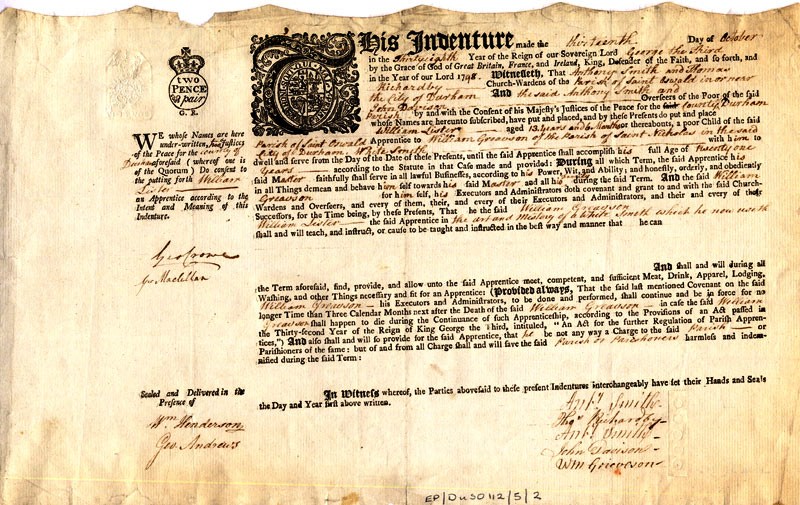
Children of poor families, orphans and widows were often the subject of the parish apprenticeship to a master within or outside the parish who were prepared to give them a trade. However, some were merely unpaid servants.

Such apprenticeships meant that the parish was relieved of any further maintenance expense for the child. Girls were apprenticed until they were twenty-one years of age or got married, and boys till they were slightly older.

Masters were legally obligated to provide board and lodging as part of the apprenticeship agreement. Apprenticeship indentures often listed a child’s father or guardian and gave the child’s age.

Illegitimacy and bastardy

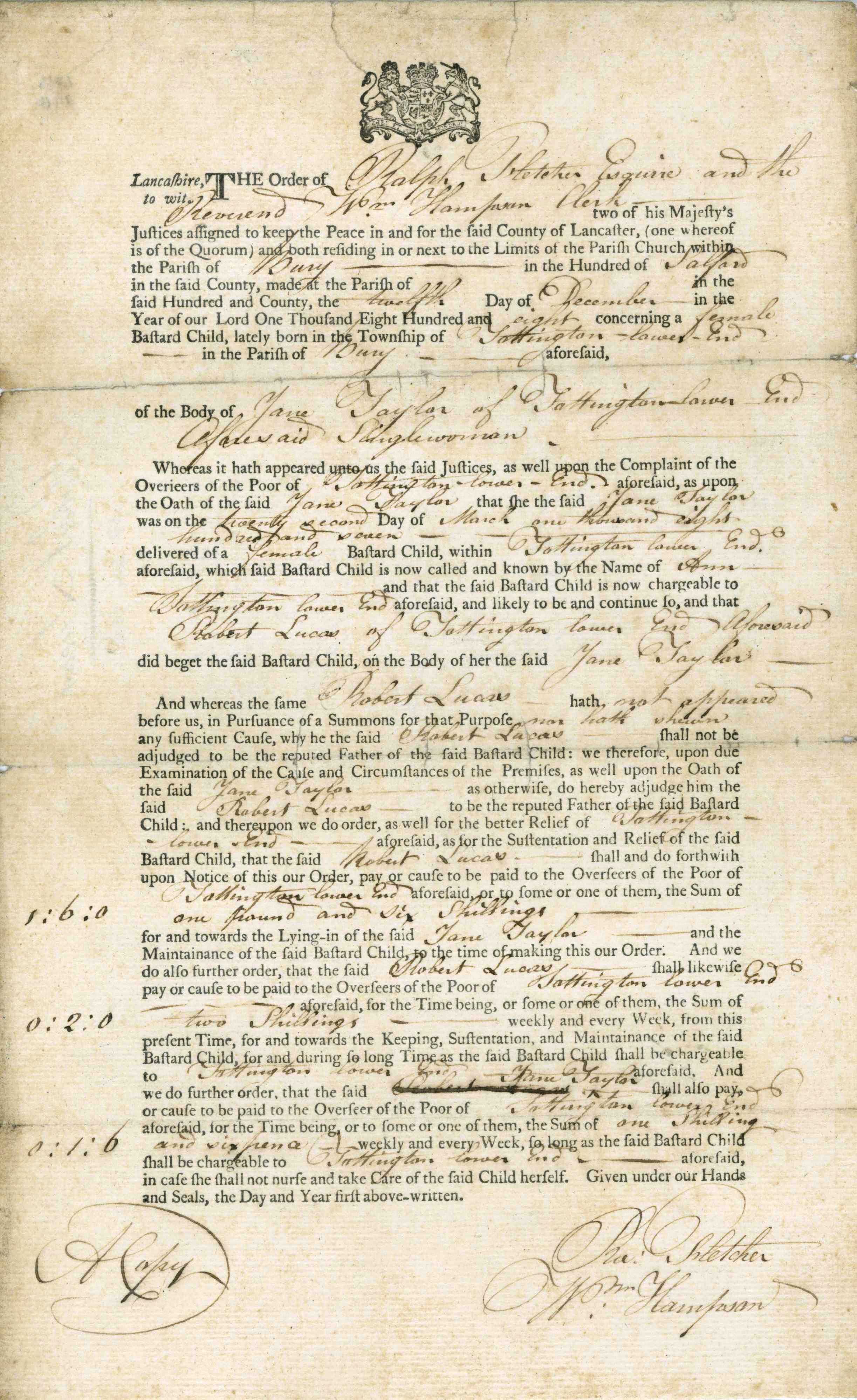
Parish officials were always vigilant in learning if a young woman was pregnant and carrying an illegitimate child. If a woman, legally settled in the parish, became pregnant out of wedlock, she could potentially become a burden on the parish for her maintenance during her pregnancy, the birth of the child and her maintenance afterward.

Therefore, a bastardy examination would be held to determine the father of the child who would then be “encouraged” to marry the young woman or sign a bastardy bond and pay for the maintenance of the mother and later the child.   

Bastardy records are valuable because they will open your paternal line.

Rate books

Rate books list the names and sums paid by each householder for the poor rate, the church rate or the highway rate. Details were often recorded on a yearly or half-yearly basis.

Rate books are basically a census of the parish and it is often possible to track when a householder arrived and left a parish based on his appearance and disappearance from the rate books.

Settlement examinations

For various reasons individuals or families left their parish of settlement without obtaining a settlement certificate.

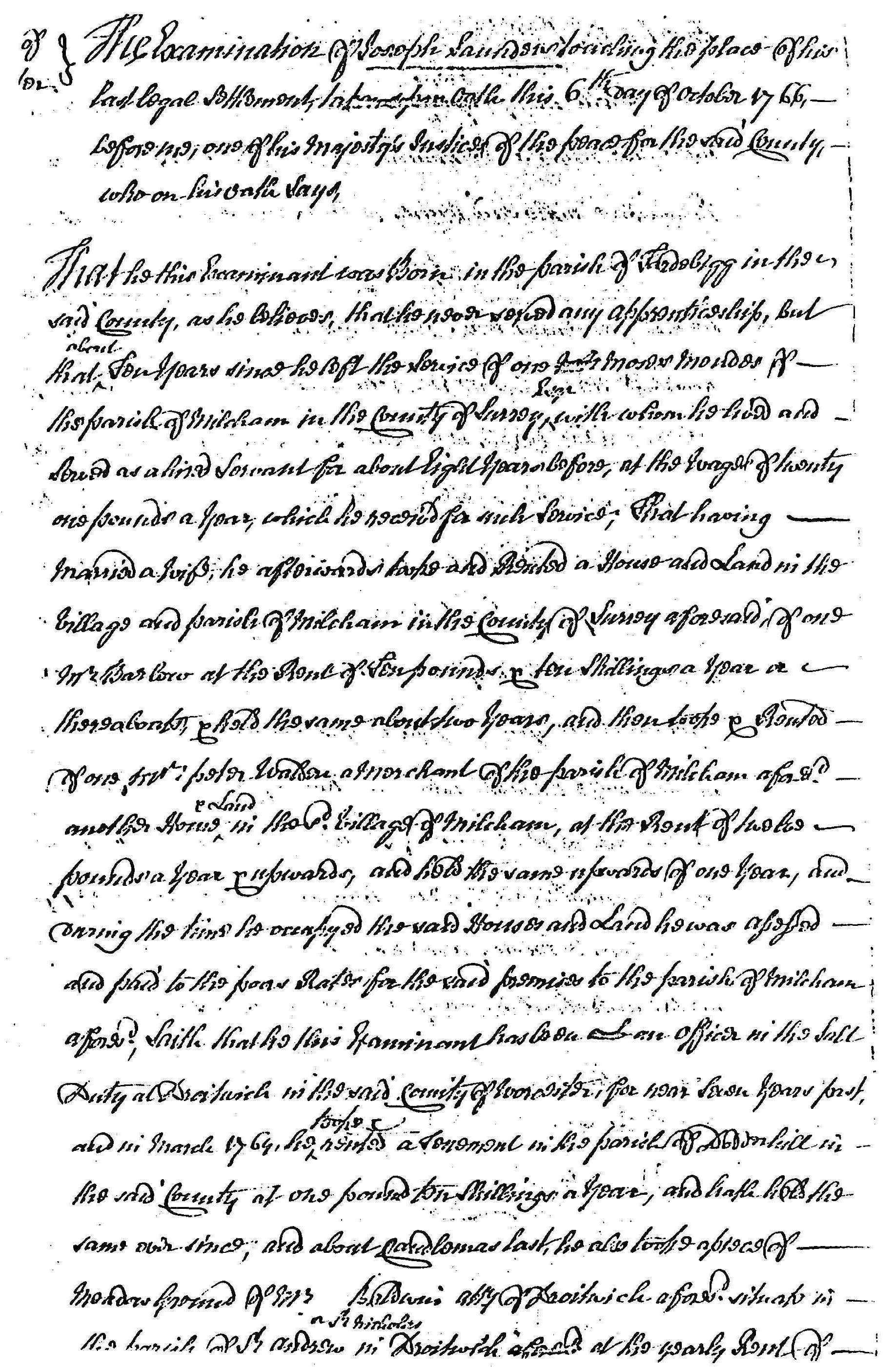
When parish officers became aware of a new family living in the parish, a settlement examination had to be undertaken This was because it had to be established whether or not the new person or family were likely to end up requiring parish relief. They needed to know their financial condition and parish of settlement. 

The examination may have resulted in a removal order being issued. However, in the absence of a settlement certificate, the declared parish of legal settlement might not take the family back and even appeal to the Quarter Sessions against the claim.

Most examinations which survive are with parish chest records or found amongst the records of the Quarter Sessions courts. Settlement records can help resolve migration problems pointing a researcher back to an earlier parish of residence or even birth.

Where to find the records

Most records relating to the old poor law administration in a parish will be part of the Parish Chest category of records held by local archives. Be aware that not all have survived and it is less likely that loose papers such as certificates and bonds exist whereas book records such as overseers accounts often do.

Documents relating to the Poor Law Commission are held by The National Archives at Kew, mainly in series MH. Use Discovery to drill down to specific areas.

The Royal Commission on the Poor Law

The 1832 Royal Commission into the Poor Laws was established following the Swing Riots. The remit of the Commission was to investigate the administration of the poor laws, produce a report on the various types of relief and suggest changes to the existing law. The report was prepared by a commission consisting of nine men with Edwin Chadwick as its Secretary. The commission concluded that the existing Poor Laws undermined the prosperity of the country by interfering with the natural laws of supply and demand, that the existing means of poor relief allowed employers to force down wages and that poverty itself was inevitable.

Assistant Commissioners collected evidence from all around England and Wales. They visited 3,000 parishes having been given specific instructions to talk with magistrates, overseers of the poor and clergymen. They also talked with ordinary residents. They were empowered to examine parish books to ascertain the payments given to the poor. The questions that they asked were aimed at exposing the 'evils' of the existing system and pointed towards the 'solution' of the 1834 Poor Law Amendment Act.

The report made certain recommendations: separate workhouses for different types of paupers including aged, children, able-bodied males and able-bodied females; the grouping of parishes into unions to provide workhouses; a ban on outdoor relief so that people had to enter workhouses to claim relief and a central authority to implement the policies and to prevent the variation that in practice occurred under the Old Poor Law.

  •  

The result was the Poor Law Amendment Act 1834 known as the New Poor Law.

This article was contributed by Ian Waller from Family History Federation.
Website by Beachshore