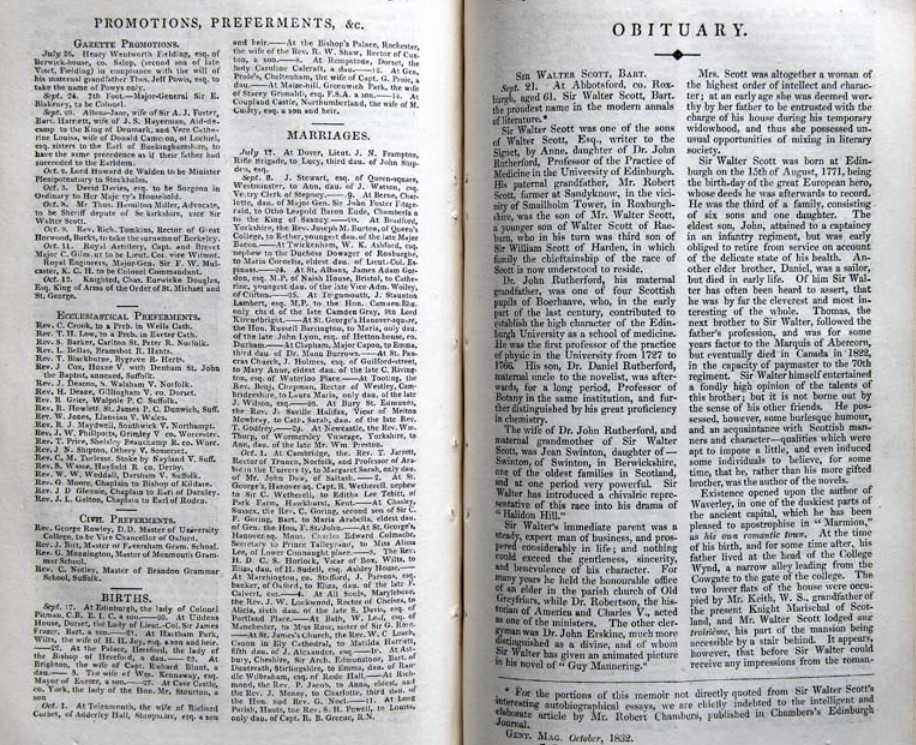




Most family historians will recognise the importance of researching in newspapers and periodicals to help place our ancestors within their contemporary environment and bring them to life. The Gentleman’s Magazine does more than that. It began as a monthly magazine first published in 1731 in London by Edward Cave and subsequently ran until 1922, nearly 200 years of history. Samuel Johnson, the English writer and lexicographer, took his first regular employment as a journalist with the magazine. During the time parliamentary reporting was banned, Johnson regularly contributed reports which reflected the position and were written in his own words.

History

The Gentleman's Magazine was also referred to as the Trader's Monthly Intelligencer. The aim of the magazine was to publish a monthly digest of news and commentary on any topic likely to interest the public. It included content from regular contributors and extracts from other periodicals and books. It was originally edited by Sylvanus Urban who was doubtless a person of a different name. Contributions to the magazine came from far and wide. The cover was an illustration of St. John's Gate which is where its founder lived and had the magazine’s offices.

Before the advent of the Gentleman's Magazine, there were other specialised journals, but none were as wide-ranging publications (apart from the Gentleman's Journal which ran from 1692 to 1694 - not to be confused with the Gentleman’s Magazine.

The magazine’s founder, Edward Cave, instigated an extensive distribution system for the Gentleman's Magazine which was read throughout the English-speaking world and continued to flourish, albeit under different editors and publishers. The magazine began to decline around the end of the nineteenth century and ceased publication in 1907. However, small editions were published periodically up until 1922 but most only contained about four pages.

Over its lifetime various series of the magazine were published.

  • 1731–1735  The Gentleman's Magazine or Monthly Intelligencer
  • 1736–1833 The Gentleman's Magazine and Historical Chronicle
  • 1834–1856 The Gentleman's Magazine
  • 1856 -1868 The Gentleman's Magazine and Historical Review
  • 1868 –1922 The Gentleman's Magazine

Indexes to and abstract from the Gentleman’s Magazine

An index for each year of was published with the December issue of the magazine, but the full 1731-1850 index by the College of Arms is available on FamilySearch. It consists of seventy-five volumes and gives the full name and an abbreviated date of the event together with the names of others who were also mentioned in the article. Ancestry hosts abstracts of the Gentleman's Magazine between 1731 and 1868 containing local history and information, topographical details and family history organised by county.

There are some partial indexes of events of genealogical value, including:

  • Index to the Marriages 1731–1768 (some are included in Boyd’s marriage index)
  • Index to the Biographical and Obituary Notices in Gentleman's Magazine, 1731–1780
  • Obituaries included in Musgrave's Obituaries.

Content of the magazine

The Gentleman’s Magazine covered many aspects of life, particularly during the Georgian and Victorian eras including medical advancements, the world of natural history, scientific discoveries, politics, both foreign and home news and letters,. There were also graphic accounts of murders, crime and punishment.

The magazine is of particularly interest to family historians because it regularly published notices of births, marriages, and deaths in persons of interest, irrespective of their status in the community, albeit that many related to notable families. The magazine also included reports of military and naval promotions and appointments as well as that for Church of England clergy and bankruptcies. However, in 1865 the magazine discontinued the notices useful to family historians and in 1868 also discontinued publishing the obituaries.

There are three volumes in the series that cover cultural topics such as local dialects and proverbs, superstitions and folklore and local customs which can only assist family historians in placing their ancestors within their contemporary environment. Besides these specific topics, the magazine featured a variety contributions about commercial information and included reports from other newspapers as well as poetry penned by well-known poets and those unknown.

The Gentleman’s Magazine was also a platform promoting science, particularly relating to the study of electricity, so much so that the first lightning conductor set up in Britian was on top of the magazine offices in London!

This article was contributed by Ian Waller from Family History Federation.
Website by Beachshore