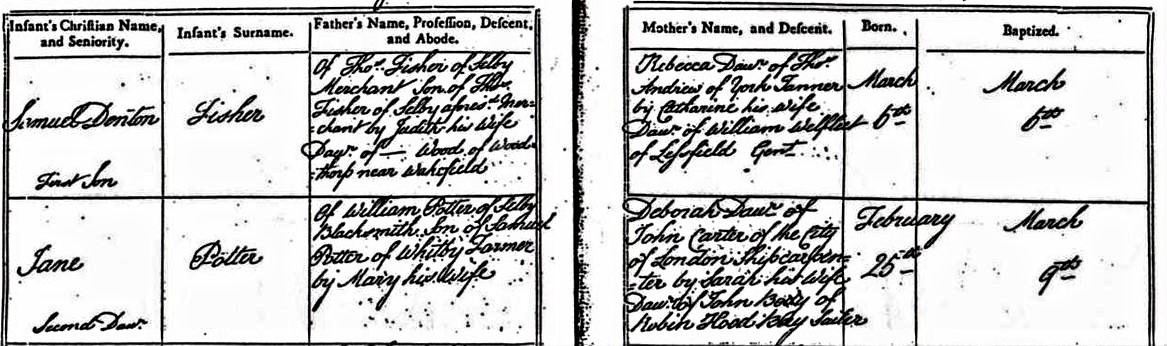
William Dade, an eighteenth century incumbent working in Yorkshire, considered that as much information as possible should be included in parish registers, particularly for baptisms. The Archbishop of York at the time, William Markham, was so impressed by Dade’s idea that he recommended its use throughout the diocese. The registers are known as Dade’s Registers and date from around 1778 up to the commencement of Rose’s Act registers at the start of 1813.
Although the format of the registers is of value for family history research, there was resistance at the time from the clergy. Many resented the extra work involved in recording all this information, especially those in urban areas of high density population.
Various incumbents from areas outside Yorkshire also recorded additional information during the same time period based upon the content of Dade's registers. Such registers can be found for parishes in Cheshire, Devon, Essex, Lancashire, Nottinghamshire, Surrey, Gloucestershire, and Dorset. For some reason they seem to have gained the classification of Dade registers. However, a similar scheme was developed in the Diocese of Durham under Bishop Shute Barrington. He followed a similar system, but the Barrington Registers did not begin until 1798 when he became Bishop of Durham. He was previously Bishop of Salisbury.