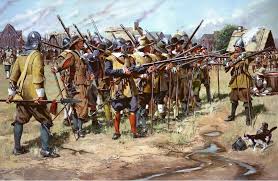
Following the Restoration in 1660, legislation was passed empowering the Lord Lieutenant of each county to appoint officers and raise men for the militia. The cost of supplying men and equipment wasundertaken by local property owners based upon the value of their land and property. The early militia played a role in coastal defence between 1665 and 1674 during the Anglo-Dutch Wars. The militia were posted at several strategic locations, in particular, the south coast of England, Wales and Ireland.
The militia thereafter declined until there was a major overhaul of the system in the mid-eighteenth century. At this point the responsibility for raising and organising the force remained at county level, but funding was no longer a local concern as it was provided by the government. Officers were appointed from the property owners and men were to be chosen from among the able-bodied men of the parish; they were required to serve for three to five years. Those who did not want to serve could provide a substitute or pay a fine.
The introduction of the Milita Act was not without opposition and in some areas of the country there was unrest, even rioting. The thought among many of the objectors was that the reform would introduce covert conscription and service overseas. The Act, however, clearly restricted service to Great Britain only. Some militia regiments served in Ireland during the 1798 Rebellion. However, some counties were tardy in implementing the terms of the Act including Derbyshire, Nottinghamshire, Oxfordshire, Staffordshire and Worcestershire. It was not until 1778 that all the English and Welsh counties had a militia.
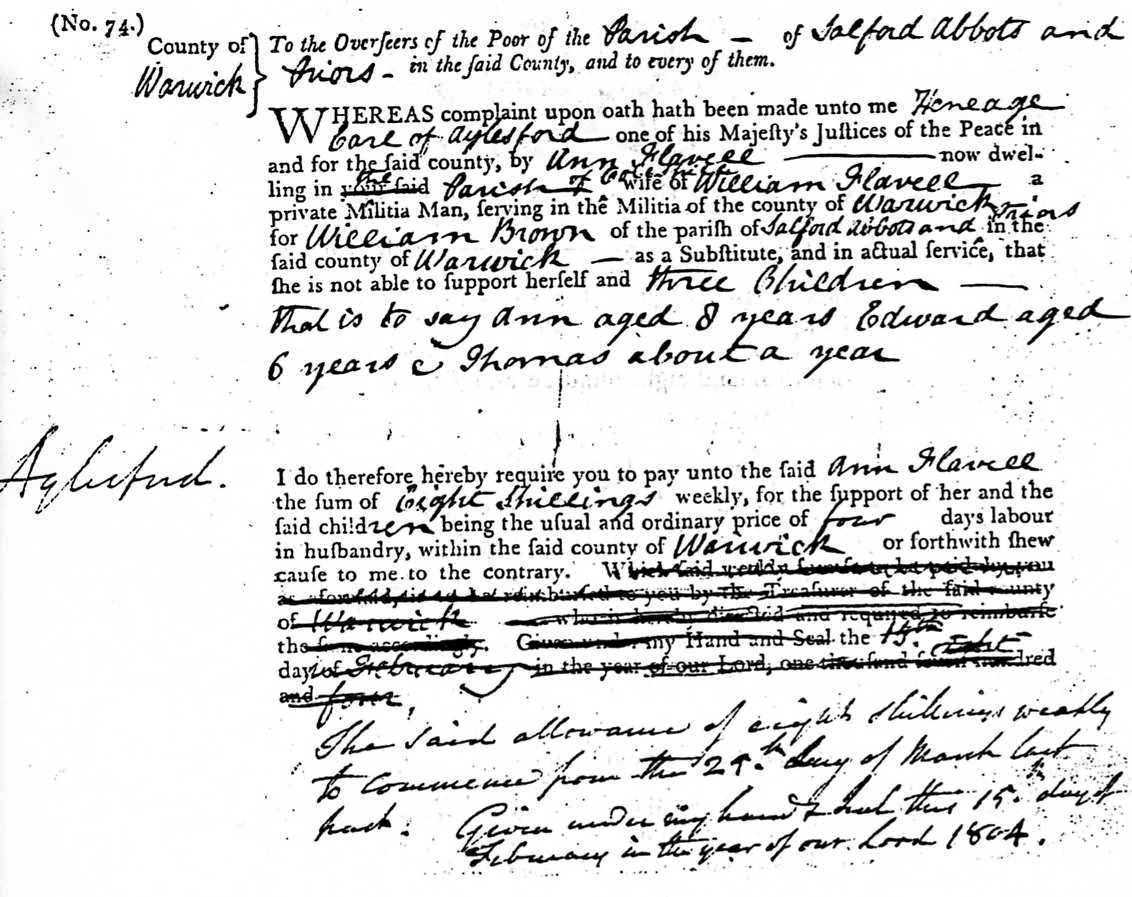
Training for militia men took place annually over a period of a few weeks. During training, regiments would normally be housed in local inns or regular army barracks if there was space. Others were housed in temporary training camps. Although overseas service was not an option, the militia regiments served all over the country. For the men of the militia, their pay and conditions were similar to those of regular army personnel, but additional financial benefits existed for their families.
The militia was always constitutionally separate from the army although after 1790 there was the option for militiamen to volunteer for the regular army - and many did so. In 1802 eventual peace with France led to a short-lived disbanding of the militia, which was began again in 1803, when hostilities resumed.
Britain's increasing overseas troop commitments during the Napoleonic Wars resulted in growing pressure on recruitment for the militia, both for home defence and as a feeder for the army. During the period to 1815, 110,000 men transferred to line regiments as against 36,000 prior to 1802.[4] The militia continued to serve as a coastal defence force, as well as guarding dockyards and prisoners of war, and performing other duties including riot control during the Luddite unrest of 1811–1813. It was disembodied in 1815, but balloting continued until 1831.