At the time of the 1921 census there were 1.7 million more females than males; this was due to losses in the First World War, although it does not include the males who were out of the country serving with the military or Merchant Navy.

There is an interesting historical backdrop to the 1921 census. A £10 fine was imposed on members of the public who did not provide details on the census form or who provided false information. Nevertheless, the 1921 census is a mine of information for family historians about our ancestors' environment including housing, employment, marital status and family structure.

Researchers would do well to read the newspapers, both provincial and national, for the first six months of 1921. The census was expected to take place in April as in previous years, but the government announced a postponement until 19 June for the census to be enumerated. The reasons for the postponement were complex.

Why the census was delayed

The 1921 census postponement until 19 June 1921 marked the first time in history a census was delayed because of industrial unrest driven by the major coal miners' strike and the potential for a nationwide strike by other unions which created a volatile atmosphere and risked making the census data inaccurate.

Firstly, from January 1919, the Irish War of Independence was looming which saw deaths in both Ireland and Britain. British troops were killed in the various battles throughout March. Secondly the government had controlled the coal mines during the war and was now returning them to private enterprise. The owners began to cut wages, sometimes by up to twenty per cent; this resulted in a major strike, involving the miners which necessitated the government declaring a state of emergency. Coal rationing was introduced. In mid-April both the railwaymen and transport workers voted not to strike alongside the miners which was viewed by them as a breach of union solidarity.

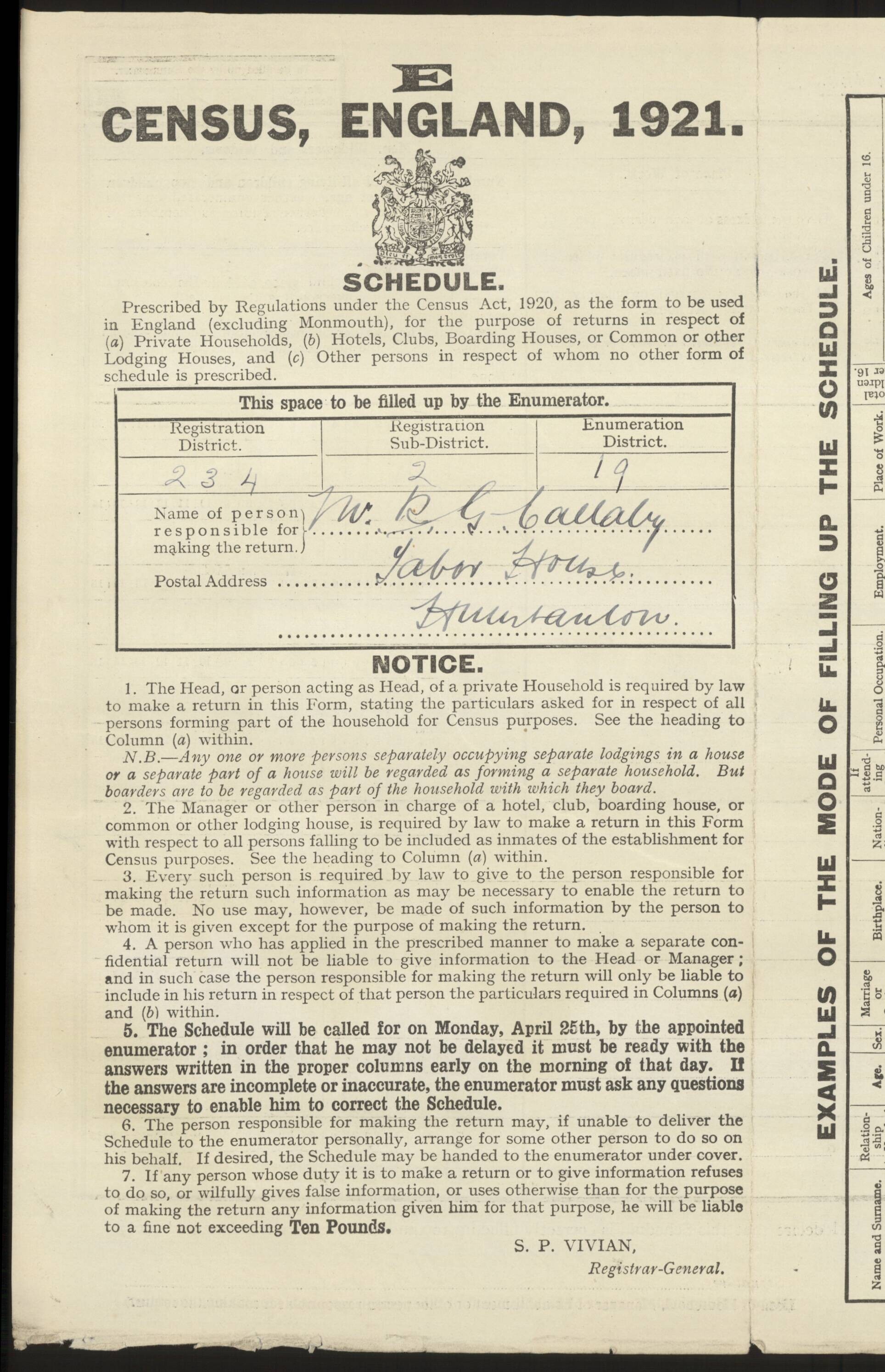
The government had printed the forms for an April census, but the same forms were subsequently distributed in June. Regulations meant that the forms could only be distributed within eight days of the event. Although postponed, the forms were not reprinted. The original April date appeared on millions of schedules which could cause confusion for family historians. The census data was collected on 19 June 1921.

Moving the census to mid-June meant that many people were on holiday, particularly in seaside resorts such as Blackpool and Southend, which saw massive population displacement with people away from their normal residences. Also, for the first time, the census allowed people to identify themselves as being divorced but only 16,000 people did so. There was no category on the 1921 census form to record disability despite many being disabled by serving in the war. Some householders chose to note their own conditions anyway - including former soldiers still struggling three years after their return from war. Many former service personnel added handwritten notes in the section for occupation such as Ruined by War doing odd work.

When the census was taken the population were asked some difficult questions. This was the first survey since the First World War and the outbreak of Spanish Flu; and children were asked whether their mother, father or both were living. The population had suffered huge losses, especially of young men in their 20s and 30s. The birth rate had dropped dramatically during the war with so many men away and then many children were conceived as men returned from the war. For the 1921 census the head of the household was considered to be a male much to the annoyance of the suffragist housewives.

Interpreting the census

To fully understand census data as applied to our ancestor family, it is important to know what the definitions of certain elements meant. The census instructions defined the following:

Private family - Any person or group of persons included in a separate return as being in separate occupation of any premises or part of premises is treated as a separate family for census purposes; lodgers were so treated only when returned as boarding separately and not otherwise. Private families comprise all such families except for those enumerated in institutions or business establishments or boarding houses in which the number of resident trade assistants or resident boarders exceeds the number of members of the employer's or householder's family (including private domestic servants).

There was often a misunderstanding between the term boarder and lodger.

Rooms - For census purposes the rooms enumerated are the usual living rooms, including bedrooms and kitchens but excluding sculleries, landings, lobbies, closets, bathrooms or any warehouse, office or shop rooms.

This definition is consistent with the meaning as shown in earlier census returns where they were defined as habitable rooms.

Structurally separate dwellings - A structurally separate dwelling has been defined for the census as any room or set of rooms, intended or used for habitation, having separate access either to the street or to a common landing or staircase. Thus, each flat in a block of flats is a separate unit; a private house which has not been structurally subdivided is similarly a single unit whether occupied by one family or by several families. But where a private house has been subdivided into maisonettes or portions, each having its front door opening on to the street or on to a common landing or staircase to which visitors have access, then each such portion is treated as a separate unit. Where an undivided private house is used partly for business or professional purposes, it is treated as occupied by a private family unless the portion used for non-domestic purposes consists of at least three rooms and is more than one quarter of the whole.

Overcrowding - The 1921 definition of overcrowding was where there were more than two persons per room, although it should be noted that the 1921 census data give rooms per person and as such can’t be used as evidence of ‘overcrowding’ as defined.

Many of the questions asked in 1921 were far from novel. For the first time, the census required householders to state the sex of persons (rather than having a sex-specific age column) as well as to give ages in years as well as months. Questions as to name, relationship to head, marital status, and birthplace went almost unchanged


Disability and fertility

The question about disability, which had been asked on each census since 1851, was dropped in 1921 because of a general recognition that responses supplied could be suspect, and better more useful data could be obtained from other sources. The fertility question which originated in 1911 was also omitted.

Rather than a question about how many infants' mothers had died, there was far more government interest in collecting data on the number of living children who needed support. Householders were asked to record the number of their 'living children and stepchildren under sixteen years of age, to aid assessment of the rate of dependency in the population. This question was answered poorly because householders misunderstood the instruction with some listing children who were not present in the household, so enumerators had to manually delete them from schedules. Those under fifteen were asked whether their parents were alive, dead, or if one had died. While concern about the impact of war losses on the nation were present, the primary concern was to determine the likely cost of pensions to widows and orphans.

Both the First World War and the devastating flu pandemic meant the 1921 census, recorded more than 730,000 children whose fathers were dead and 55,000 who lost both parents. The government used this information to help prepare the financial framework of the Widows, Orphans and Old Age Contributory Pensions Act, 1925.

Employment and place of work

Earlier censuses asked for varying details such as whether anyone was an employer or not and in which category of industry an occupation fell. In 1921, householders were asked to state the name and business of present employer and the address at which they worked making this section invaluable for family and social history for the first time. If someone was unemployed, it often gave details of their previous employer. These questions provided a better understanding of the practical population and how far people commuted to work.

This kind of information can be used to help take your search further in newspapers or company records, if they survive, and find more detailed information about your ancestor's job.

Individual household forms

Up until 1911, access to the census was in the form of books completed by the enumerators.

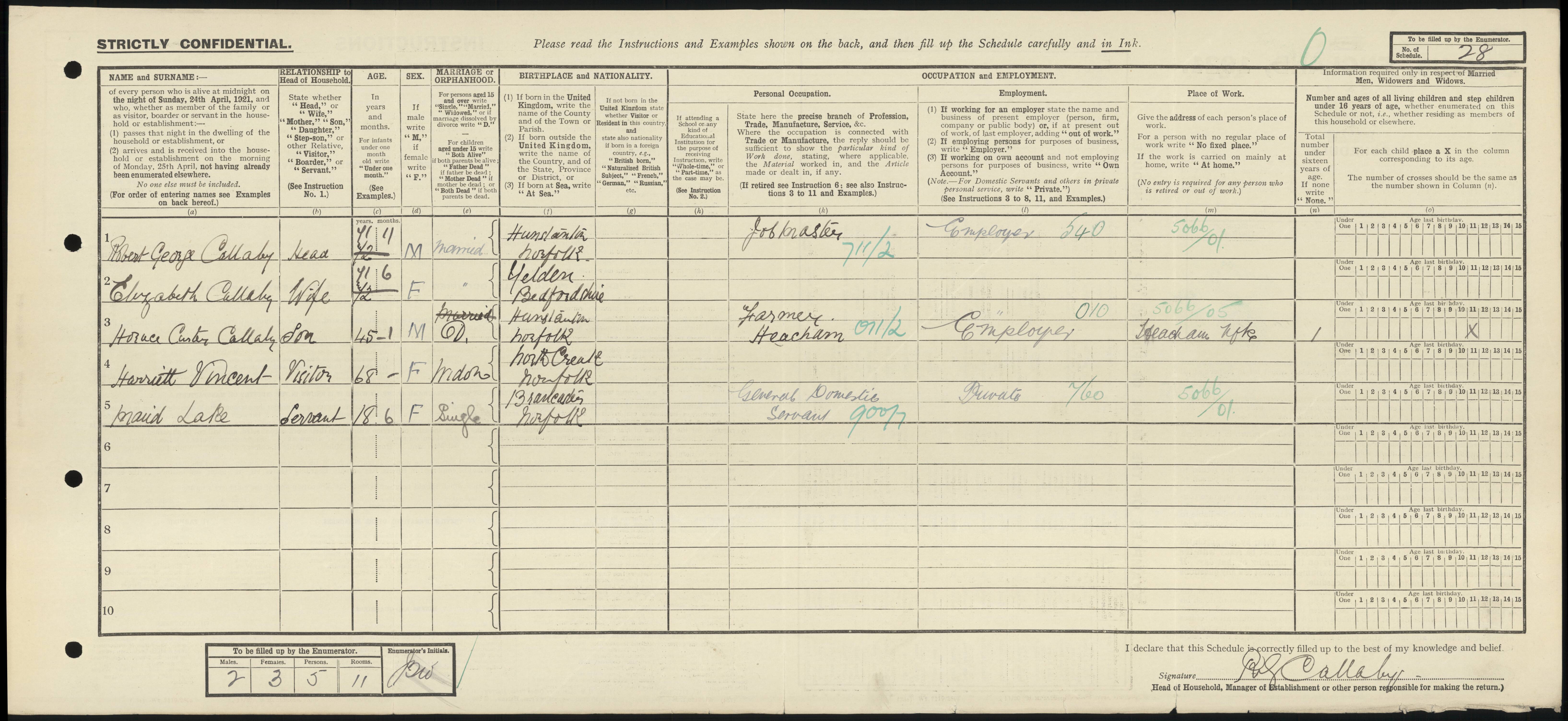
However, in both the 1911 and 1921 census, we have access to the original household schedules actually completed by our ancestors responsible for recording the details of each person in their household on the night of 19th June.

As a result of this, you will see and read the handwriting of a relation.  With thousands of men lost during the First World War, there were many widowed women who completed the schedule.

Surplus women - Aftermath of the 1921 census

The sinister side of this situation resulted in the government implementing schemes that encouraged these ‘surplus women’ to emigrate to other countries in the British Empire, such as Australia, New Zealand and Canada. Was your ancestor amongst them?

The main goals were to "rebalance" the sexes in Britain and the colonies, populate the Empire with British stock, and provide economic opportunities (specifically marriage or domestic service) for women who would otherwise remain single in this country.

The Society for the Oversea Settlement of British Women was formed in 1919–1920, and became the primary body tasked with handling female migrants under the auspices of the women's department of the Overseas Settlement Committee. They aimed to select "suitable" candidates, prioritizing health, youth, and sometimes middle-class status, as they were meant to bolster the "civilising" influence of the Empire. It directly led to the Empire Settlement Act of 1922 which allocated £3 million annually for assisted passages to the dominions and included specific provisions to encourage the migration of “single” women and their families.

Some schemes encouraged women to use skills gained in war work such as nursing or agricultural work abroad. These initiatives were designed to move the surplus women from Britain to areas where they were needed to marry British male colonists and ensure the expansion of the British Empire

This article was contributed by Ian Waller from Family History Federation.
Website by Beachshore