


Watching my dad

As a young lad whenever I visited my father at his place of work, I was fascinated by the way he used to sit cross-legged at his work station - assis en tailleur - making a suit or a pair of trousers. He even sat like it at home when making clothes for the family. He had a very keen eye and was meticulous in the way he viewed styles of clothing and everyday fashion. He trained as a tailor and cutter and worked for a renowned tailors in Northamptonshire. Brown paper (used for patterns), triangular pieces of tailor’s chalk, various pairs of tailoring shears and a special tape measure were some of his tools. Woe betide us if we ever tried to use his scissors!  He also had three irons that no one else was allowed to use – the plates were pristine. Until he retired, I wore bespoke suits, jackets and trousers all made by him including my 1960's Beatles-style suit! He also made mum’s costumes.

My father was one of several tailors in my family who were involved in the tailoring trade over several generations. So, did your ancestor work in the tailoring or outfitting business whether in the bespoke world, in an East End sweatshop or for one of the large clothing manufacturers?

In the 1960s there was a television situation comedy entitled Never Mind the Quality, Feel the Width.  It centred around two tailors in business, one was Jewish and the other Irish, so both had differing religious and political views. Above the tailors’ shop was a Jewish cloth importer and this series epitomised very humorously the early to mid-twentieth century tailoring trade. The business was supposedly set in London’s East End. The Jewish tailor was a jacket maker and the Irish tailor made trousers - both incapable of understanding and accepting one another’s views.

Understanding the tailor's job

In order to appreciate the work that a tailor did, it helps to have a broad understanding of the types of clothing through the ages that they would have made and the techniques they used. Methods and techniques would obviously change as technology improved. So these facts plus the associated social history will help you place your ancestor in his contemporary environment.

These elements all had a direct bearing on the tailoring operation your ancestor was involved in, so an understanding of this will help you find the type of records you need to look for in your research of your tailoring ancestor. Tailoring spanned the whole class spectrum; it ranged from high class tailors with royal warrants working out of Savile Row to immigrants working in the sweatshops of the East End, not forgetting the individual tailors in rural communities who spent much of their time undertaking alterations and outfitting rather than making garments from scratch. Many rural tailors made all types of garment for the local gentry and their households.

Arguably tailoring is both an art and a craft. Understanding fashions of the day and the imagery associated with that is the art, whereas the craft is designing, cutting, fitting and finishing clothes.

Origins and history of tailoring

Tailoring developed gradually between the twelfth and fourteenth centuries with its origins mainly in Europe. According to the Oxford English Dictionary, the first reference to tailor was in 1297 by which time many locally based tailoring guilds had been established.

Tailoring has its origins in the linen armorers; these were craftsmen who fitted fighting men with padded linen undergarments to protect their bodies against the chafing of chain mail and later plate armour. Men's general clothing at the time was mainly loose-fitting robes, tunics and hose. Tailoring has traditionally been a hierarchical and male-dominated trade - and remains so today.

Throughout history tailors have traditionally catered for a wide variety of fashion trends, some of which were decorative garment enhancements. Some tailors became known as picadilloes, said to have originated with Robert Baker, a well-known seventeenth-century London tailor based at Pickadilly Hall, hence the name. It is said that he brought fame to Piccadilly Circus but how true that is remains conjecture.

In the sixteenth and seventeenth centuries, tailors made a variety of outer garments including cloaks, coats and breeches. They gave shape to them by using coarse linen and canvas for interlining horsehair cloth and even card stiffened with whalebone for structural elements. Imperfections within body shapes were compensated for by using woollen padding. Luxury garments were frequently lined with satin or velvet.

During the eighteenth century most tailors were skilled workers making clothes by hand. The largest concentration of the industry was then in London. Journeyman tailors travelled around the country and stayed in homes of wealthy people for the duration of making the season’s clothes for the whole household including servants.

The nineteenth-century tailor made trousers, waistcoats and sporting clothing and was adept at working woollen fabrics, shaped using heavy steam irons. In Britain, wool implied masculinity and patriotism so it completely replaced the silk and velvet used earlier. Men also began to wear trousers as opposed to breeches.

Lower quality, mass-produced and more affordable clothing was made in factories by clothing operatives rather than qualified tailors. Many unskilled ladies sewed on buttons, made button holes in the factories and sweatshops. By 1860 the sewing machine made mass production easier and quicker than bespoke tailoring.

The tailoring shop

The tailoring shop of the nineteenth and early twentieth centuries were either sparsely or luxuriously fitted, depending in the size of the business and the types of clients. The basic requirements included shelving for the display of cloth, a counter where samples could be consulted, a space for initial measurement and a fitting room.

The workroom, usually behind shop, housed a cutting table and other tools of the trade. Several up-to-date fashion prints were also shown to clients. More prestigious firms made garments on the premises while "jobbing" tailors often sent work to outworkers, usually female seamstresses, who made up the garments at home.

By the turn of the twentieth century, many top-class bespoke tailoring shops had plush carpets, hardwood fittings, upholstered chairs and gilded mirrors. In the twentieth century tailors such as Simpsons and Austin Reed appointed their shops in art deco style and included barbers' shops and outfitting departments. Very often, and particularly in the mid-nineteenth century, other tailors were joined by high-end accessory providers and outfitters, making tailored shirts and selling items such as hats, ties and cravats, umbrellas and even footwear. Their shop-window displays tended to appeal because of their orderliness and neatness.

Tailoring shops were owned and managed by a master tailor, who always dealt with customers. He would employ journeymen tailors paid by the day or job and who would undertake the cutting and sewing work. The apprentices did the menial tasks whilst learning the trade. Cutting was really the most skilful element of garment making.

The way tailors sat often led to physical or medical conditions. They often developed round shoulders commonly known as tailor’s stoop or tailor’s bunion caused by prolonged pressure on the small toe joints as they sat cross-legged for hours on end.

Definitions of tailoring trades

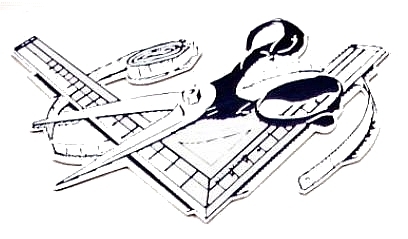
TAILOR – A person who makes, repairs and alters outer clothing for men and women.

CUTTER – A person who measures, produces a pattern and cuts cloth for a tailor to make up.

OUTFITTER – A person who deals in accessories and equipment to complement the fashion of the day.

Progress in the trade

In modern times we perhaps associate tailors with making suits and menswear but that was not always the case. In times gone by many specialised in making items such as collars, cuffs or even overcoats. Some would be engaged in making clothes for women, military and school uniforms or cloaks. However, it was not unheard of for collar-makers or vestors (sewers) to work alongside tailors.

Traditionally tailors were highly-skilled workers who only produced clothing for the well-to-do who were really the only class able to afford their services. Virtually all work was completed using hand techniques which meant that each tailor’s method remained a secret only to be passed down to his apprentices who were normally from the tailor's own family.

At the other end of the social scale, the labouring poor relied on cast-offs or the clothes were made by the women of the household. In most cases they wore the same clothes each day until they wore out. Many rural tailors would make relatively cheap ready-to-wear clothing using low-cost materials; they were simple designs such as smocks as workwear. Many also made a living by outworking for tailoring businesses from the local towns.

In the first part of the nineteenth century various technical advances occurred including the tape measure, sewing machine and cutting templates which paved the way for off-the-peg mass production of clothes. Master tailors, however, continued to work in bespoke producing made-to-measure clothing but less skilled tailors worked either in workshops or in their own homes..

Where might your ancestor have worked?

Bespoke tailors

Sweatshop

Village or town tailors

Military tailors

Shirt and collar maker

Ladies' tailors

School tailors

Tailors' merchants

Gent's Outfitters

Tailors' training

Records for locating tailoring ancestors

Census returns are good for showing who was involved in the business, often in extended families as tailoring was usually a family concern.

Trade directories help to establish the premises occupied by tailors. Use maps and photographs to enhance this information.

Business records - most record offices hold the business records of local tailoring and outfitting businesses including:

Account books

Correspondence

Pattern books

Cutting guides

Photographs

Specialist journals and newspapers

The Merchant Taylors' Company is one of the City of London's livery companies. Their records include:

Freedom registers from 1398

Apprenticeship binding books from 1398

Quarterage books from 1664

Wardens' accounts

Court minutes

Tailoring trades union - When the major tailoring unions began, only skilled tailors were allowed to join. In the late nineteenth century unions opened membership to the clothing operatives in factories. There were over fifty different unions covering the tailoring trade.

The Tailor's Asylum was built in 1837 housing forty tailors and their wives. Each received eight shillings a week and coal. Located on Haverstock Hill, St Pancras. Records at the London Metropolitan Archives include logbooks, medical application register, tenancy register, minute books and financial records dating from. 1837 to 1981.

The Tailors' Benevolent Institution 

Bankrupts and Insolvent debtors - Both gent's and ladies' tailors had a fairly high incidence of bankruptcy and insolvency possibly because of the way clients paid or did not pay.

Local trade guilds - These defended the interests of the tailoring trade, regulated the quality of workmanship and the trained new members as well as provided support and welfare. Membership of a tailors' guild was gained by completing an apprenticeship, as a result of by patrimony, by redemption or payment of a fee. Surviving records, held mainly by local record offices, can include master, journeyman and apprenticeship letters, lists of members, family lists, letters of recommendation and birth documents.

This article was contributed by Ian Waller from Family History Federation.
Website by Beachshore