Most people associate Edward Jenner as the doctor who successfully tested and introduced a vaccination to eradicate smallpox. However, there was one man who worked on this same topic several years earlier.

John Williamson (c1730-c1803) was known by his nickname Johnnie Notions. Like many islanders he had many occupations...it was a case of needs must for people living on the edge. Men and women were expected to be able to turn their hand to anything and Johnnie was no exception; he was a tailor, joiner, clock and watch-mender, blacksmith, farmer, fisherman, weaver and self-taught physician!

Island populations are particularly prone to large-scale outbreaks of disease, especially if it is brought in by a visitor from the mainland. This was the case in the early 1700s and records show that many people lost their lives to smallpox. So it was that Johnnie turned his hand to the problem of smallpox. Through trial and error and rudimentary medical knowledge, he eventually developed a vaccination which in fact was highly successful; it was highly regarded by the people of Shetland. It is thought his inoculations were done in late 1780s but many people think it was even earlier than that.

Johnnie’s work has been somewhat overshadowed by that of Edward Jenner, nevertheless, he is well-remembered in Shetland. His memorial stone is in the Cross Kirk cemetery, Eshaness, Shetland.

In 1798 Edward Jenner, a Gloucestershire doctor, successfully tested what had become folklore that a dose of cowpox infection gave protection from smallpox. Smallpox was known as the speckled monster because of its blister-like rash; it had killed thousands since medieval times. In the nineteenth century smallpox was a common killer in Britian. It was contagious and is thought to have been fatal to around thirty per cent of those who contracted it. Smallpox also left many of the survivors blind or permanently scarred.

History

There was wide opposition to the vaccination because some people claimed the vaccination were unsafe or not needed while others argued that compulsory vaccination was nothing more than interference from the state.  Misinformation about vaccines has been around for as long as vaccinations have existed. Many people were suspicious of using substances from cows to cure human disease and some objected for religious reasons. 

The anti-vaccination movement was at its height during the 1890s; this was due to the National Anti-Vaccination League which organised anti-vaccine propaganda and held protests. Thousands of people gathered and protested in opposition to compulsory smallpox vaccinations, resulting in arrests, fines and jail in some cases.

Although the smallpox vaccine was highly successful, parents were able to obtain certificates of exemption from 1898 and compulsory vaccination for smallpox ended in 1948 just after the establishment of the NHS. 

In the early 1850s the average life expectancy was around forty years with fifteen per cent of children dying in infancy. The 1858 Medical Act brought in standards and registration but the medical profession still believed that miasma was the cause of most illnesses. Immunisation was still in its infancy and natural cowpox material varied in quality so it took years to prove that vaccination did not always give complete lifelong immunity. The initial process of vaccination also led to secondary infections.

Progress towards vaccination

The Vaccination Act 1853

This is the Act which had the most impact on the public. It stated that:

Every child, whose health permits, shall be vaccinated within three, or in case of orphanage within four, months of birth, by the public vaccinator of the district, or by some other medical practitioner.

That notice of this requirement, and information as to the local arrangements for public vaccination, shall, whenever a birth is registered, be given by the registrar of births to the parents or guardians of the child.

That every medical practitioner who, whether in public or private practice, successfully vaccinates a child shall send to the local registrar of births a certificate that he has done so; and the registrar shall keep a minute of all the notices given, and an account of all the certificates thus received.

That parents or guardians who, without sufficient reason, after having duly received the registrar's notice of the requirement of vaccination, either omit to have a child duly vaccinated, or, this being done, omit to have it inspected as to the results of vaccination, shall be liable to a penalty of £1; and all penalties shall be recoverable under the Summary Jurisdiction Act 1848 and shall be paid toward the local poor rate.

The Vaccination Act 1867

The Vaccination Act 1867 consolidated the previous Act and updated the existing laws relating to vaccination. This Act remained in force until the National Health Service Act. This Act required the poor law guardians to control vaccination districts and pay vaccinators between one and three shillings for each child vaccinated in their district.

Within one week of the birth registration, the registrar had to issue a notice of vaccination meaning that if a child was not presented for vaccinated within three months, the parents or guardians were prosecuted and a fine of £1 could be imposed. This was one of the reasons that family historians may not be able to locate a birth certificate because objectors did not register their child's birth.

The Vaccination Act 1871

This Act appointed a Vaccination Officer and authorised a defendant to appear in court either as themselves or any member of his family or any other person authorised by him. The Act also emphasised the principle of compulsion.

The Vaccination Act 1874

This Act served only to clarify the role of the Local Government Board in making regulations for guardians to implement the 1871 Act.

The 1889 Royal Commission

With all the controversy surrounding vaccination a royal commission was established which resulted in various reports being made between 1892 and 1896. The commission recommended the abolition of collective penalties and the use of safer vaccines. Some of the recommendations were incorporated into the 1898 Vaccination Act.

The Vaccination Act 1898 

The 1898 law modified and consolidated many of the earlier Acts but also introduced conditional exemption of conscientious objectors. It removed completely the cumulative penalties and introduced a conscience clause which allowed parents who did not believe vaccination was effective or safe to apply for a certificate of exemption.

Exemption could not be taken for granted and parents applying for a certificate of exemption had to satisfy two magistrates of their legitimate conscientious objections. Some magistrates on principle refused to be satisfied resulting in delays to the system because exemption could not be granted if the child was older than four months.

In 1907 the Government became fully aware that magistrates had declined to carry out the requirements of the 1898 Act, so passed a new law under which a parent escaped penalties for the non-vaccination of his child if within four months from the birth he made a statutory declaration that he confidently believed that vaccination would be prejudicial to the health of the child and within one week delivered the declaration to the Vaccination Officer. All magistrates were required to sign a statutory declaration if asked to do so.  A statutory declaration could also have been witnessed by a commissioner for oaths if a magistrate still refused.


Vaccination Lists

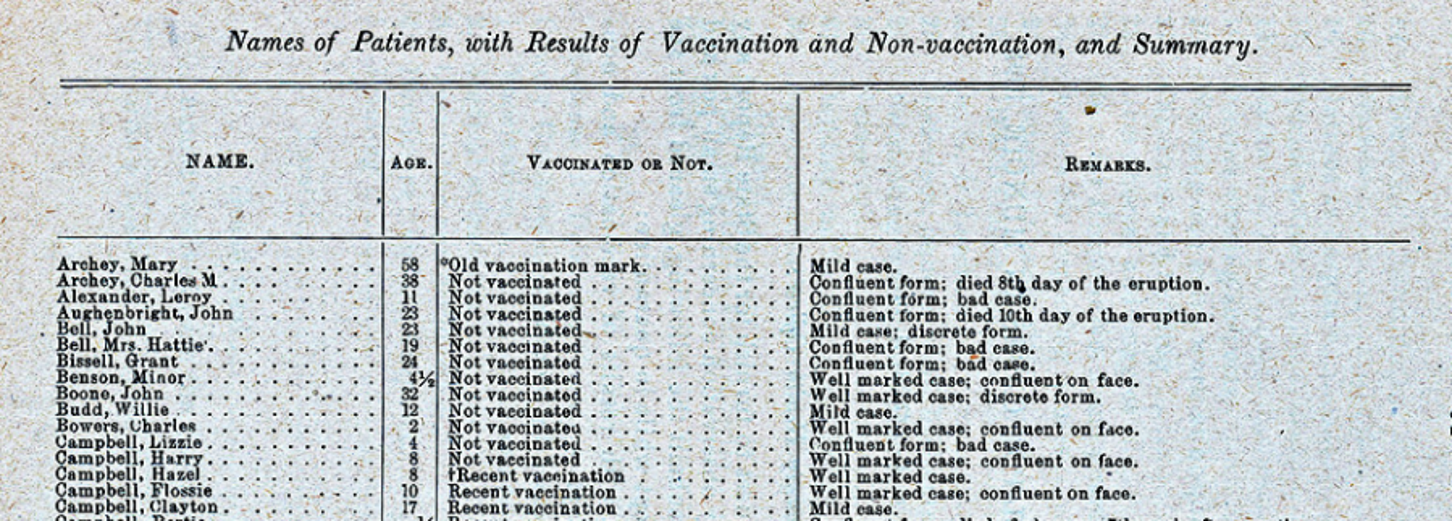
To ensure that all children were vaccinated, the vaccination officer for each district compiled lists from birth registrations. These lists were organised in districts and then subdistricts. The system was such that children were visited when they were one or two months old and vaccinated accordingly. The appointment could be postponed to a later date if the child was not fit to be vaccinated but once the child was healthy enough, parents had to take the child to the next public vaccination clinic.

Where vaccination lists survive they provide the following information:

  • Name
  • Age
  • Parish
  • Date of vaccinated or an indication of “not vaccinated.”
  • Father’s / guardian's name (if another surname was recorded it was in brackets)
  • Birth place
  • Father's occupation
  •  

In most cases surviving records can be researched in local archives. Most records can be located in the Poor Law Board of Guardians records for the area you are interested in. Some records do not survive and some have been published.

Once a child had been vaccinated, an individual certificate was issued under the Compulsory Vaccination Act certifying that the vaccination had taken place. There is a possibility that such certificates many survive in family papers.

This article was contributed by Ian Waller from Family History Federation.
Website by Beachshore