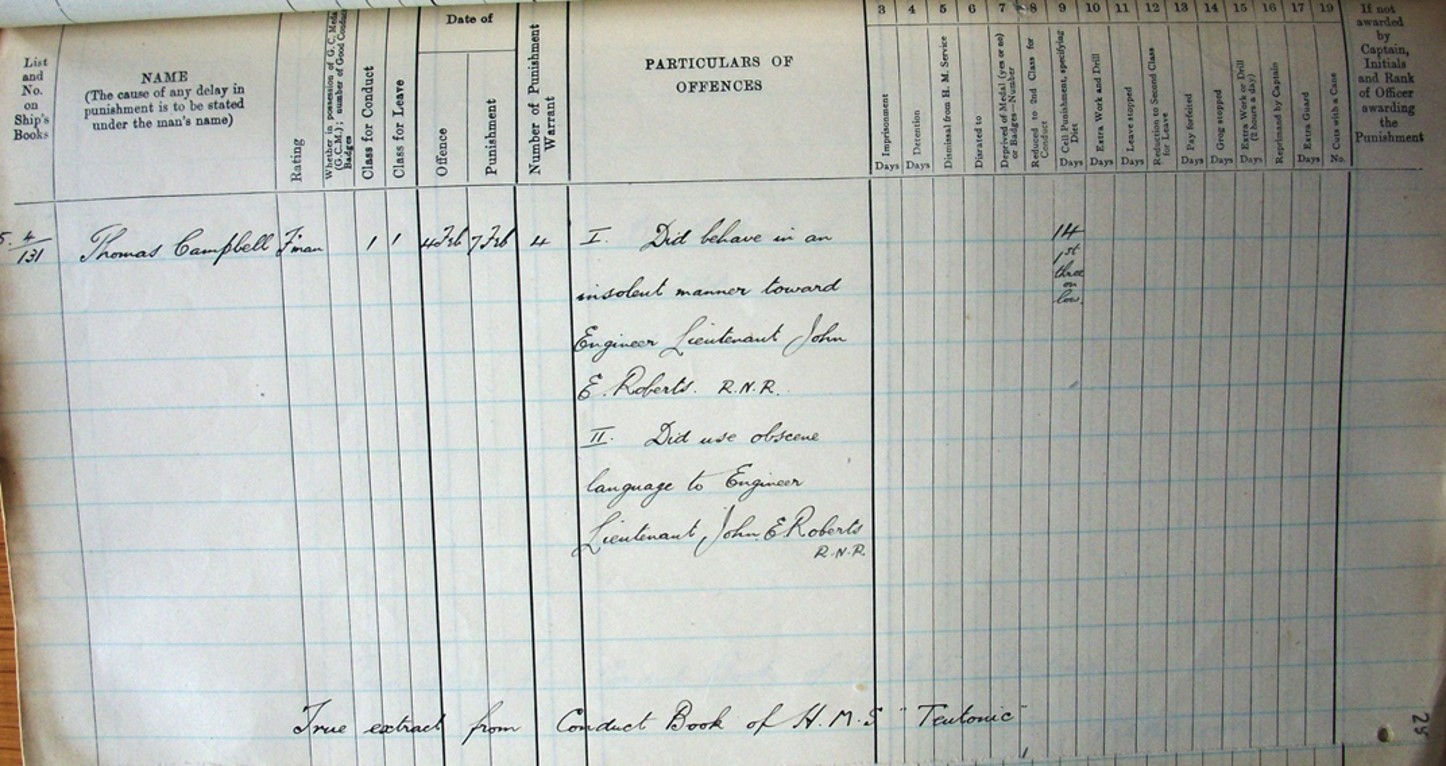
The ancient maritime laws as far back as 1336 provide the basis of Royal Navy discipline which was later determined by statute. Before the mid-1600s naval discipline was the responsibility of the captain of each ship, meaning that there was no uniform system of administration or punishment. Disciplinary offences were punished in accordance with an individual captains’ personal code of conduct.

The system changed in 1652 when the Admiralty introduced the Articles of War which allowed fixed punishments and/or penalties for certain, but less serious offences. Articles of War were also enforced during peacetime and as such became incorporated in the 1661, 1749 and 1886 Naval Discipline Acts by which all naval tribunals and courts martial had to adhere.

Articles of War and Naval Discipline

As required by the Articles of War, whenever a ship was lost there was an automatic court martial of the captain. The published list The Lost Ships of the Royal Navy 1793-1900 is an important reference guide and is available at The National Archives' reference library and the National Maritime Museum. This lists the ships and the date of the court martial together with The National Archives' series reference thus allowing access to the appropriate documents without further recourse to catalogues, indexes or finding aids.

The system of dealing with general discipline was unique to the Royal Navy and serious offences could be dealt with by courts martial imposing the death sentence. Trivial offences were dealt with by the captain and did not go before a tribunal or courts martial, but both naval and social offences were always dealt with through the courts martial system.

Offences under the Naval Discipline Acts

Naval offences

There were a series of offences laid down in the Naval Discipline Acts including desertion (run); being absent without leave' mutiny, brutality and conduct unbecoming of an officer; the loss, collision and grounding of ships and submarines; neglect of duty, disobedience to orders and sedition.

Social offences

Those offences falling under the social offences code included alcohol and drug related offences, embezzlement, theft and plunder (which sometimes involved the whole crew of a ship), disturbance of the peace, fighting, striking an officer and self-mutilation.

In some cases multiple offences from either or both categories formed part of the same case against men or officers. Murder and manslaughter cases were often tried in the criminal courts rather than by courts martial.

The naval judicial process

The judicial process began with a formal letter of complaint to the Lords Commissioners of the Admiralty for offences within home waters or to the Commander-in-Chief of Foreign Stations for offences internationally. The regulations and instructions required the information to be precise and cover three essential points:

  • the charges
  • a clear explanation of the crime or offence detailing time, place etc. of each transgression
  • details of how the offence had been perpetrated.

In some cases a court of inquiry was then held to determine the validity of the complaint letter. This was a less formal setting than an official court martial. Between three to five tribunal members gathered evidence and testimonies which were not taken under oath, and the sole purpose was to determine if courts martial action should be taken. The commander then determined the action needed and if necessary issued the orders for a formal Naval Tribunal or Court Martial to be convened.

The courts or tribunals had to follow a rigid procedure and the accused was entitled to the protection of the regulations in order that a fair trial was given. The second or sometimes the third ranking officer of the naval station was normally the President of the Court and between five and fifteen officers formed the panel which was convened on the day of the trial for that specific purpose.

The rigid procedure was as follows:

All qualified justices were present and they sat according to seniority. The Judge Advocate had to be well=-versed in the laws and regulations relating to naval procedures. Judge Advocates were civilian judges who were responsible for the supervision and superintendence of the court martial system in the Royal Navy from 1663.

The witnesses and audience were then admitted to the room.

The accused was then brought to court by the Provost Marshall, a Royal Navy police officer.

The order for the trial and the warrant appointing the Judge Advocate were actioned.

All parties swore their respective oaths.

The letter of complaint was then read out.

After this all the witnesses were ordered to withdraw from the court.

The trial then began with prosecution and defence cases and witnesses in turn were interviewed and cross-examined. The naval disciplinary regulations determined the number of witnesses for each side dependent upon the severity of the case.

The accused would then enter his defence.

The court was cleared whilst the case was deliberated on by the panel.

The verdict was then ratified – some offence sentences were pre-determined by the articles of war (the procedure could be slightly different if a commissioned officer or warrant officer was the accused as opposed to a rating).

The decision of the tribunal was put in writing and signed by each member of the panel in order of seniority.

The court was reconvened and the Judge Advocate announced the findings. Those found to be innocent or with no case to answer were immediately released and exonerated and those convicted were handed to the custody of the provost to action the sentence and the accused man’s (or woman’s) service record was marked accordingly.

Deserters

One of the most common aspects relating to naval discipline was the vast number of ratings who deserted, indicated by “R” or Run on many ships' musters and service records. It is thought that desertion rates amongst ratings was often around twenty-five per cent., reaching the height during the press gang period. Between 1755 and 1763 around 38,000 men deserted the service and into the nineteenth century it is estimated that around 2000 men each year deserted. Men who deserted gave up their right to pay, medals, “prize money” and pension.

Information about deserters can be found in various sources. After about 1870 it is worth searching the Police Gazette/Hue and Cry because it published weekly lists of all personnel who deserted. The single line information gives valuable basic information including name, date of desertion, rating, age, physical description and details of the ship from which they deserted. You may even be lucky enough to find a photograph of the deserter as these are included in some instances.

Ships' musters also provide information as the entry against a seaman is indicated by “Run” or “R” making musters the main source of such information earlier than the Police Gazette published information on the deserter. However, no ships' musters exist after 1878. The Police Gazette for 1828-1845 can be searched in series HO75 and some later ones exist in series MEPO6 at The National Archives, although the run is incomplete in the latter series. It is also available online. Information about deserters can also be found in the Admiralty digests but this cannot be guaranteed because the digests do not include all deserters, however, they sometimes list all the deserters from one ship if mass desertion took place. Men frequently deserted in groups. Records of courts martial are also a useful source for those deserters who became subject to naval discipline if you have already established such a situation.

Many Royal Navy personnel deserted in Australia and a database exists on ancestry.com giving the name, ship, reference to the pre-1862 NSW Government Gazette or Antipodean Police Gazettes after 1862 and a physical description including place of birth.

Records of courts martial

Researching all the information relating to a courts martial can be complex. Minimum information required for finding courts martial records are the date the case was heard and the name of the accused. Most records are organised chronologically. Many hearings took place some time after an actual offence was committed.

Records of the courts martial commence around 1680 and the content of records varies from a brief summary of the case to full transcripts and minutes. Some records from the mid-nineteenth century to the early twentieth century have not survived. As you research the case papers, you may also find other records filed with the case including the service record of the accused, other official documents used as evidence such as casualty lists, extracts from ships' logbooks and warrant officer accounts.

Indexes and finding aids

Many of the official courts martial records are found within Admiralty digests in series ADM1. If you do not have a date for the hearing, it may be possible to find the reference for the case by entering the name of the accused and the key words “courts martial” in Discovery and restricting your advanced search to ADM1. Not all cases are individually listed so you may have to revert to other finding aids and indexes available.

Indexes to series ADM1 are found in series ADM12 which enables the date to be located. Use the register in ADM12 arranged by initial letter of the surname or the ships' name. Once you locate the name with a suffix of CM (courts martial) or the subseries “Ct Mar” then you can use the reference to find the actual files in series ADM1.

Registers – lists of trials

Series ADM 194 consists of the Courts Martial Registers covering the period 1812-1978 and cover courts martial only for Portsmouth and Plymouth Divisions. Some records in series ADM13 also contain registers of courts martial of Royal Naval officers and ratings between 1812 and 1815 and Royal Naval officers and warrant officers between 1857 and 1915. Some appear to overlap with those in series ADM194.

In these registers you should find brief details of the trials arranged chronologically and including the number of the courts martial, date of the trial, name, rank, ship of service at the date of trial, nature of the charge/s, whether proved or not and details of the sentence imposed or the acquittal.

Courts martial papers

Series ADM1 contains the records of courts martial covering 1680 - 1839 and 1845 -1910. For whatever reason there are no records covering 1840 to 1844. The records comprise minutes of proceedings and the sentences of courts martial held both at home and abroad. Most records are handwritten documents of around ten pages depending upon the complexity of the case. Some are written using shorthand.

For some reason records have been extracted from ADM1 specifically pieces 116, 137 and 167 covering 1890-1965 and are now included in series ADM156. They relate to records of courts martial of officers and those for personnel in the Royal Naval Reserve and other auxiliary divisions.

Naval Courts Martial and Boards of Enquiry Reports of a sensitive nature for the period 1892-1951 can be located in series ADM178 but may be subject to access restrictions in some instances.

There are also other series which include papers relating to navy courts martial outside the main series and not always indexed.  Registers and returns of cases conducted on the Nore Station (Chatham) between 1848 and 1863 are in series ADM153 and those for the Mediterranean station between 1863 and 1874 are in series ADM121

Marshalsea prison Admiralty side

Within the Marshalsea prison in Southwark, most noted as a debtors' prison, there was an Admiralty side which housed those navy personnel sentenced to imprisonment under Royal Navy courts martial for mutiny, desertion, piracy, and what was referred to as "unnatural crimes". The premises occupied by the Admiralty were part of the old borough gaol. Because of the state of the cells and the attempted and successful breakouts of naval prisoners, they were often housed in the infirmary which was more secure. The naval prisoners were supposed to have a separate exercise yard in order to prevent criminal and debtor prisoners from associating with each other but layout plans for Marshalsea suggest that this may not have been the case.

The records for these Admiralty prisoners for the period 1773 to 1843 are maintained in separate admission and discharge records found in series PRIS11. The records give details of the man, his quality, age, details of the crime/charges, where and on what date the court martial was held, the terms of the sentence and when and under what conditions the discharge took place.

Digests of convictions (black books)

The digests or black books cover the period 1741 to 1815 and consist of three volumes of digests of convictions of officers at courts martial. They are in series ADM12/27 suffixed by the letters B-D and are arranged chronologically. They are indexed by initial letter of the surname. The information is in summary format and only provides date of the courts martial, brief outline of the charge and details of the sentence. A similar document for warrant officers covering the same period can be found in ADM11.

Although not directly concerned with matters of the courts martial, the High Court of Admiralty (Admiralty Sessions) does contain some records relating to courts martial, between 1802 and 1857, namely warrants for the arrest and imprisonment of both officers and ratings in regard to breaches of either naval or criminal law and can be located in a warrant entry book which cover the period 1811 to 1857 in series HCA55.


Navy Courts Martial

If you have an ancestor who fell foul of navy law and discipline, no matter how trivial or serious, the offence, like most navy records, will usually be some documentation which will flesh out the bones of your ancestors' lives and may well indicate their future lifestyle. They simply cannot be ignored.

This article was contributed by Ian Waller from Family History Federation.
Website by Beachshore