




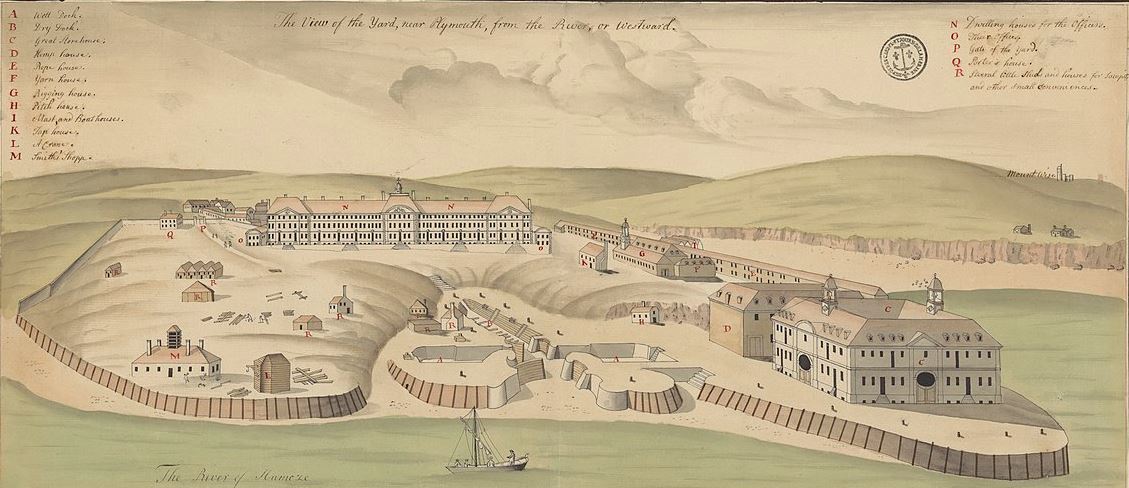
Many of us will find we have ancestors who worked in Royal Navy dockyards either in Britian or around the world. Most of these workers would have been civilian as opposed to Royal Navy personnel although officers at the yards were appointed by the Board of Admiralty. All the yards were initially under the administration of the Navy Board and controlled by a resident commissioner. Well into the eighteenth century, a Royal Naval Dockyard was often referred to as the King's Yard or the Queen's Yard.

During the seventeenth and eighteenth centuries, Britain had six important Royal Navy dockyards - Deptford, Woolwich, Chatham, Sheerness, Portsmouth and Plymouth. There were also a number of outports around Britain and at various strategic overseas locations including Bermuda, Malta, Gibraltar, Halifax, Den Helder in the Netherlands and Jamaica.

Principal dockyard staff

Each dockyard would have employed principal staff responsible for specific operations at the yard. The Master Shipwright, renamed Chief Constructor in 1875, was responsible for most of the workmen and for all ship construction and repair work. The Master Attendant managed the ships in the dockyard and oversaw the harbour and the maintenance of the ships which were laid up out of service and requring repairs; these ships were called ships in Ordinary.

They were supported by a number of clerks. The Clerk of the Cheque mustered the workmen and looked after payroll, journals and ledgers for all expenses and earnings. The Clerk of the Survey was effectively the store’s manager who was responsible for the receipt and issue of all materials. The master ropemaker was responsible for the ropeyard assisted by the Clerk of the Ropeyard; it was his task to muster the ropery workers and for the receipt and issue of stores associated with that operation at Woolwich, Chatham, Portsmouth and Plymouth roperies.

Various foremen known as inferior officers supported the senior officers. The number employed depended upon the size and capacity of the dockyard.

Significant changes in personnel and operation occurred after 1822 when the positions of Clerks of the Survey and Ropeyard were abolished, At the same time, the Navy Board was abolished, so all the dockyards came under the principal officers at the Admiralty. Resident commissioners were also replaced by a captain or admiral superintendent who were commissioned Royal Navy personnel. The various overseas dockyards and British outports, which generally had fewer facilities and personnel, adopted the same organisation, although most received their stores direct from the Deptford dockyard.

Royal Naval Dockyards in Britain

Portsmouth Dockyard

Portsmouth was the oldest yard established in 1495 and in active use during the reign of Henry VIII. It was the most important dockyard from the mid-eighteenth century onwards. There was then a period of neglect until the Civil War when permanent officers were appointed. Expansion continued during the Dutch wars and spasmodically until around 1723. The expansion and the transfer of naval operations to the Western approaches made Portsmouth strategically important. The Steam Basin, built after 1843 and the construction of docks and basins into the twentieth century allows the dockyard to remain in operation today.

Deptford Dockyard

This was the leading dockyard during the sixteenth century having been established in 1513 However, because the Thames was silting up by the eighteenth century, it could only be used for actual shipbuilding and as a warehouse distributing stores to other dockyards around the world and supplying the fleet when they were overseas. It was subject to a gradual shutdown from the 1830s and finally closed in 1869.

Woolwich Dockyard

Woolwich dockyard was established in 1512 and included its ropeyard, established in 1610 away from the yard. Although strategically important during the sixteenth and seventeenth centuries, it gradually declined because of restricted space and like Deptford was affected by the silting up of the Thames. By 1800 it was only used for fitting vessels built at Deptford or the refitting small ships. The ropeyard closed 1835 and the dockyard closed in 1869.

Chatham Dockyard

Chatham was established as a royal dockyard in 1567 and due to its strategic location on the Medway, it became an important naval yard during the Dutch wars. By the late 1600s it was the largest of all the dockyards. With the threat of invasion from France, the dockyards at both Portsmouth and Plymouth became more prominent; Chatham was not as important and, like the Thames, the river Medway had silted up hindering navigation. So the dockyard became a shipbuilding yard rather than undertaking refits etc of laid-up ships. In the 1860s St Mary's basin was constructed at Chatham for the steamships of the navy so when Deptford (and Woolwich) closed in 1869, Chatham regained prominence which remained until it closed in 1983.

Plymouth Dockyard

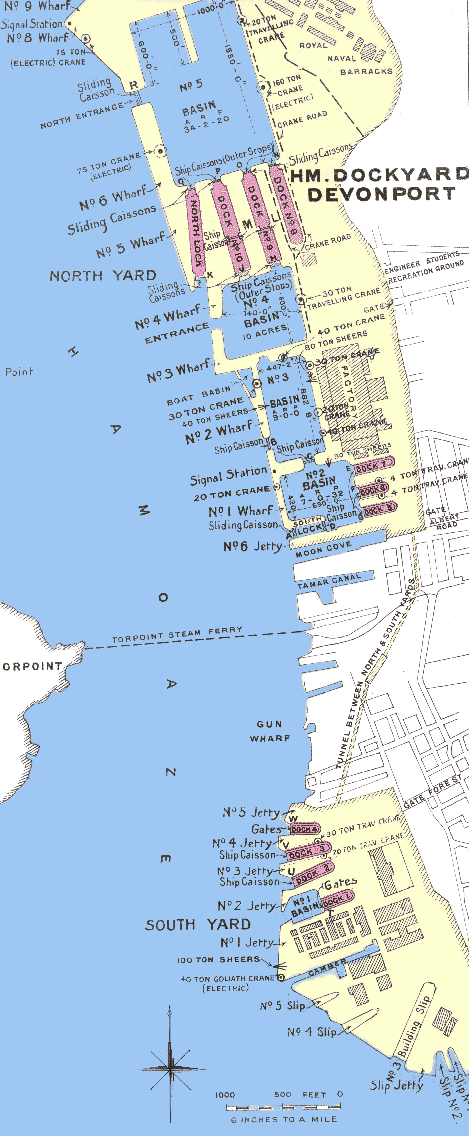
Since 1824 Plymouth dockyard has been known as Devonport but was originally established in 1690. During the wars of the eighteenth century, it maintained the Western squadron, but in peacetime it built and repaired warships. It was expanded to cater for steam ships in the mid to late 1840s with a later extension being constructed around the end of the nineteenth century.

Sheerness Dockyard

Situated on the Medway estuary, this dockyard was established in 1665 initially for storing and refitting ships. In 1720, after the second dry dock was built, its prime role was the building of fourth- and fifth-rate warships. The dockyard was remodelled between 1815 and 1826 with a steam yard added in 1854  and it remained operational until 1957.

Harwich Dockyard

This was another dockyard which so important during the Dutch wars; it served as a small refitting and storage base throughout the eighteenth century until it closed in 1829.  During World War I and II it was revitalised and used as a base for coastal forces.

Pembroke Dockyard

The dockyard was established in 1815 when equipment and personnel were moved from Milford Haven. In 1930, Pembroke dockyard ceased to be an active yard and was reduced to a naval store and fuel depot.

Kinsale dockyard

Established in 1647, this dockyard was a supply and repair base for the Royal Navy's Irish Squadron. The yard closed before 1812.

Harwich Dockyard

This dockyard was established in 1652 and was very active during the Anglo-Dutch Wars. It closed in 1713 although a small naval dockyard remained with refit and storage facilities until 1829.

Deal Dockyard

This was a small dockyard that provided basic repairs and supply facilities for ships at anchor nearby from 1672. The establishment closed in 1864.

Portland Dockyard

This dockyard was established in 1845 having been previously used only as an anchorage. The main purpose was to provide coal for the steam-powered ships. In the 1850s there were plans to expand it with the construction of dry docks and building slips, but this did not happen. The dockyard closed in 1959.

Royal Naval Dockyards around the world

Gibraltar Dockyard

The dockyard dates from 1704 when Gibraltar became a British possession and is still frequented by the Royal Navy today although it is now privately owned. At the start of the twentieth century, the dockyard was significantly expanded and modernised to include three dry docks The dockyard closed in 1984.

Halifax, Nova Scotia Dockyard

This dockyard was established in 1759 and served as the headquarters for the Royal Navy's North American Station for sixty years. It would have participated in various military campaigns including the Seven Years' War, the American Revolution, the French Revolutionary Wars and the War of 1812. In 1818 Halifax became the summer base for the squadron which shifted to the Royal Naval Dockyard, Bermuda for the remainder of the year. It continued to operate as a seasonal naval dockyard until it closed in 1905. The Halifax dockyard played a vital role in supplying masts and spars for the entire Royal Navy.

Jamaica Dockyard

From as early as 1675, a naval dockyard existed at Port Royal for the careening of ships. (Careening, also known as heaving down, was how a ship was titled to lie on its side so that the hull could be repaired or cleaned.) During the reign of Queen Anne, a hulk was also established there. In the early 1730s additional development and expansion took place; the dockyard's wharfage and storage capacity was also increased with coaling sheds added in the mid-1800s. The yard closed in 1905.

Antigua Dockyard

Antigua harbour was first used in 1671 as a hurricane shelter but its use as a naval dockyard commenced in 1725. The dockyard was extensively developed beginning in 1743. It became Lord Nelson's principal naval base in the Caribbean during the Napoleonic Wars. The use of the dockyard declined and it closed in 1889.

Bermuda Dockyard

The Royal Navy began work on the dockyard in 1809 The project involved land reclamation and the labour force, primarily comprising transported convicts from Britain, housed aboard rotting hulks moored there. The dockyard played an important part in Bermuda’s economy. It was from this dockyard that troops and Royal Marines set sail for the attack on Washington, DC and Baltimore during the war of 1812. The dockyard remained an important strategic base until the early 1950s and during both World Wars was used for repairs of about 600 warships.  Anti-submarine training was also undertaken in the dockyard area. The Royal Navy vacated the main dockyard in 1951 but was not officially closed until 1995.

Kingston Dockyard

This dockyard is located in Canada and was established in 1789. The site was expanded during the war of 1812. It closed in 1853.

Trincomalee Dockyard

This dockyard in Sri Lanka, formerly Ceylon, was established in 1813 as a careening wharf, with a capstan house and storehouse. It gradually grew but was threatened with closure in 1905. However, it remained in service and was headquarters of the Eastern Fleet during World War II. During the Napoleonic Wars, the Royal Navy took over Madras Dockyard established in 1796 and Bombay Dockyard established in 1811, both of which were formerly operated by the East India Company.

Hong Kong Dockyard

There has been a dockyard on Hong Kong since 1859. The base was later known as HMS Tamar; and it remained operational after the closure of the dockyard until just before the UK relinquished its lease of Hong Kong.

 Ascension Island Dockyard.

The dockyard and adjoining naval base was established in 1816. It included a victualling yard as well as a repair facility for the West Africa Squadron. A naval hospital was established on site in 1832, and new facilities for servicing steam warships were added in the 1860s. Naval activity had substantially decreased by the end of the nineteenth century, but the facility closed in 1922 - but it was revived for a brief time as a naval base during the Falklands War.

What was a dockyard like?

Depending upon their size, most dockyards had at least one dry dock for building ships and water docks used for fitting them out whilst afloat. As part of the early shipbuilding process, the dockyards also had a mast pond where lengths of well-seasoned timber were soaked before being used in shipbuilding. If the wood was not seasoned properly it would split in the salt water.

Up until c1574, naval dry docks were closed off at one end with a wall of mud, and when a ship was ready to be launched it took a number of men nearly a month to remove the mud wall in order to fill the dry dock with water. Flood gates were part of the dry dock system after 1574 making the filling with water and the launching of vessels much easier.

Each dockyard was a self-contained community of highly skilled civilian craftsmen; in order to function efficiently it needed storehouses for masts, rigging and storage barrels. Some dockyards had ropeworks where they made and supplied ropes for the rigging. There were also engineering, carpentry and joinery workshops, sailmakers' workshops together with residential housing for the dockyard officers families.

In order to build a warship, some 140 men were needed covering all sprts of trades -  labourers and skilled craftsmen including caulkers, joiners, carpenters, riggers and sailmakers.

Regular hull maintenance was vital so a ship's wooden hull would be inspected and repaired every two to three years and its copper covering replaced at regular intervals. Where there was no nearby dock available, ships would sometimes be careened - beached at high tide to enable hull maintenance work to be undertaken.

During routine maintenance, sailors were not quartered ashore and they were expected to live on board the ship. When a ship was decommissioned at the end of a voyage, the crew were dismissed or transferred to other vessels. If a vessel was undergoing a refit or repair, her crew was usually accommodated on a commissioned dockyard hulk moored nearby.

Ships' guns, weaponry and ammunition was provided by the Board of Ordnance which established Ordnance Yards alongside the Royal Naval Dockyards both in Britain and abroad. The Victualling Board established victualling yards in some dockyards supplying warships with their food, beer and rum. In the mid-eighteenth century the Sick and Hurt Board established naval hospitals close to many of the naval dockyards in Britain and overseas.
Records of dockyard workers

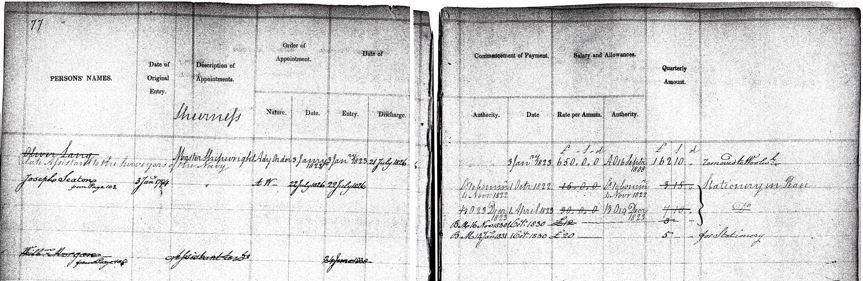
The majority of dockyard workers were civilian employees. The surviving dockyard workers' records tend to be pay and pension records and dockyard muster books, the latter only existing until the mid-nineteenth century. Throughout their career, some men such as shipwrights worked both in the dockyards and on periodically on board ships, so you should also look for records of individuals in Royal Navy service records if gaps appear in dockyard records.

Most records are arranged by dockyard, so you need to know which dockyard your ancestor worked at. There are some gaps in the records so not every yard has records covering every year of their existence. Some dockyards also changed their name so you may need to search using the alternative names or by the dockyard locations.

In the records of pay, the following terms appear: Ordinary refers to the permanent staff who were paid salaries including senior officers, the inferior officers, established artificers and labourers of the yard. Extraordinary refers to the payment of casual employees who were employed only when needed such as during the war period.

Because no muster books survive after the mid-nineteenth century, you will need to consult salary and pension records for dockyard workers after that period. These records could be in various series held at the National Archives ADM 23 (1830-1926), ADM 7 (1857-1914), PMG 24 (1836-1918) and PMG 25 (1836-1928).

There are often separate records, from before 1832, for the various trades within the dockyards including: Shipwrights, coopers and labourers in series ADM30, and caulkers, coopers and ropemakers in series ADM6. One other valuable record to research is the registers of protections from being pressed, 1794-1815 in series ADM 7.

This article was contributed by Ian Waller from Family History Federation.
Website by Beachshore