




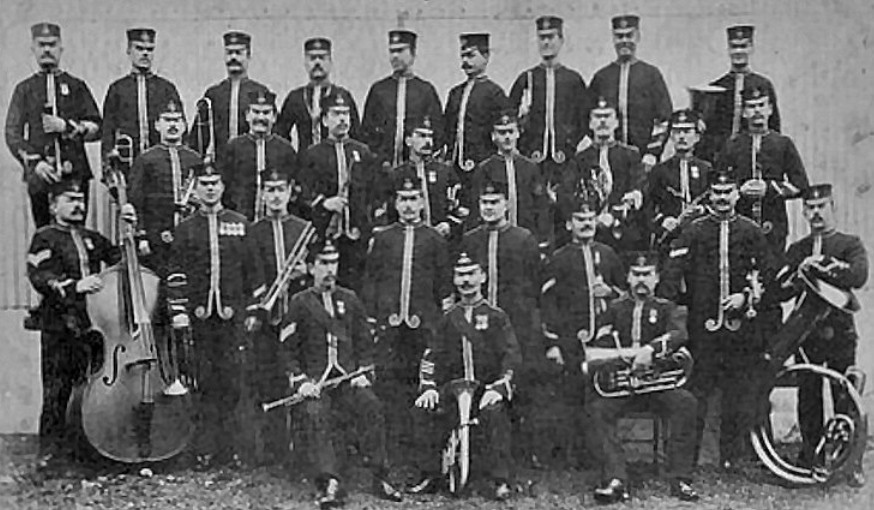
The Royal Marines (Britain’s Sea Soldiers) have always been an integral element of Britain’s armed forces. There origins date to 1664 when the Admiral's Regiment of around 1,200 men was raised and sent to His Majesty's Fleets to be prepared for sea service. . However, it was not until 1694 that two marine regiments were formed, and from then on soldiers were recruited exclusively for service at sea. Initially they were employed at sea to fight the Dutch.

Like other navy records, the service records of the marines are generally complete thus providing a rich resource for family historians.

The role of the Royal Marines

Right from the start it was intended that the marines would combine the role of infantry soldier and seaman. Initially, marines and the existence of their regiments depended on the wartime needs. The Royal Marines were soldiers based on Royal Navy ships but they were also deployed on land as an assault force which resulted in some famous actions including the capture of Gibraltar from the Spanish in 1704. In the early period of their existence, there were two periods when they were disbanded: between 1713 and 1739 and between 1745 and 1755. Since then, the Royal Marines have been a continuous establishment.

The early marine regiments were under the control of the Board of Admiralty when afloat, but the Corps of Marines from 1755 was under overall control of the Board. The corps did not form into a regiment but was organised into companies, within three divisions or depots. The corps became the Royal Marines in April 1802.

The three divisions were established at Chatham, Portsmouth and Plymouth, with a later division established at Woolwich in 1805 which only existed until 1869. Each of the divisions consisted of several numbered infantry companies. Their locations can be ascertained in the Navy List and by looking at the lists of officers in series ADM 192 at The National Archives. Artillery companies were introduced in each division in 1804 and in 1862 these were amalgamated into the Royal Marine Artillery which had its base at Portsmouth. The Royal Marines Depot, Deal was also established in 1862. The infantry companies became the Royal Marine Light Infantry in 1855. Both the Royal Marine Artillery and Royal Marine Light Infantry became a single corps called the Royal Marines in 1923.

The Royal Marines Light Infantry wore red uniforms and the Royal Marines Artillery had blue uniforms, but despite this distinction they served alongside each other and for the family historian service records are archived together.

The men of Royal Marines Light Infantry formed the majority of those deployed on a ship. Whilst on board they helped to maintain discipline among the crew, guarded the ship against attack; they also guarded the captain’s cabin and the ship’s munitions stores. They were also deployed as a formal armed escort when disciplinary measures and courts martial were required. Before 1923 when both divisions merged, the Royal Marines Light Infantry were firearm experts whereas the Royal Marine Artillery were gunnery and explosives experts, but in practical terms their roles overlapped, particularly in times of war. The number of Royal Marines on board a Royal Navy ship depended on the size of the ship and was normally one marine per ship gun, plus officers. In context this meant that a First Rate Ship had 104 marines while a 28-gun frigate had twenty-nine.

Royal Marines Bands

The Royal Marines Band Service is the musical division of the Royal Navy and its headquarters were first in Portsmouth then in Deal from 1930. There are currently five bands and the Royal Marines School of Music is based at HMS Nelson. The development of Royal Marines music is linked with the growth of British military bands generally. Royal Marine drummers were mentioned as early as 1664 at the formation of corps.

In 1767 Royal Marines Divisional Bands were formed at Chatham, Plymouth, Portsmouth and Deal. Marine bands and their corps of drums provided music on board ships during the Napoleonic Wars.  In 1903 the formation of the Royal Naval School of Music was given to the Royal Marines and it was from that point onwards that the Band Service became an integral part of the Royal Marines.

Royal Marines service records

As a result of the Royal Marine affiliation to the Royal Navy, and also their control by the Admiralty, some of the records which will relate to Royal Marine service can be located within the records of the Royal Navy. Under the Admiralty, record keeping was comprehensive and detailed. The following relate specifically to researching records of service. Pension records, ships musters etc. are not part of the Royal Marine exclusive records. Royal Marine records are extensive and generally complete. The majority of Royal Marine records are held by The National Archives at Kew with some being available online. The most important single document you can find for a Royal Marine is his service record. You can search for and download these from The National Archives website up to c1925.

Royal Marine records - other ranks

There are three series of records available to research the career of a Royal Marine. But they are all arranged by division so it is essential to know in which division he served.

There are certain strategies to be employed to establish the division if this is unknown.

Medal entitlements.

The name of a ship he served on. Prior to 1947 marines who served on board a ship came from the same division as the home port of the ship.

If you have a company service number (and a date) consult the tables of allocation of Company Numbers to Divisions available at The National Archives.

If your marine was a war casualty during either World War, consult the war graves roll.

If an address is known where a marine lived, he may well have joined, or be serving with, the nearest division as he would have been resident within the division's catchment area.

Attestations (ADM157) 1790-1925

Royal Marines attestations have not survived before 1790 although from 1750 onwards, they were summarised in the description books. These documents give birthplace, previous occupation, physical description and often a record of service. They are filed either by date of enlistment or discharge.

Most genealogical information is in the upper section of the record including date of birth, next of kin, address, prior occupation, physical description, and if relevant the date of marriage. The remainder of the information relates to where served, promotions, conduct, training, medals, wounds and date of discharge or death. These records are partially indexed in ADM313.

Description Books (ADM158) 1755-1940

The description books are a type of register giving the date and place of enlistment, age, parish of birth, previous occupation, physical description, promotions and whether injured or killed. Information was usually compiled from attestation papers. They are organised by company within a division and then by initial letter of surname or by rank. These records contain information from attestation forms which may well have been lost.

Records of Service (ADM159) 1842-1936

These service records are arranged by division and then by service number. They provide a marine's date and place of birth, trade, physical description, religion, date and place of enlistment and a full record of service with comments on his conduct. Use ADM313 in order to locate a marine’s service number.

The Registers of Service Indexes covering 1842-1925 can be searched on Ancestry.

Royal Marine campaign medal rolls (ADM171) 1793–1995

The campaign medals for Royal Marines can be searched on Ancestry.co.uk which is useful for a complete listing of all Royal Marines who served in the First World War. It also has service details for a large number of men.

Registers Royal Marine marriages (ADM183 and ADM184)1830–1920

Marriage registers by name for marines who served in the Chatham Division (ADM 183) and Portsmouth Division (ADM 184) can be searched on findmypast.co.uk You may also find details of births and deaths of the children of marines.

Royal Marine records - officers

In many cases the records of a Royal Marine officer are included within the general records of the Royal Navy officer records and are included in the Navy Lists.

Officer records of service (ADM196) 1793-1925

The records contain similar information to other ranks' service records but uniquely can name a man’s wife. Importantly they also show assessments of an officer’s ability and conduct. The records are not complete until around 1837. They can be searched by name within the Discovery catalogue of The National Archives and cover both commissioned and warrant officers.

Until the late nineteenth century, the records are basic containing only the officer’s name, rank, ships on which they served with dates of admission and discharge from each ship and possibly a death date. From the late nineteenth century, they also give birth information and next of kin.

You can also trace the outline careers of officers by searching successive editions of the Navy List, which can be searched online at www.navylistresearch.co.uk

For officers serving before 1793, there are no original service records but later official publications may provide information about a commission or appointment. Army lists also includes names of Royal Marine officers on full and half pay.

There are also Seniority List of Officers of the Royal Marines (ADM192 or ADM118 depending on time period) from 1757 to 1886 which may can also be searched.

The First World War

Relevant to family history research, in addition to Royal Marines serving aboard ship, they were also part of the Royal Naval Division serving on the Western Front. The first two commanders of the division were senior Royal Marine Artillery officers. Royal Marines were also present at other First World War land campaigns.

Royal Marines Museum

As well as the wealth of records for Royal Marines held at The National Archives, the museum archives include manuscripts, documents, diaries and administrative papers, many of which date to the eighteenth century. The museum also holds a valuable collection of photographs, Navy lists in a complete run from 1783 and information on uniforms worn by marines.

Looking for service records of Royal Marines after 1925?

You can apply for a deceased marine's service record post-1925. Apply online www.apply-deceased-military-record.service.gov.uk but you will need to provide full name, birth date, service number and if possible supply a death certificate for an unredacted copy of the record. Those who served during the Second World War had the option to take their service record with them on discharge, so these may well be within you own family archive. In any case, they will not be available through the government service.

This article was contributed by Ian Waller from Family History Federation.
Website by Beachshore