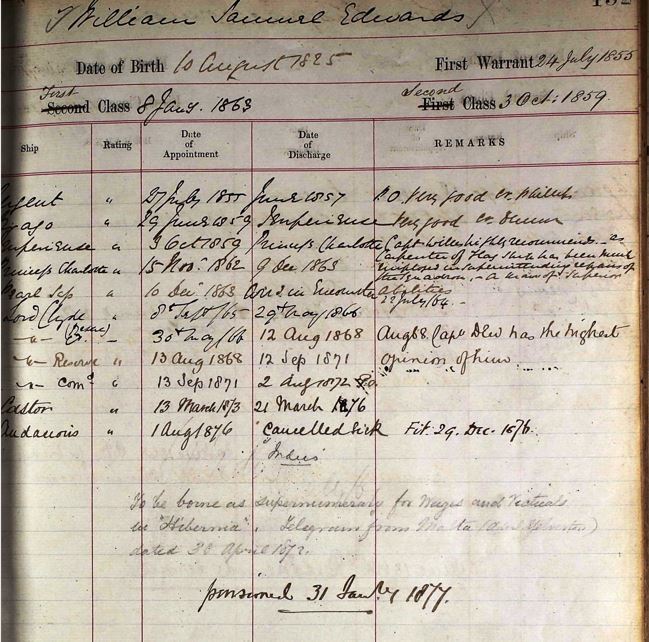
Warrant officers hold the King's Warrant; they are not saluted as they do not hold the King's Commission. They are addressed as Sir or Ma'am by NCOs and lower ranks but commissioned officers address warrant officers either by their appointment - sergeant major - or as Mr. followed by their surname - Mr Jones. All branches of Britsh armed services had warrant officers.

Some experts have said that without warrant officers, it is unlikely that the Royal Navy could have retained its supremacy at sea.  Warrant officers were in a class of their own who uniquely reported direct to the captain of their ship because they were in charge of specific branches of the ship’s company. As such, their role on board ship and ashore was vital to the smooth running of any operation. 

They also reported to the specific naval board which governed their roles. They held a warrant from the Board of Admiralty after having served an apprenticeship and/or undergoing examination.

The term warrant officer dates from the thirteenth century at a time when ships were commanded by noblemen with only some military experience and who therefore depended on those with specialist skills of warrant officers to manage the running of the ship. The ship's master and other warrant officers were experts in the technical aspects of running the ship, vital to the safety of all on board. The warrant officer rank and status was abolished in 1949 only to reappear in a slightly different guise in 1973.

One essential element of running naval ships related to the guns and cannons carried on board. Commanders needed gunnery experts and the first to be employed were warranted gunners in the early sixteenth century. Thus began the specialist roles. Most warrant officers in those days were literate - which distinguished them from the ordinary sailors - and Admiralty regulations stated that no person shall be appointed to any station unless he can read and write and is sufficiently skilled in arithmetic.

The role of warrant officer evolved as technologies advanced; there were five standing warrant officers assigned to each ship, namely the boatswain, gunner, carpenter, purser and surgeon. They were supported by inferior warrant officers who were senior ratings.

In the nineteenth century some warrant officer ranks transferred to commissioned ranks, and with the advent of steam power and the new branch of engineering required, this provided even more opportunity for men to hold a warranted rank.

Warrant officers were those privileged to share the wardroom and quarterdeck with the commissioned officers and those who ranked with more junior members of the ship's crew. Somewhere between the two were the Standing Officers; they remained with the ship, even when it was out of commission for repair, refitting or when laid up. In such cases they were under the pay and supervision of the Royal Dockyards.


What role did each warrant officer have?

Master – He was not a standing officer but held the senior warrant rank equivalent to that of lieutenant. The master was professionally examined by Trinity House and had to be re-assessed each time they were posted to a different rate ship. In the mid-nineteenth century, their rank was fully integrated into the commissioned officer structure. The master’s main duty was navigation. He had a direct supervisory role for midshipmen and mates in navigation and was responsible for the ship's compass, the maintenance of the rigging and sails, stowing of the hold, reporting fabric defects to the captain, the issue of rum to the crew and entering information about weather and expenditure in the ship's official logbook.
Surgeon - All surgeons were warranted by the Navy Board. Up to 1832. Their examinations were normally conducted by the Barber-Surgeons' Company. After 1832 the Admiralty supervised the examination process. There was only one surgeon appointed to each ship, irrespective of its size, but he was assisted by one or more surgeon’s mates who were inferior warrant officers. The rank of surgeon became a commissioned officer rank in the mid-nineteenth century. They were responsible for all health matters on board, the treatment of the sick and injured irrespective of status, the dispensing of medicine and performing surgical operations. They also kept highly detailed medical journals.
Purser – These men were warranted by the Admiralty but did not require any examination or professional qualifications. In exchange for their warrant, a financial surety was deposited. Their role was to oversee the supply and issue of victuals, clothing and consumables. In the mid-nineteenth century the rank was commissioned and also had the responsibility for payment of victuals and wages to the crew. The purser was responsible for the compilation of the ship's pay lists and musters.
Boatswain – This was one of the oldest ranks dating back to medieval times. A boatswain (pronounced bos'un) was appointed by the Admiralty and was initially responsible to the navy board. His responsibility was for the rigging, sails, boats, anchors and all cabling. In most cases they were less educated than the other warrant officers and the rank never achieved commissioned status. The ship's sailmaker and boatswain's mate worked under the direct command of the boatswain.

Carpenter – These men were responsible for the maintenance of the timber hull and masts of the ship. Many initially qualified as civilian employees of the Navy Board working mainly in the dockyards and only periodically on ships. Most carpenters served apprenticeships and qualified as shipwrights in the dockyards before going to sea. In 1918, they were renamed warrant shipwrights when they ceased to work solely with timber.
Gunner – This rank can be traced back to the fifteenth century and as the name suggests, these men were responsible for the maintenance of guns, their equipment and ammunition. They were appointed by the Navy Ordnance Board to whom they were responsible and who reassessed the gunner periodically. Gunners also made tackle and breeches for guns and had to ensure that the gunpowder on board and in magazines was kept in accordance with strict Admiralty regulations. They remained a warranted rank. In the 1880s other specialities were added such as torpedo gunners and those involved with mines, depth charges and other similar devices.
Engineers – In the early days of steamships, the naval engineer was only employed by the firms that actually built the ship's engines. Engineers were first introduced in 1837 and it was another ten years until they became warranted and later joined the commissioned ranks. As advances were made in tehnology, engineers developed their skills with many becoming specialists in various new engineering disciplines. 
Master-at-arms – This was an Admiralty-appointed warranted rank. The master-at-arms was responsible for discipline and training petty officers in the use of small arms. When the Royal Marines were established, the work previously done by the master-at-arms  diminished and eventually transferred to the Royal Marines. In the early nineteenth century the rank became that of a petty officer. His role was later taken over by the Royal Navy provost.

Inferior officers

Petty officers in the Royal Navy were seamen who had been rated to fill a particular specialist trade on board ship. They had a certain technical skill maybe or perhaps were a little higher educated than some other seamen - for this they were rated. It was the rating which set petty officers apart and the class he belonged to was determined by this title.
Chief petty officer - The following ranks were all petty officer. Master-at-Arms, chief gunner's mate, chief boatswain's mate, chief captain of the forecastle, Admiral's coxswain, chief quartermaster, chief carpenter's mate, schoolmaster, steward and cook.
Petty officer 1st class - Ship's corporal, gunner's mate, boatswain's mate, captain's coxswain, corporal of the forecastle, qartermaster, yeoman of signals, coxswain of the launch, captain of main and fore tops, sailmaker, ropemaker, carpenter's mate, caulker, blockmaker, armourer, leading stoker and sick-berth steward.
Petty officer 2nd class - Coxswain of the barge, coxswain of the pinnace, corporal of the mast, sailmaker's mate, coxswain of the cutter, cooper, caulker's mate and sickberth attendant.
Chaplains – In 1626 chaplains were officially included on each ship under a decree form Charles I. No person could be appointed a chaplain unless they were thirty-five years of age and ordained in the Church of England ministry. Chaplains were examined by the Bishop of London and appointed by the Admiralty. Up to 1843 they were warranted, but from then on they became a commissioned rank, which from 1859 included four classes of chaplain. Chaplains were eventually appointed from all denominations.
Cooks – From 1838 onwards cooks were ranked as petty officers. They were often disabled seamen and in many cases had no formal training or apprenticeship. From around 1740, their main responsibility was to ensure that meat was stored properly and to prepare food for the ship's company. There was usually more than one cook on board ship depending upon the ship's crew size.
Schoolmasters and instructors – This rank was established in 1702 and was frequently given to a midshipman. Initially qualification was by examination through Trinity House but in 1819, the responsibility for qualification came under the Royal Naval College. Schoolmasters and instructors became a warranted rank in 1836 and later in 1861 became a commissioned rank subject to seniority. The rank temporarily vanished in the early twentieth century but was reinstated after the First World War as an executive officer known as instructor.

Other inferior warrant officers included surgeon's mates, boatswain's mates, carpenter's mates, sailmakers, armourers and clerks.

Midshipmen

The rank of midshipman originated during the Tudor period but the first use of the term midshipman did not occur until 1662. The term originated from the mid-ship's area where they worked or were berthed. Midshipmen were senior petty officers waiting to become commissioned officers. Midshipmen have never held commissioned status. The rating of a ship determined the number of midshipmen allowed in the crew; however, the Navy had a supply/demand problem. Basically there were too many men seeking a lieutenant's commision and too few positions to full. So, the supernumerary post of midshipman was created. Although the possible number allocated to a ship was determined by the Admiralty, the actual number of midshipmen taken on board was at the vaptain's discretion. During their period as midshipmen, they undertook instruction in seamanship.

By the eighteenth century four classes of midshipman existed based upon the ordinary or the extraordinary. Most midshipmen were officer candidates who failed the lieutenant examination or were passed over for promotion. By 1794, all midshipmen were considered officer candidates and the original rating was phased out.

By 1661, young men who wanted to become officers were sent by their families to serve on ships as midshipmen with a letter of service from the crown. The context of the letter was to instruct captains that the bearer of the letter was to be... shown such kindness as you shall judge fit for a gentleman, both in accommodating him in your ship and in furthering his improvement. They were referred to as King’s Letter Boys. From 1677 those promoted to lieutenant had to have served as a seaman or midshipman which required compulsory sea service of at least six years and for which information is included on their subsequent passing certificate.

Around half of the midshipmen were sons of other naval officers or of professional men. The remainder who became midshipmen were of artisan or working-class backgrounds who frequently suffered because their chances of promotion to lieutenant were slim due to competition from the upper classes.

Many midshipmen with family naval connections exploited this advantage and had their names included on ships' musters without actually serving on the ships! This practice was known as false muster which enabled them to be promoted to lieutenant without having completed the requisite sea service.

Attributes of warrant officers

The attributes of the warrant officers meant that they were not fighting officers per se but it was thier responsibility to prepare the ship's crew to fight successfully; the ship always had to be in a high state of readiness. Ships had to be fit for purpose, well maintained and ready for battle, as well as being in the right place at the right time, bviously. As such, standing warrant officers were attached to the ship throughout its life, whether it was in commission, or in ordinary (laid up).

It took some years for the navy to build up a force of specialists and the process continually evolved and changed; the most significant change was just prior to the First World War when the King's Regulations and Admiralty Instructions 1913 defined the extent to which the warranted ranks structure existed for duties both at sea and on shore.

Warrant officers had their own specific journal the Naval Warrant Officers’ Journal which was published between 1888 and 1949 covering all aspects of navy life, both anecdotal and factual as well as detailing promotions and Admiralty orders. Some editions are held by both the British Library and the National Royal Navy Museum at Portsmouth. Unfortunately, there does not appear to be a complete run of the journal.

Researching Royal Navy warrant officers

Certificates of Service can be searched online at Ancestry.co.uk for the period 1802 to 1894 if they applied for a pension. Few individual records exist before this time.

If this search proves negative, then the records in series ADM196 at The National Archives should be consulted. These records cover those joining between 1830 and 1931 but they are not complete. For warrant officers this series includes some records for gunners, boatswains, carpenters, masters before 1808, surgeons, chaplains and pursers before 1843 and engineers before 1847. Until the late nineteenth century, these records are basic but after c1855 can include important genealogical data such as date and place of birth and details of next of kin.

Officers’ Service record cards can be found in class ADM340 at The National Archives. These are incomplete and cover c1840 to the end of the First World War; they mostly relate to commissioned officers, but there are cards for standing warrant officers. If a card exists for your ancestor, then the details provided include name, date and place of birth, rank, training undertaken, names of ships served on, dates of joining and discharge and home address.

Official Navy Lists - Warrant officers appear in the official navy lists which exist from 1814 to date. There are various online collections The National Archives, and National Maritime Museum have a good run of originals.

Warrant Officers’ Surveys  At the end of the Napoleonic Wars periodic surveys of warrant officers were carried out to see who were the most capable men to retain in service as this was a time when it was necessary to reduce the establishment. The surveys are a valuable resource but some were never returned by individuals and some were lost. The surveys are in series ADM11 at The National Archives and cover the following groups:

  • Masters 1822, 1833-35, 1851, 1855 and 1861
  • Gunners, boatswains and carpenters 1816-18
  • Pursers 1836 and 1852
  • Chaplains 1833-34
  •  

Other resources are avaiable; information about warrant officers can be found in other navy records including ships' musters, pay lists and description books, registers of pensions and allowances, half-pay records, naval dockyard pay and establishment books, and many of the operational records of the Navy.


Warrant Officer importance

Warrant officers in the Royal Navy held important positions on any ship and as such, most had very interesting careers. So if you have a warrant officer in your ancestry who served in the navy, researching them can prove extremely useful and often reveal more than you expect!

Warrant officers in all branches of the military are held in very high regard by commissioned officers and lower ranks alike. They were as revered as they were feared and they held special standing wherever they were stationed! Some say that without warrant officers, no ship would have been ready to fight and our naval supremacy could have been severely weakened.

This article was contributed by Ian Waller from Family History Federation.
Website by Beachshore