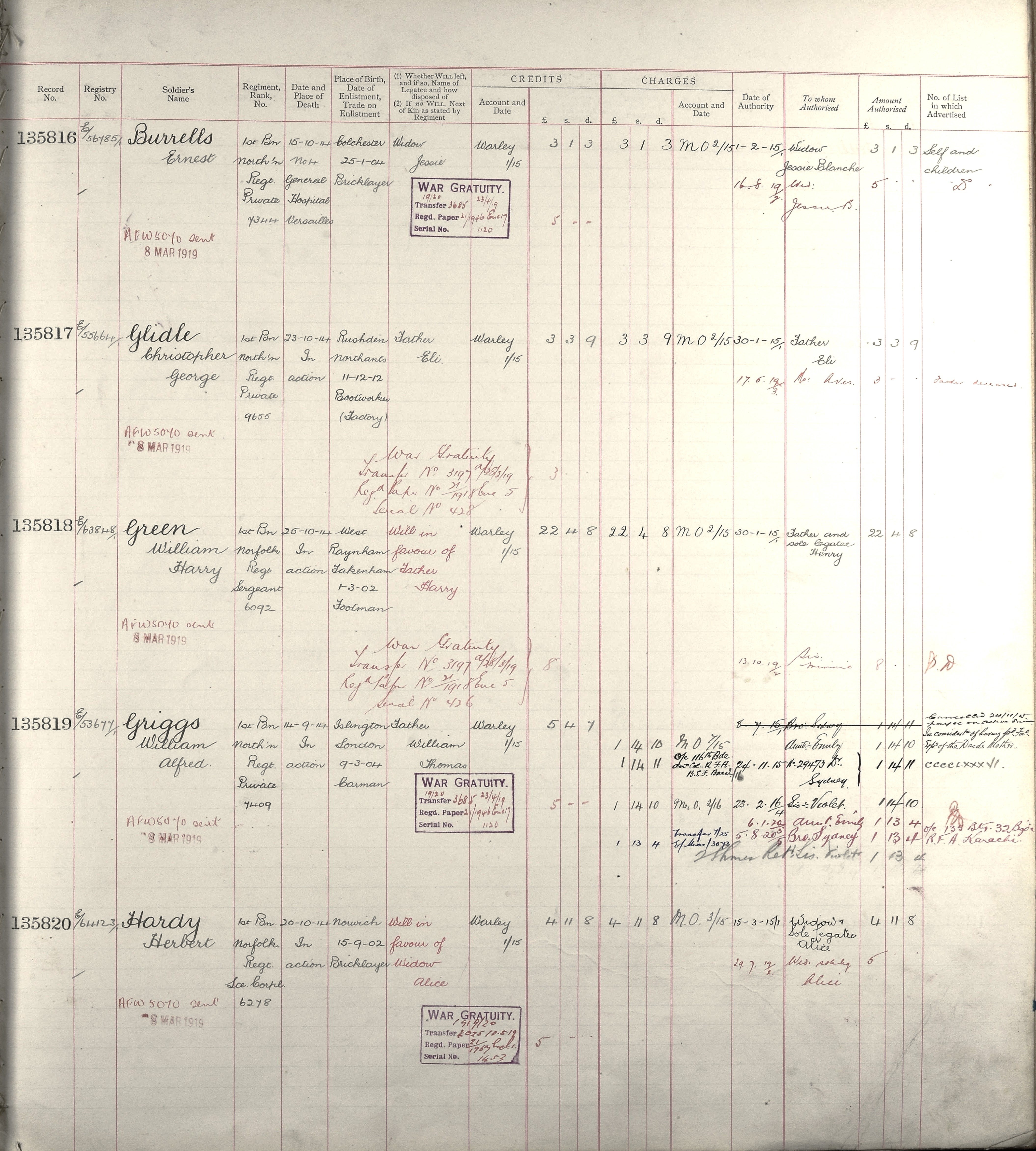





Each entry contains basic military details including:
- Name
- Regimental number (at the time of death)
- Rank
- Regiment and battalion
- Date and place of death (if the death occurred in a hospital gives the name of that hospital)
- Circumstance of death (usually listed as killed in action or died of wounds).
Some entries relating to events before the First World War, and in the early period of the war, also list the soldier’s place of birth, enlistment date and trade before enlisting.
You may well find the next of kin listed as ‘himself’ which usually relates to soldiers who were discharged because of psychological disorders. However, if the soldier was considered fit enough, they would have received a direct payment; if no,t it was normally paid to a relation or, if undergoing treatment for a disorder, it was paid to the institution to hold until the soldier was fit enough to administer his own affairs.
Some entries contain information of more than one next of kin and usually indicates that each corresponds with a payment. Entries written in blue relate to pay owed at the time of his death and those written in red to the war gratuity paid once the war was over.
Entries may also detail a soldier’s specific place of death. This is more likely to occur when someone died of wounds. The entry in the Soldiers’ Effects Records will normally show where they died of wounds - in a specific hospital, a Casualty Clearing Station or as a prisoner of war. Such information may not be recorded in a service record or other military correspondence.