Most of us will begin this element of research when a soldier is identified in common genealogical records or family stories lead us down this trail. Basic information such as full name, date of birth, approximate period of service and a service number will be needed to mkr progress on your research and can be found from many digitised military records.

Researching a former soldier requires piecing together information from a variety of different sources and is dependent upon surviving records. For some soldiers, little or no information is available. It is also important to establish whether your ancestor was an officer or “other ranks”.

These records are incredibly valuable because they track all soldiers, unlike many other War Office records that only survive for men who received an army pension.

Regimental musters

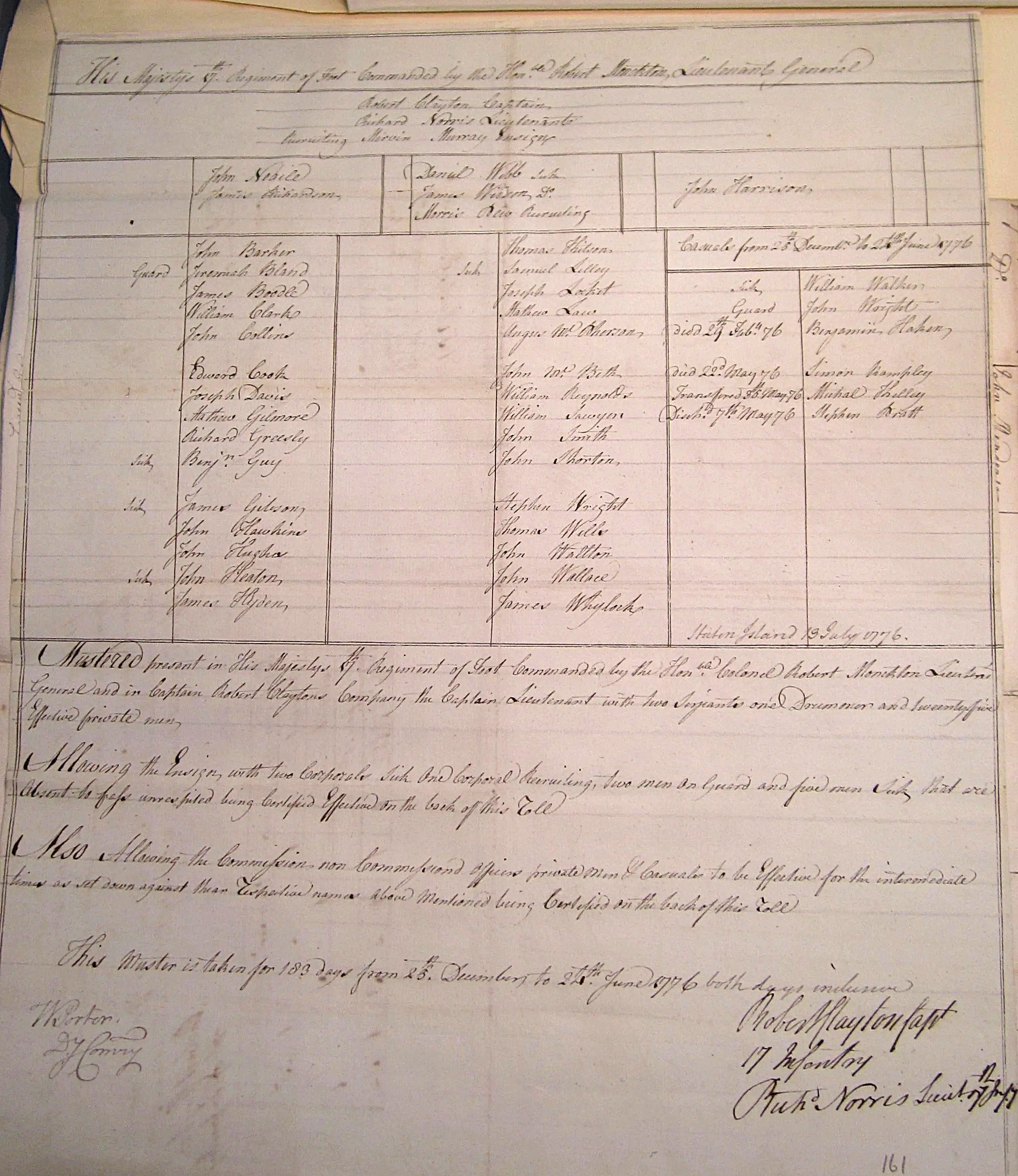
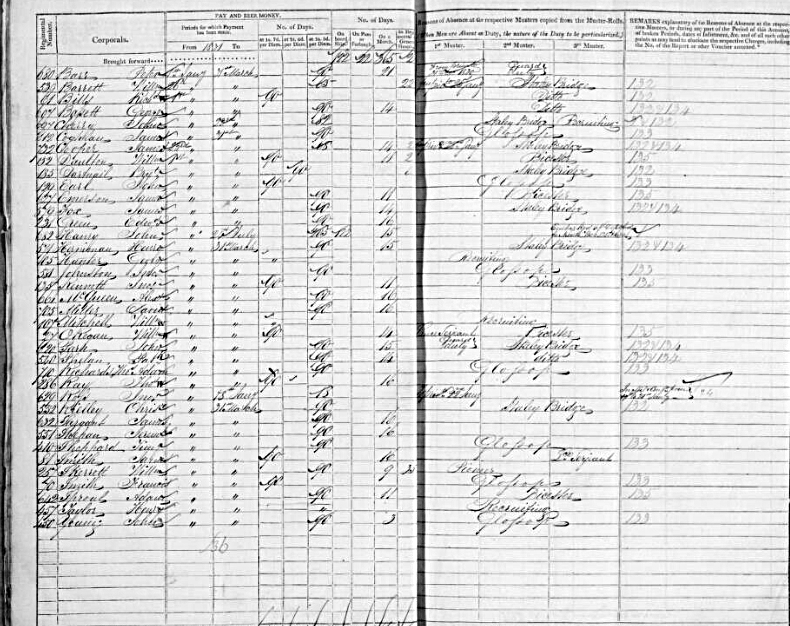
Regimental musters are a record of the presence of each soldier in a particular unit and record the reasons for a soldier’s presence and absences such as illness or serving time in prison. The corresponding pay lists also show the soldiers present at a unit together with their pay details and other allowances. The lists are arranged by regimental number or rank and then by the soldiers’ surname, usually alphabetically. Using both musters and pay lists, it is possible to build up a picture of the full career of a soldier. They span from roughly 1730 to 1898,

From the early eighteenth century, regimental musters were produced monthly or quarterly for pay and accounting purposes. The regularity of keeping musters depended upon the period. Musters and pay lists, were effectively the main everyday service records of men in active service. They are particularly essential sources when a set of attestation and discharge papers cannot be found.

All muster rolls and pay lists contain the following information:

  • enlistment dates
  • movements
  • discharge dates.
  •  

From 1868 to 1883 there may be quarterly lists which contain details of ‘men becoming non-effective’. In other words, leaving the military. These can be found at the end of each quarter and provide the following information:

  • birthplace
  • trade
  • date of death or discharge.

Musters and pay lists before 1878

Between 1732 and 1878, the records for household troops, cavalry, guards, infantry, special regiments and corps, colonial troops, foreign legions and the regimental, brigade and other depots can be found in TNA records series WO12 known as the General Series.

Musters for the Artillery between 1708-1878 are in series WO 10, WO 69 or WO 54. Use the Discovery catalogue to identify which set of records covers where your ancestor served.

If your ancestor was in the Royal Corps of Sappers and Miners, or from 1856 the Royal Engineers between 1816-1878, then the musters are in series WO 11 or WO 54.

Muster for British troops sent to the Scutari Depot during the two years of the Crimean War 1854-1856 are in a separate series WO 14.

Musters and pay lists from 1878 to 1898

Between 1878 and 1898, all muster rolls and pay lists are in series WO 16 irrespective of army division which makes research more straightforward. However, from 1888, only muster rolls exist as pay lists were no longer maintained.

You may also find a decline in the number of musters up to 1898 as from that date, the War Office no longer maintained them. There may be some challenges associated with using documents in series WO16 as a result of the Cardwell and Childers re-organisation of the Army from 1881.

The Childers reforms of 1881 led to major changes within infantry regiments. Infantry regiments, which until this time had been identified by numbers (e.g.41 Foot) were known as county regiments. Some original foot regiments were paired together to form the new county regiments. Each ‘new’ regiment had two battalions and all infantry regiments were placed into numbered regimental districts. To find the relevant regimental district numbers, use the key found in the record summary of WO 16.

After 1880, most volumes include several organisational tables at the beginning; these show the line infantry regiments with their pre-1881 designations and include their militia and volunteer battalions. The old regimental numbers of the 2nd battalion are also given for ease of identification when trawling through the earlier musters.

British regimental districts organized the infantry into local territorial areas to strengthen recruiting ties between specific counties and regiments.

Initially, sixty-nine districts were created, focusing on strengthening the links between regiments and their assigned areas. Regimental Districts acted as the administrative centre for records and recruitment, and they are often identified by a number or letter.


Description books

These books give a description of each soldier - his age, place of birth, trade, physical description and service - and can be found in series WO 25 which can be searched by regiment using Discovery.

The description books are in alphabetical order by soldiers’ names and cover the period 1756 to 1900, although for many regiments the volumes only cover up to the first half of the nineteenth century. Description books for depots cover the period 1768 to 1908, and are found in series WO 67.

If your ancestor was in the Royal Artillery, the description books cover 1749 to 1876 in series WO 54 and WO 69, the latter of which includes books for the Royal Irish Artillery. Description books for sappers and miners covering the period 1756-1833 are also in series WO 54.

Marriage rolls

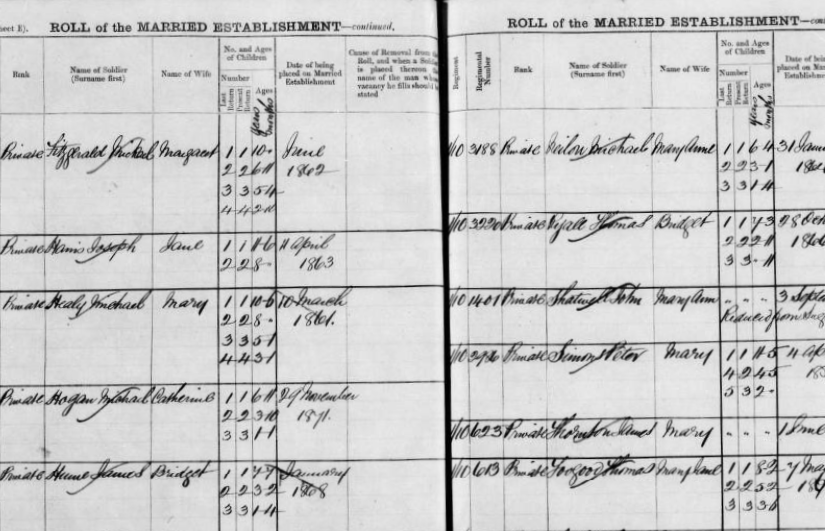
Sometimes musters covering the same time period may give details of marriage, From about 1868 onward, these include details of wives and children who were occupying official married quarters.

Drunkenness

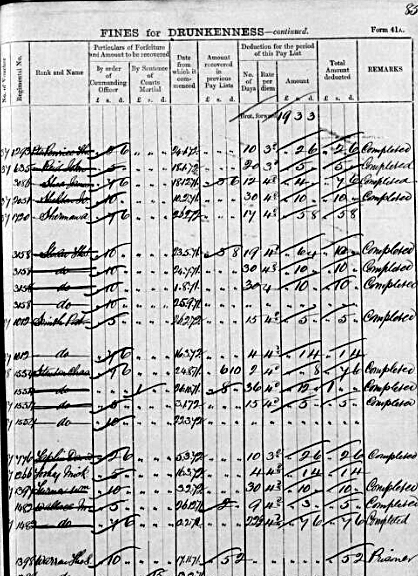
Fines and forfeitures for drunkenness were standard disciplinary measures in the British Army, and they were formally recorded in Regimental Muster Books and Pay Lists to track deductions from a soldier’s daily wage.

During the Victorian era, drunkenness became a major focus of military administrative reform. Under the Army Regulations of the late 1860s, and the subsequent Army Act 1881,  Commanding Officers were given summary powers to issue fines specifically for drunkenness; this action bypassed the need for a court martial.

Drunkenness offences could also result in the loss of "good conduct pay".  A single entry in the Regimental Defaulter's Book often triggered an automatic forfeiture of this pay.

Researching muster rolls and pay lists

For research purposes, there are two classes of document covering up to 1878 and the twenty years from 1878 to 1898. After 1898 there are no musters. All surviving records can be searched at The National Archives, some being online.

Unlike individual service records, which were only preserved for soldiers who qualified for a pension after 1760, musters and pay lists span the entirety of the regular army. Because these lists were taken every month or quarter to authorize pay, they provide a continuous log of a soldier’s presence or absence in a unit. Information would be recorded if a soldier was present, absent, sick, detached or had deserted. Pay accounts and records of deductions for equipment or hospital stays were also included.

Useful records to research

Different series cover different branches of the army and other corps.

WO 10, WO 11, and WO 12: Regular infantry and cavalry muster books and pay lists.

WO 13: Militia and Yeomanry pay lists.

WO 14: Royal Artillery and Royal Engineers musters.

WO 68 and WO 69: Royal Artillery non-commissioned officers and other ranks

They are formed into annual volumes for each regiment and, apart from a small collection available on ancestry.co.uk around the time of the Napoleonic Wars are originals, so you will need to view the documents at TNA at Kew.

When using the musters to piece together a soldier's career, the initial muster entry as a recruit should give his age, place of enlistment and occupation on joining.

This article was contributed by Ian Waller from Family History Federation.
Website by Beachshore