




A Victorian clergyman in the Church of England was a prominent figure in local society with a significant role beyond his religious duties. They were frequently involved in education, welfare, and sometimes the legal system. Their attire typically included a black suit, stock or cravat, and a black cassock, sometimes augmented with white bands or a surplice for church services. Their perceived moral authority influenced community life and standards.

The incumbent did not receive a wage; it was thought of as a gentlemanly profession where younger sons of gentlemen pursued a career in the church. There were three different classes of clergy within a parish - rector, vicar and curate. It is normally a vicar and curate that we hear about most.

The incumbents

Rector

A rector did not have to be ordained. The rectorship could be vested in a college or university, a group, bishop, a nobleman, or occasionally in a female. In reality the rector was the one who received the ‘greater’ tithes. Ten per cent of crops grown in the parish, could easily equate to three-quarters of the total tithe, or more. Beyond the rector’s clerical role, a rector played an active role in the social life of the parish and in its administration; he was involved in such activities as the registration of births, deaths and marriages, and being a magistrate.

Vicar

The vicar was frequently referred to as a cleric or clerk in holy orders. Although some vicars (or parsons) may have been devoted to their parishioners, the Anglican Church generally had a reputation for idleness and there are many cases in ecclesiastical courts where incumbents are absent and did not undertake divine services. Serious faith was not an essential qualification for ordination as a minister of the Church of England. Those with sufficient money and connections to the local gentry often meant that an ordained man might have secured a desirable living.

A living was established so that a rector or vicar presided. A clergyman needed a living of £300-400 per annum to be on the level with the lesser gentry.  In the Regency era, once an incumbent was installed in a living, he was there for life. Only a bishop could remove him. An income and home for life was appealing to most but if the holder of the living chose to retire, he had to appoint a curate to take charge of a parish. Whether or not a vicar could hire a curate depended on the parish itself because his living would be financed by the lesser tithes, i.e. ten per cent of the parish’s crops and livestock. This could be as little as £1 per week but could equally be a considerable amount.

Curate

A curate was normally a recently ordained man who assisted with or performed the duties of a clergyman. They were frequently paid a pittance but even so a curacy, the starting point for many, was not easy to obtain despite curates accounting for around half of ordained clergymen.

There was a degree of job insecurity as a curate. The death of the parish vicar did not mean that the curate would automatically take over the living nor was there any guarantee that his successor would continue to employ the curate.  A curate could not retire unless he had private means. The Church had no pension facilities. Curates were regarded as gentlemen within the profession but often, because of their position, some of the gentry had little regard for them. 

A vicar could assign his duties to a curate provided he obtained the bishop’s permission to do so. Some curates were paid out of the vicar’s own resources from the outset of their incumbency. A vicar did not have to give up the vicarage to the curate. He continued to live in it himself, thus the curate had to find his own accommodation which had to be within an easy distance of the church.  Additional income might also be obtained through teaching or cultivating gardens and the glebe.
Duties of a clergyman

The clergyman’s basic responsibilities were to conduct church service every Sundays and hold Holy Communion at least three times a year. The Sunday service could last as long as three hours. Most clergymen delivered a sermon as part of the service. Most took their sermons from books published for that specific purpose. Some would read extracts but, in many cases, adaptations might be written to suit particular circumstances. Very few clergymen wrote original sermons.

For most clergymen there were also various midweek duties to attend to including baptisms, marriages, funerals and visiting the sick. There were also various parish meetings at which the clergyman officiated; these would be to discuss local affairs relating to parish charities, employment, care of the poor, repair and maintenance of the church.

Locating a clergyman in your ancestry

There are many resources online to find details of an Anglican clergyman in your ancestry

Crockford's Clerical Directory

A search of the Internet Archive for ‘clergy lists’ opens several useful, free-to-download digitised volumes including some editions of Crockford's. Crockford’s Clerical Directory was first published in 1858, Most biographical entries for a clergyman will include details of where they studied and when they obtained their degree together with a potted history of where and when they undertook clerical duties. The individuals listed were normally still working or retired and their biographies were removed after death

Ancestry – Church of England Clergy database

There is a valuable collection of records available on Ancestry pertaining to clergy of the Anglican Church between 1540 and 1835. Information is included from various sources including:

  • - church registers
  • - licensing books
  • - subscription books
  •  - call books or visitation books.
  •  

The records in the collection vary but most will provide some or all of the following information.

  • - name
  • - ordination details
  • - dates of appointment
  • - degree details
  • - employment history
  • - name of parish
  • - name of diocese
  • - birth year
  • - date of death.
  •  

It is important to remember that not all clergy were ordained and that they could serve in different capacities to the parish priest including schoolteachers, hospital chaplains, in orphanages and jails or in the military chaplaincy.

Church of England Records centre

There is a series of research guides relating to clergymen which detail the centre’s collections. There are records relating to financial assistance given to a parish, particularly the records of the Ecclesiastical Commissioners between 1836 and 1948.

The Clergy of the Church of England database,

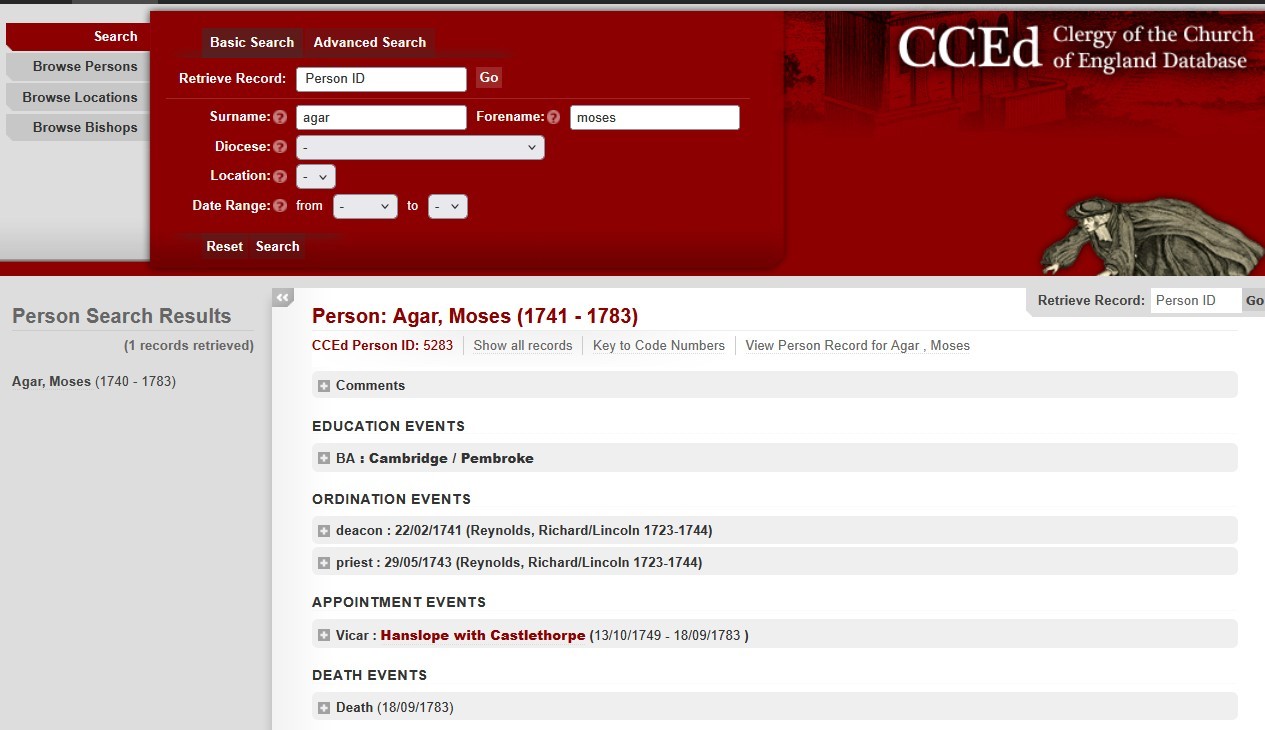
This is a great source for identifying Anglican clergymen between 1540 and 1835 because It identifies all incumbents of Anglican parishes, most curates, and some schoolmasters including where they served, who ordained them and who their patrons were. Sometimes you will be able to locate their dates of baptism, details of their education and dates when livings became vacant which could lead to finding death information.

The CCE database uses sources from archives and diocesan record offices around the country and includes records of events in their careers such as ordinations, institutions, appointments as schoolmasters, lecturers and curates and resignations. Because it is a collection from different resources, the information may vary from entry to entry.

University alumni

Many of these lists are available online and relate to Oxford and Cambridge Universities, which can be useful for tracing the educational backgrounds of clergy.  Most Church of England clergymen were university graduates. Any degrees awarded prior to the nineteenth century would usually have been at Oxford or Cambridge. Registers of graduates of several of the Cambridge and Oxford colleges have also been published.

My Ancestor Was….

There is a useful book published by the SOG My Ancestor was an Anglican Clergyman.

  • Newspapers

Biographical information including obituary notices can be found in specialist church newspapers and in many national newspapers, journal publications and annual reports, although relatively few are indexed. For the nineteenth century, the key resource for locating the dates of clerical appointments is the Ecclesiastical Gazette,

This article was contributed by Ian Waller from Family History Federation.
Website by Beachshore