



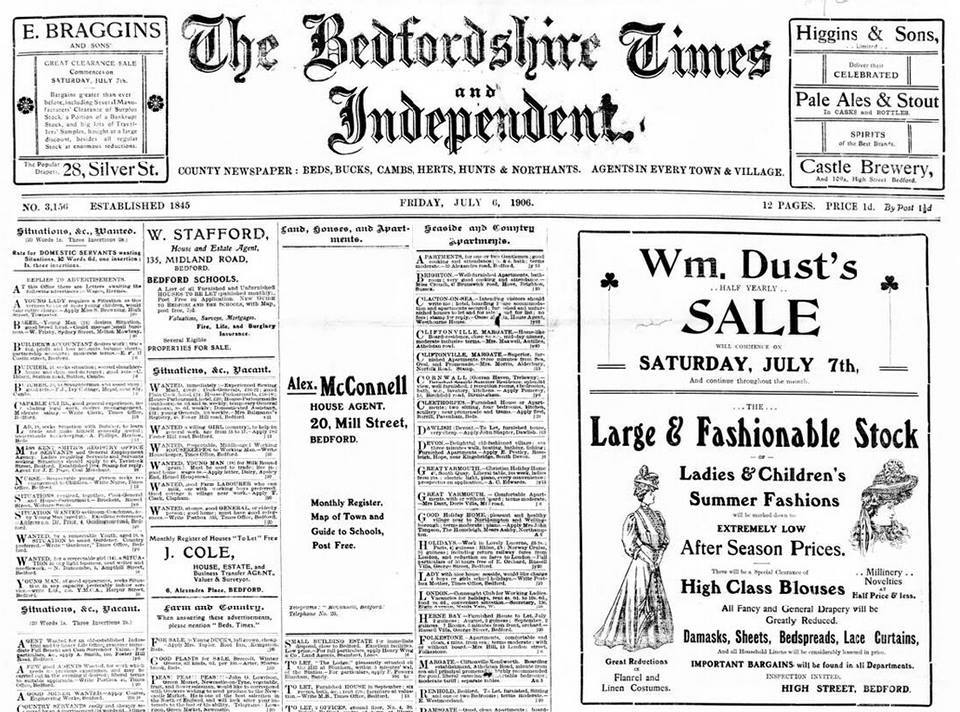
These items appear in most provincial newspapers of the Victorian era and later.

- Home
- Contribute
-
Browse topics
- Civil Registration
- Parish Registers
- Family Heirlooms
- DNA
- Wills
- Graveyards
- Military
- Archives
- Poor Law Records
- Census Records
- Nonconformist Records
- Occupations
- Old Handwriting
- Names
- Research Challenges
- Leisure and Pastimes
- Both sides of the law
- Maps & Gazetteers
- Society Records
- Education Records
- Genealogical Records
- Newspapers
- Property, Manorial and Land records
- Accidents, Illness and medical records
- Medieval Records
- Relationships
- Scottish Records
- Irish Records
- Resources
- Podcast
- Find a Society
- Subscribe
- Search
- News & Events
- Surname interests
PROVINCIAL NEWSPAPERS
Gems in family history
Newspapers have to be one of the most invaluable resources for family history research. They can also be one of the most distracting! Within the pages of any provincial newspaper are reports, advertisements and notices that can help you solve any research challenge or brick wall and can also tell stories about your ancestors' lives. They will also place your ancestors well and truly in their contemporary environment so can be useful for general historical research.
If nothing more, provincial newspapers reveal insights into the daily lives of our ancestors by placing local people, places and events in their context and reporting national news events often as seen through the eyes of the local community.
The first English newspaper was the Daily Courant, first published in 1621 as the Corante, by a lady called Elizabeth Mallet. It became a daily newspaper in 1702 and ended publication in 1735. It comprised a single page with two columns and mainly covered foreign news.
The oldest provincial newspaper is thought to be Berrow’s Worcester Journal established in 1690 although not published regularly until the second decade of the 1700s. By contrast the oldest regularly published national newspaper was the Aberdeen Journal first published in 1748. The Daily Universal Register which became The Times began in 1788.
A tax on each printed sheet of paper limited the number of pages and therefore the amount of information. The London Gazette which began in 1665 as a bi-weekly official government journal; it listed bankruptcies, naturalizations, official Acts and public notices. It continues today. Local newspapers did not flourish until the paper tax was lowered in 1836, and when the tax was completely abolished in 1855, hundreds of newspapers began to be privately published, albeit that some were very short-lived.
What are the gems for family history research?
-
1
Hatch, match and dispatch
One of the most useful resources found in virtually every provincial newspaper was the hatch, match and dispatch columns. Birth, marriage and death notices and subsequent reports of weddings or obituaries have appeared regularly since around 1820.
The value of these family notices is that you can find notices for those who were serving with the military abroad and those who emigrated. Marriages and milestone wedding anniversary entries often include photographs and details such as names of relatives and even addresses which help researchers to identify the wider family.
-
2
Civil and Army Promotions
If your ancestor was in the civil service or military/naval service, their promotions and movements can often be followed in the newspapers.
They are particularly useful during the First World War period because newspapers regularly printed extracts from family letters to show what was happening on the battlefields. May recipients of gallantry medals were reported in the papers.
-
3
Advertisements
In many provincial newspapers rather than report news on the front page, it was covered with trade advertisements. At the time this is what promoted local businesses - there were no other media sources.
Early advertisements relied on words rather than images to get their message across and these narrative advertisements provide an insight into your ancestor’s business dealings.
Advertisements frequently existed for the hiring of household servants, nannies, butlers and so on. Ancestors involved in trade and commerce will also have advertised in the local press and their adverts give us an idea of exactly what kind of trade they pursued.
-
4
Court reports
Reports of proceedings in the courts for both criminal and civil proceedings feature regularly in newspapers and usually contain more detail that the official records; they give the names of defendants, victims, and witnesses and often providing physical descriptions and testimonies.
In criminal trials the evidence was often reported verbatim with quotes from the police officers and other expert witnesses which bring the trials to life!
-
5
Public meetings
The minutes of all manner of public meetings are reported in newspapers including local trade union branches. various society and fraternity organisations, sports clubs, allotment associations, boards of guardians, local authorities etc.
These reports will usually be full of names, if only for committee or board members. They also provide an insight into what was currently happening in the area at the time and could easily include your ancestor.
-
6
News and Events
Provincial newspapers often included reports of national and international events, albeit that they may be slightly historic - usually a week or so after the events. They nearly always included local events.
Finding information from a local newspaper often backs up or enhances stories that have been passed down through the family. It can be very interesting to research what exactly happened without an inevitable family bias.
They are extremely useful when reporting accidents, suicides and other traumatic events. One thing that Victorian journalist did was to report the facts. There was little false news included.
Research in provincial newspapers
There are various places to consider researching provincial newspapers including online resources, although these are far from comprehensive so results will not always be guaranteed. However, it is worth starting your research in the comfort of your own home, albeit that a subscriptions will be needed view.
- British Newspapers Online
- Newspapers at FindMyPast
- Newspapers on Ancestry
Many local record offices and local studies facilities will have editions of local newspapers which will more than likely be available on microfilm necessitating a visit to the archives. Some may even have name or place indexes whih is helpful.
Using the British Library Newsroom or National Newspaper Library at Boston Spa, Lincolnshire are also essential to your research. Both of these establishments provide access to most of the provincial newspapers published in the UK; they also include several papers abroad including Irish newspapers and those published mainly in Commonwealth countries, India and UK dependencies. Many editions are available from around 1840.
Many of the newspaper editions which are not online are available on closed access and need to be ordered for which a British Library reader's ticket is needed. At Boston Spa there are strict retrieval times throughout the day for newspaper production. At the British Library newsroom you need to order in advance so that there you do not have a wasted journey. Some have to be retrieved from Boston Spa and transported to London. You will need to become familiar with the British Library catalogue to enable you to quickly find the edition and title of the newspaper you wish to research.
Newspaper research tips
Browse through issues page-by-page. You will become more familiar with the people, local economy, crimes, epidemics and local history of an area this way. However, don’t get side-tracked as you do this - remember you are browsing.
Don’t rely on searching names in indexes even if the index appears comprehensive.
Search initially for articles or announcements about births, deaths, and marriages. Most newspapers follow the same format each week so it is often a case of just turning to page..
Search for any articles about your ancestor’s church and church-related events.
Look specifically at the sports section, court section or village sections as they may well include mention of your ancestors.
Search the names of parents, spouses, children, siblings and every known extended family member.
Newspapers can be very frustrating because sometimes court cases are not always seen through to the end, so researchers can be left in the lurch when all of a sudden the last day of the trial is not reported because the reporter has been sent to cover another more important news event! Nevertheless, provinicial newspapers do include many gems of family history.
This article was contributed by
Ian Waller from Family History Federation.






Registered Office: 2 Primrose Avenue, Urmston, Manchester M41 OTY
Email: admin@familyhistoryfederation.com
©2026 Explore Your Genealogy
Website by Beachshore