Sub postmasters these were not employed by the post office. They were shopkeepers who offered post office services. They are not included in any appointment records or establishment books but there are some records which contain details of the running of individual sub post offices.
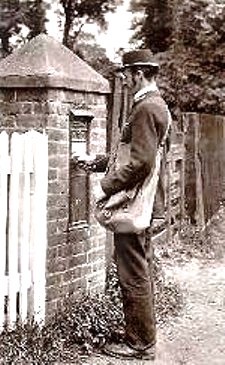
Letter carriers became postmen in 1883. Post women were not employed until after World War One.
Separate records exist for Scottish and Irish establishments and staff.
Mail Guards were the only employees of the Post office on a mail coach. Mail coaches were privately owned and under contract to the Post Office. Mail Guards Appointments exist between 1798 and 1847.
Until 1981 when BT came into existence all telephone engineers, telephone operators and those who worked in exchanges and scientific development were employed by the Post Office and records appear in standard key sources for any Post Office worker. Records for those who worked for the Post Office telephones and in 1981 transferred to BT do not record later employment details.
British Forces Post Office - The First Army Post Office was founded in 1808 during the Peninsular War. By 1882 Queen Victoria had established the Post Office Corp and the Army Postal Corp both of which amalgamated into the Royal Engineers Telegraph Reserve. In 1918 the first Air-Mail service to troops in Germany was established and adopted later by the international postal system to provide air mail services. In 1962 the BFPO was formed and began to recruit civilian personnel. Its service includes the Defence Courier Service. Records of earlier personnel can be found with the records of the Royal Engineers
The Post Office Rifles had its origins in the Fenian scare of 1867 after bombings in the name of Irish independence. In 1868 the War office sanctioned the formation of a 1000 strong regiment which became the 49th Middlesex Rifle Volunteers (Post Office Rifles). In 1880 a numbering change occurred and they became the 24th not the 49th Middlesex Rifle Volunteers. In the 1899-1902 Boer War the Rifles were the largest volunteer force in South Africa. In 1908 they became the 8th bttn City of London Regiment. All of the soldiers were Post Office workers. Their service records can be found within the Army records at the National Archives.
Being a government department the records of the Post office and Royal Mail are deemed to be public records and the series codes are those used by the National Archives. However the records in the POST series are all held by the Post Office Archives (Discovery Room part of the Postal Museum).
Other useful tips
Try and find out when your ancestor was employed by the Post Office and more importantly the circumstances of leaving – retirement, marriage, dismissed, resigned etc.
The same document classes are used for most of the Post Office occupations – appointments, establishment, pensions & gratuities.
Pensions and Gratuities records before 1860 generally list senior and clerical grades only (before then, not everyone was eligible for a pension).
Indexes to pensions and gratuities are arranged by year of award and then surname. Employees usually retired at 60.
From 1860 up to c1940, pension and gratuity applications were sent to the Treasury. They give details of individuals’ careers, but do not contain personal information Not all records survive. After November 1940, the Post Office granted pensions.
Appointment Books (POST 58) provide a register of all employees between 1831 and 1956 searchable online via ancestry.co.uk
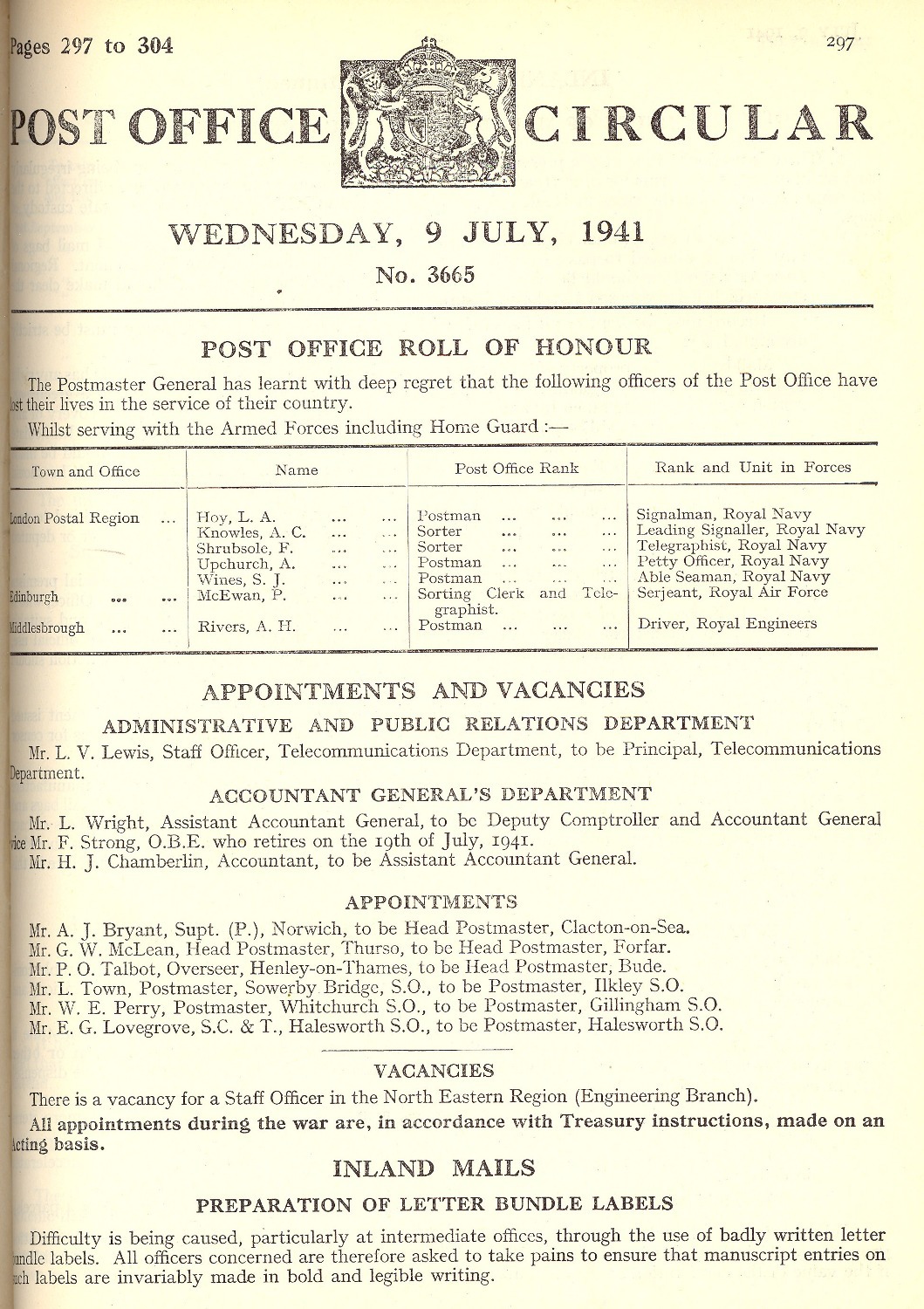
Two books commemorating those who worked for the Postal Service and were killed or died during both World Wars have been digitised and made fully searchable,
The running the telegraph service became part of the Post Office in 1870. Young teenage boys were employed to deliver the messages, but anyone below the age of 18 were not always recorded.