



Police forces were established after 1829 when Sir Robert Peel, the then Home Secretary introduced the Metropolitan Police Act. However, a force for keeping law and order had been established in London by Henry Fielding in 1749; these were known as the Bow Street Runners. The Runners were the first professional police constables and consisted of the Bow Street Horse Patrol and the Bow Street Foot Patrol. With the success of the Bow Street Runners, the government created a further seven police offices outside the City of London.

Sir Robert Peel argued that because the crime rate was rising, especially in the industrial towns and in London, a change in policing was needed. At the time most people were aware that existing methods of apprehending criminals were ineffective, particularly in the light of the population changes occurring because of rural to urban migration following the industrial revolution. A professional police force was required.

Following the success of this new police force in London, the County Police Act of 1839 was passed and this allowed for the voluntary formation of county police forces. Initially only twenty-five counties established their own police forces. It was not until  the 1856 County and Borough Police Act that the formation of police forces became compulsory.

Once the Metropolitan Police Force was up and running, attention was turned to policing the rest of the country. A series of Acts then empowered county and borough councils across the country to set up their own police forces.

Legislation creating new constabularies

1835 - Municipal Corporations Act gave towns outside of London the power to set up their own police force.

1839 - County Police Act gave each county the power to set up their own police force.

Both Acts were not compulsory and only about half the areas that were able to establish a police force did so.

1856 - County and Borough Police Act made it compulsory for all towns and counties to establish a professional full-time, paid police force. The legislation stated that there should be one policeman for every 1,000 people. The Home Secretary appointed Inspectors of the Constabulary to make sure that all counties and boroughs abided by the new law. 

New forces were established in response to the legislation with over 200 formed in England and Wales by 1860. Each had a Chief Constable who reported to the local authority responsible for police administration within the county or borough. The Metropolitan Police for historical reasons, reported directly to the Home Secretary and was under central government control headed by a commissioner rather than a chief constable.

Who became police officers?

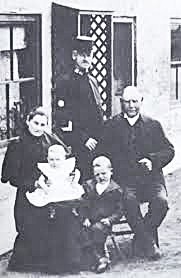
Before the Second World War, most police constables were from the semi-skilled and unskilled working classes. Most did not join  the force with a career in mind but to cover a period of unemployment. The pay was steady and secure which meant that many did develop a police career, seeking promotion and seniority.

In smaller boroughs the chief constable was normally a career policeman who had risen through the ranks thus of the working class. In the counties, larger towns and cities, the chief constable was often a man of standing who could associate with the wealthy. Invariably he was a man used to leading others, often having a military or naval background.

The life of a policeman and his family

A policeman’s wife was not allowed to take up employment on her own behalf. This was a restriction on the family income. The fear was that a policeman's wife could be tempted to use influence because of her husband's job. Police officers were members of the respectable working class and it was generally accepted that the wives did not work.

As a village policeman the wife was expected to take messages if he was out on patrol or at court. Some chief constables allowed police wives to undertake domestic service or dressmaking, providing this did not jeopardise her duties in looking after the home and family.

Many police officers enjoyed perks such as rent assistance and family medical care. Many officers also benefitted from unofficial perks, such as a free loaf of bread from the local bakery or a small money reward for being the “alarm clock” for those needing to get up in the morning. As in many jobs there was always those who abused their position and would even participate in, or turn a blind eye to, criminal activity. Some accepted more illicit perks.

Changing roles of police officers

When the police forces were initially established, officers were told that their main role was the prevention of crime. Each man was assigned a beat and was supervised by sergeants who regularly checked that each officer was where he was supposed to be. In Cities, towns and London, the police were expected to walk at 2½ miles an hour but this did not apply to rural forces as they had more ground to cover.

The traditional beat patrols continued for well over a century but became more flexible as attituded to crime changed and cities and their suburbs grew. Increases in vehicle ownership meant that more police were required to patrol in cars to prevent breaches of traffic regulations.

Special Constables

Special constables have existed since 1831 and could be appointed and mobilised to boost full-time police numbers particularly in times of crisis or emergency. Legislation introduced in 1834 defined the Specials as a volunteer organisation with full powers of arrest and equality in equipment with the full-time constabulary.

Their heyday occurred at the start of the First World War in 1914. Full-time police numbers were reduced because of army recruitment  so special constables were called upon to fill the void. As well as performing regular policing duties, the specials guarded water, gas and electricity supplies against enemy agents and collaborators. The Special Constables Act of 1914 regulated their role for the duration of the war.

Finding records of a provincial police officers

Surviving records of local police forces are not public records and are held either by local archives or the respective police force itself. Not all police staff records have survived. Contact the local police force itself for their records or try the local record office.

The following is list of known modern police forces with personnel records held by the force themselves:

  • Avon and Somerset Police
  • Bedfordshire Constabulary
  • Cambridgeshire Constabulary
  • Derbyshire Constabulary
  • Devon and Cornwall Constabulary
  • Dorset Constabulary
  • Greater Manchester Police
  • Gwent Constabulary
  • Hertfordshire Constabulary
  • Humberside Police
  • Kent Constabulary
  • Leicestershire Constabulary
  • Lincolnshire Constabulary
  • Merseyside Police
  • Norfolk Constabulary
  • North Yorkshire Police
  • Northamptonshire Constabulary
  • Northumbria Police
  • Nottinghamshire Constabulary
  • South Wales Constabulary
  • Staffordshire Constabulary
  • Suffolk Constabulary
  • Sussex Police
  • Thames Valley Police
  • West Mercia Constabulary
  • West Midlands Police
  • West Yorkshire Police

Police service records

The  records of police officers likely to be of interest to famiy historians, where they survive include:

  • attestation ledgers
  • leaving registers
  • personnel and discipline books
  • order books
  • station logbooks
  • diaries
  • pension records.
  •  
  • Researching commercial and trade directories may enable you to locate a police division and may provide the names of local officers and sometimes the constables.
  •  
  • Guide to archives of the police forces in England

For information on provincial police forces you can download a useful PDF guide from the Open Univerity at:

https://university.open.ac.uk/arts/research/policing/sites/www.open.ac.uk.arts.research.policing/files/files/ecms/arts-policing-pr/web-content/guide-to-police-archives.pdf


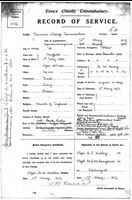
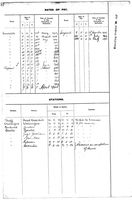
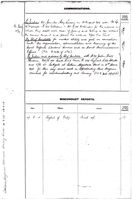
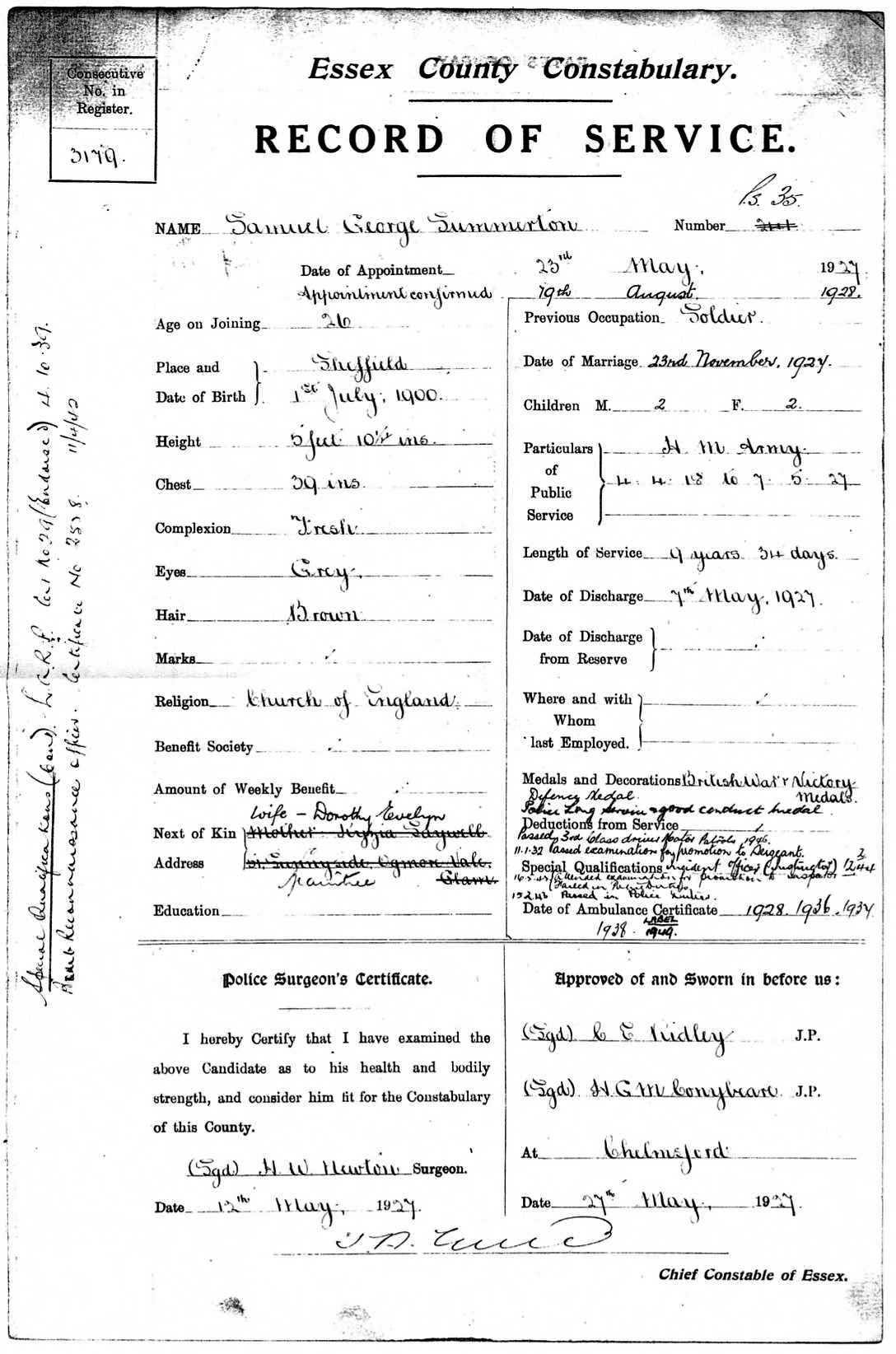
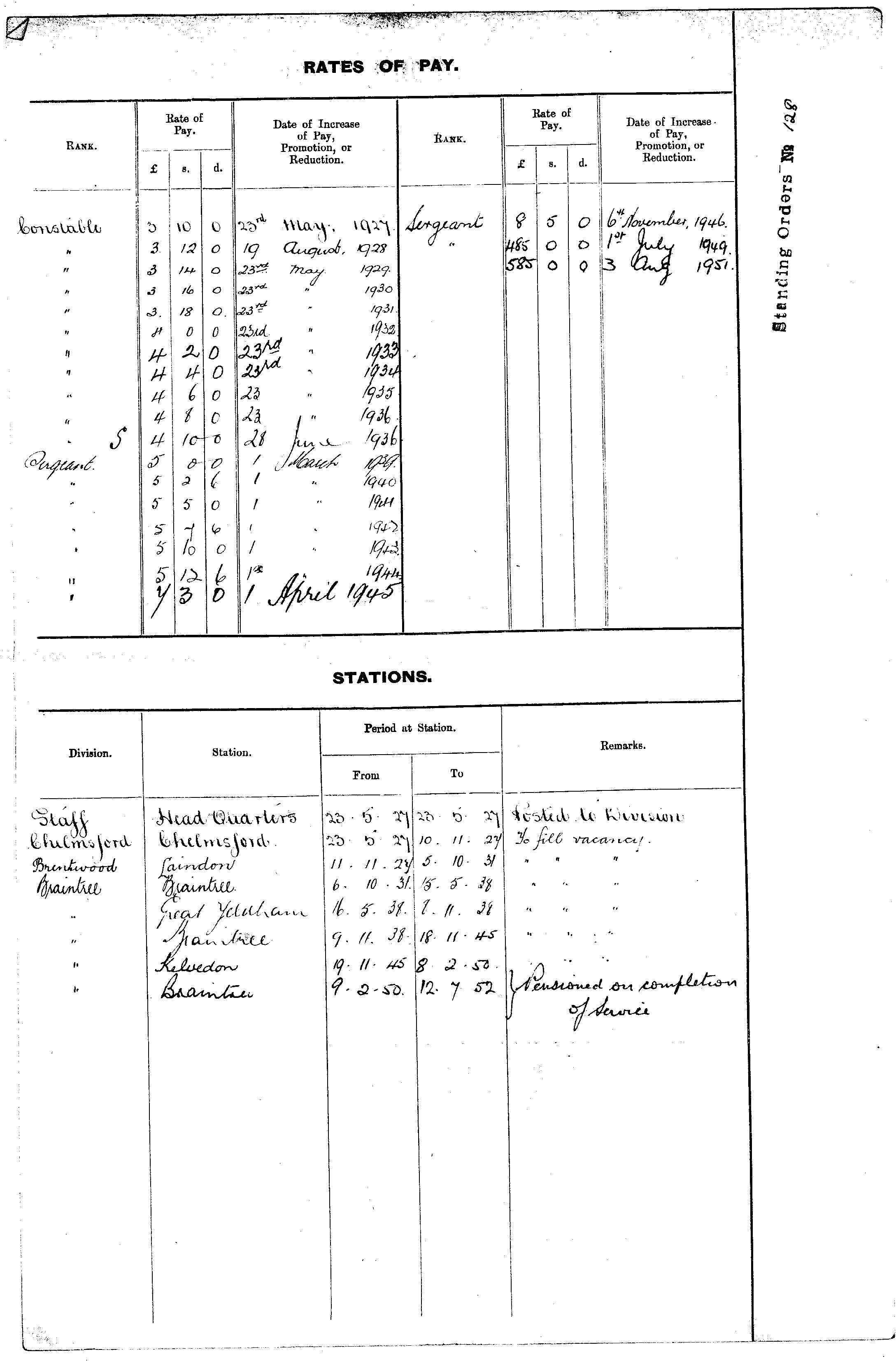
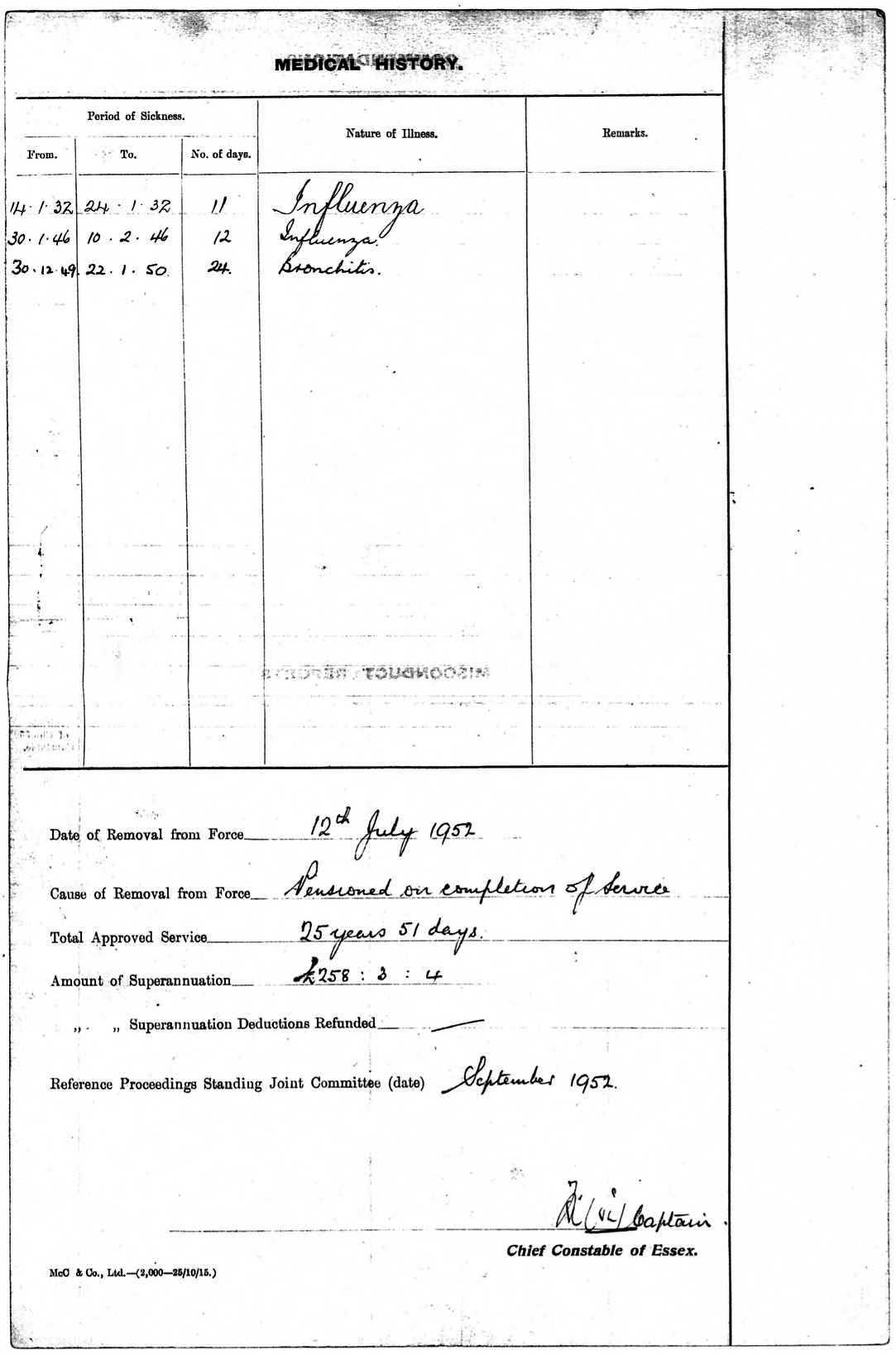
Example of a police service record from Essex constabulary

London police records

City of London Police records

The City of London and the Metropolitan Police forces are two different entities. Registers of the City of London Police are held by the London Archives and relate to every member of that force since warrant numbers were introduced in 1832. Personal files only exist for about ninety-five per cent of officers.

Metropolitan Police records

Not all records survive for members of the Metropolitan Police Force, which, because they are government controlled, are held by The National Archives at Kew in series MEPO. Some classes of records are also available online.

The main classes of records to locate information on metropolitan officers are:

  • MEPO 4, Metropolitan Police: Service Records (Incomplete)
  • MEPO 21, Records of Police Pensioners 1852-1890)
  • MEPO15, Divisional maps showing boundary changes.
  • .

As researching a Metropolitan Police Officer can become a little complex, download The National Archives research guide “London Metropolitan Police” for further guidance before pursuing your research. It is useful to know in which division or geographical area that your ancestor may have served as divisional records often provide additional information about officers.

The Metropolitan Police archives in Brixton hold a number of records relating to personnel and station logs which will be of interest to researchers.

The Metropolitan Police Service Heritage Centre, Sidcup, holds historical documents including:

  • Central Records of Service from 1911
  • 60,000 name database from 1829
  • Pension cards for pensioners who have died
  • Joiners’ and leavers’ records (copies of records held at The National Archives).

British Transport Police records

The first railway police force in Britain was formed in 1830, but as early as 1826, men were employed as policemen on the railways. There early role was to direct the trains and included signalman. These early records will be found within staff records for each separate railway company if they have survived. Following the Railways Act 1921, the four largest railway companies had their own police force controlled by a Chief of Police.

In 1949 after railway nationalisation, the British Transport Commission Police was established which incorporated the former four police forces, and as late as 1958, the London Transport Police also became part of the British Transport Police.

The British Transport Police hold records of its officers and staff including several thousand staff record cards dating back to the 1860s. Contact the British Transport Police History Group for research information. Some administrative records are also held by The National Archives at Kew which also holds records in series RAIL of the police departments of the GWR, LMS, LNER and SR companies.

This article was contributed by Ian Waller from Family History Federation.
Website by Beachshore