


Background

Military Service Tribunals were organisations set up around the country to hear applications for exemption from conscription into the British Army during the First World War. The records should have been destroyed at the end of the war but somehow those for Northamptonshire (and a few other areas) have survived.   

By the spring of 1915, it became obvious that voluntary recruitment was not providing enough men for the army. The National Registration Act of 15 July 1915 stated that all men between fifteen and sixty-five years old were obliged to register and give details of their trade.

The Military Service Act of 27 January 1916 brought in conscription where single men aged nineteen but not yet forty-one were deemed to have enlisted and were placed in the reserve. This was later extended to married men and the age increased.
 

Grounds for exemption

There were some grounds for claiming exemption from military service namely:

 - That it was in the national interest that he be engaged in other work or to continue his training

 - That hardship would ensure through his financial or business obligations or domestic position

 - Through ill health or infirmity

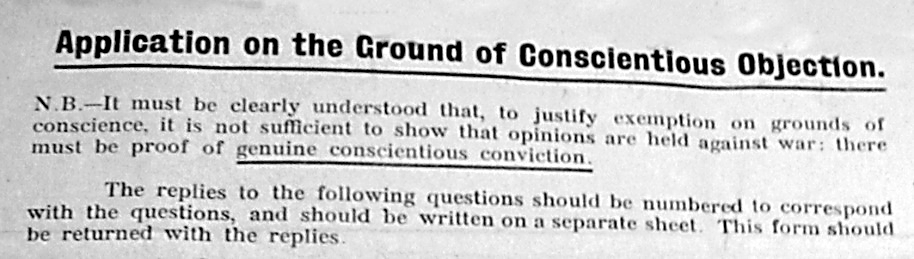
 - That he had a conscientious objection to the undertaking of combatant service.

Certificates of exemption could be absolute, conditional or temporary.

Local tribunals were familiar with an appellant’s background and were often able to easily determine those who were using the appeal system to avoid serving. The military could also appeal against a decision, and did so on numerous occasions, especially where they felt the exemption granted was for too long a period of time.

Conscientious objectors

There is a misconception that the tribunals were only about conscientious objectors; in fact in Northamptonshire, only one per cent (about 100) men actually appealed on those grounds. If their appeal was approved, men may be given a non-combatant role, perhaps joining the Friends' Ambulance Unit or helping the YMCA build huts.

Conscientious appeal

The tribunal panel's balancing act

Most tribunal panels had a tricky job; they had to satisfy two masters in a way and it was, truly, a balancing act.

On one hand, there was the demand of the War Office for a continual stream of men to serve; on the other hand, there was the need to maintain vital industries and services which supported both those on the front line as well as those on the home front.  There were also the personal economic and family circumstances of the men to consider. A skilled man who was absolutely essential to his employer might be more valuable to the war effort if he remained in his employment.

Shoe trade appeals

Of particular interest with the Northamptonshire records are those relating to the shoe trade. Many men rushed to join up at the beginning of the war.  Those who did not became ever more essential to their employers.  The War Office was placing orders for army and navy boots - but at the same time it was asking for more men to be released. This potential loss of men would jeopardise the company’s ability to complete the contract. 

Shoe workers in Northampton supplied 23 million pairs of army boots during the war years and to this is added another 24 million from workers across the rest of the county.

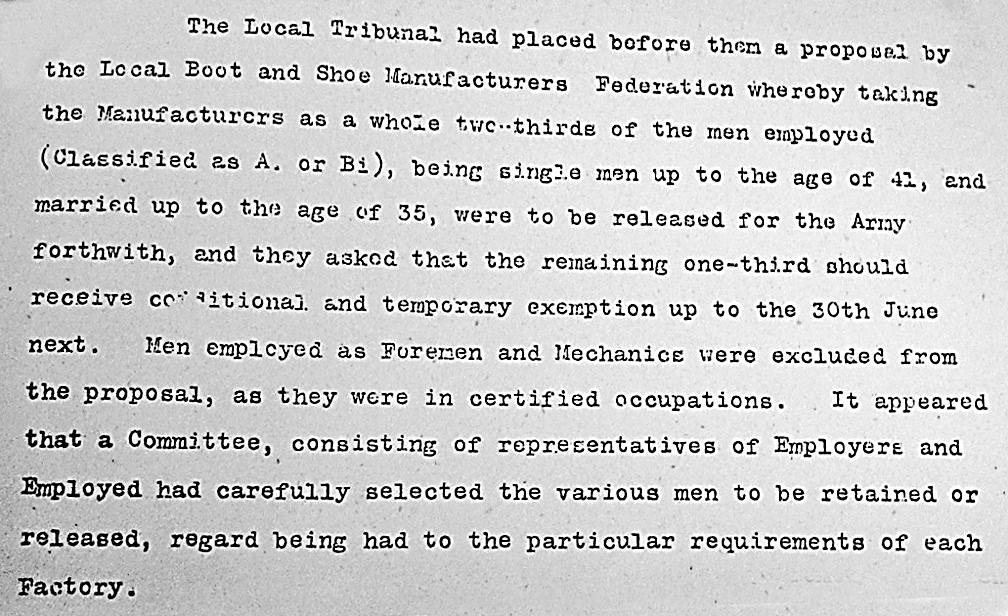
Shoe Trade Proposal to Tribunal

Lists of shoe workers

The county tribunal panel worked with the shoe manufacturers to draw up lists of their employees. This showed who could be released immediately, those who could be released in a short period of time and those who were essential to the continuation of the business.

The lists are valuable for the family historian in that they may show which shoe manufacturer an ancestor may have worked for and his role there.  Allied with this were the trades of tanners, leather factors, heel manufacturers and such, which were essential to support the shoe manufacturers.

Northamptonshire record office has twenty-five boxes of records relating to over 10,000 individual appeals.  These have been indexed by volunteers and can be searched on FindMyPast.

list of shoe workers
This article was contributed by Angela Malin from Northamptonshire Family History Society.
Website by Beachshore