




There are no specific provisions under British laws that allow parties to be married at sea; thus the General Register Office hold no records of such events and none are included in the marriage indexes. However, this does not mean that marriages did not take place at sea.

Marriages on board British-registered merchant ships

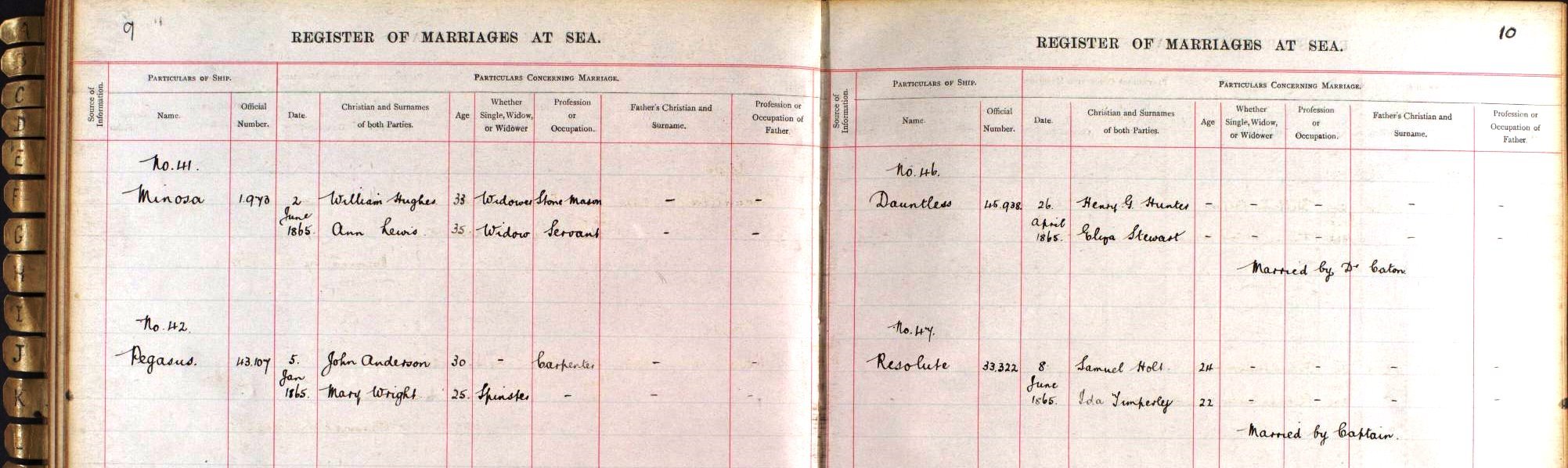
Under British maritime law if any such event did take place aboard a British-registered ship after 1854, details had to be entered in the ship’s official log. Details of these events were copied by the Registrar General of Shipping and Seamen into registers now held at The National Archives in BT158/1-4 covering 1854–1906; these were later copied to BT 334/117 covering the period up to 1972. A database transcript of this register is available online at The Ships' List, headed Marriages at Sea.

In that marriages performed by masters of British-registered ships were not legally valid, only a relatively small number of records exist.

The information found about the marriages performed at sea can include:

  • Name of the ship and the official number
  • Names of both parties
  • Ages
  • Condition, single widowed etc.
  • Occupation
  • Father’s name and occupation.
  •  

Recording of marriages began because the Mercantile Marine Act of 1850 required masters of vessels to keep a ship’s official Log to record all events on board - not just marriages but also births and deaths.

Logs were deposited with the Registrar General of Shipping and Seamen after each foreign voyage, or half-yearly for home trade ships and begin to appear amongst the Merchant Navy records from 1852 onwards, however, many have not survived. It would seem that only those recording a birth or death generally exist.

In order to see if a logbook exists, you need to search series BT165 at The National Archives by ship’s name or number for official logs covering the period 1902-1920. There are over 40,000 merchant navy ships’ logs in this series. Earlier logbooks seem to be missing. They can be more of a ‘parish register’ for the ship, noting vital information about the crew and passengers including the occasional marriage.

There are also a small number of log books in series BT 98 and BT 99.
Marriages on board Royal Navy ships

Captains of Royal Navy ships were able to perform marriages at sea under certain circumstances. This is governed by the Naval Marriage Act of 1908 subsequently amended in 1949. The main responsibility is that of the Royal Navy Chaplains. These provisions are not applicable to persons other than officers and personnel of the naval service on the books of Her Majesty’s ships at sea. Captains have to perform certain duties of Registrars of Marriages. Such marriages if properly constituted are legal.

Records of marriages on board Royal Navy ships were returned to the Registrar General and are in series RG33 at The National Archives. Each record will provide:

  • Names of both parties
  • Ages
  • Condition
  • Profession
  • Residence
  • Signatures of parties
  • Signatures of witnesses

Questions of validity

Papers relating to the implications and the validity of marriages at sea can be seen in piece RG48/2955. In general terms for a marriage at sea to be valid, it must be conducted in accordance with the laws of the country in which the ship is registered. British marriage law does not allow for marriages outside authorised buildings which excludes merchant ships.

Possible implications

If an ancestor was married in such circumstances, then they were not legally married and therefore had no legal recognition. This will have had far-reaching effects for the rights of parties and on subsequent children’s legitimacy, and also wives do not have any protection afforded to them under British marriage law. If parties were not legally married, then they cannot divorce so any relationship breakdown may have been contested in the civil courts which often needs further research. Situations regarding inheritance, property, pension and parenting rights are also affected.

Even today a marriage on a British-registered cruise ship whilst at sea is not legally recognised because British law dictates that the wedding ceremony must be held in a publicly accessible space and a cruise ship does not allow that. Ships registered in other countries may be covered by the marriage laws of the registration country and may be perfectly legal.

This article was contributed by Ian Waller from Family History Federation.
Website by Beachshore