Marriages have always centred around traditions many of which originated during the Victorian period. Even the day and the month and the weather had their traditions. If it rained or was cloudy, the marriage would be stormy. If it was sunny the couple would have a bright future. If it rained in the morning but was sunny in the afternoon the couple would have good luck
It was considered good luck to drop the wedding ring as evil spirits were then shaken loose. The bride’s parents always left the church before the bride and groom as a further token of them relinquishing responsibility for their daughter i.e. walking away. If rice or confetti was not thrown, there would be no children. In wealthier circles a white horse drawing the wedding carriage was considered good luck. The ringing of church bells was said to ward off evil spirits.
As we research marriages we notice that many marriages took place mid-week. Marrying on a Saturday is very much a twentieth-century tradition. Ironically, to marry on Saturday brought no luck at all. Marrying on the Sabbath (Sunday) was out of the question except for Christmas Day or Easter Sunday. So each day of the week had its own tradition:
- Marry on Monday for health
- Tuesday for wealth
- Wednesday the best day of all
- Thursday for crosses
- Friday for losses
- Saturday for no luck at all.
-
Choosing the month was also considered important particularly for the bride. The following is not of Victorian origin but was still relevant.
Married when the year is new, he'll be loving, kind and true.
When February birds do mate, You wed nor dread your fate.
If you wed when March winds blow, joy and sorrow both you'll know.
Marry in April when you can, Joy for Maiden and for Man.
Marry in the month of May, and you'll surely rue the day.
Marry when June roses grow, over land and sea you'll go.
Those who in July do wed, must labour for their daily bred.
Whoever wed in August be, many a change is sure to see
Marry in September's shrine, your living will be rich and fine.
If in October you do marry, love will come but riches tarry.
If you wed in bleak November, only joys will come, remember.
When December snows fall fast, marry and true love will last
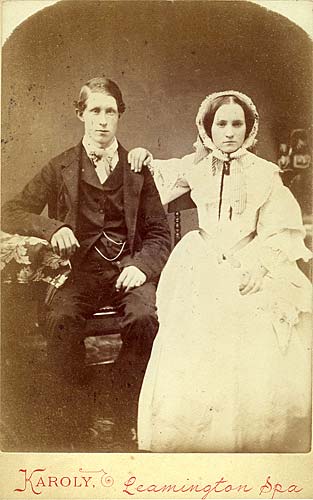
Even the colour of a bride's wedding dress had different connotations. Not all weddings had the bride traditionally wearing white:
Married in White, you have chosen right,
Married in Blue, your love will always be true,
Married in Pearl, you will live in a whirl,
Married in Brown, you will live in town,
Married in Red, you will wish yourself dead,
Married in Yellow, ashamed of your fellow,
Married in Green, ashamed to be seen,
Married in Pink, your spirit will sink,
Married in Grey, you will go far away,
Married in Black, you will wish yourself back
To assure that the marriage continued to have strength and good luck, we have the “Something….” tradition:
- something old - continuity with her family
- something new - optimism for new life
- something borrowed - good fortune carrying over.
- something blue - relates to the way Christianity dressed the Virgin Mary in blue
- the tradition of a silver sixpence in your shoe for financial security.
-
The village bride and her wedding party would have walked to church led by a girl spreading blossom in their path in the hope that the bride would have a happy life.
The association of the horseshoe with the wedding ceremony is not too clear. There are ancient pre-Christian supernatural powers attributed to the horseshoe. Because the horseshoe is " U " shaped, to retain the good luck forever, it is essential that the horseshoe is hung by the ribbons which are attached to the shoulders. The horseshoe should not be turned upside down or else all the good luck of the marriage may fall out.
There are many myths and traditions associated with chimney sweeps - many lost in the mists of time. One reason from folklore is that when on one occasion King George II's carriage horses bolted, the only person to attempt to stop them was a small sooty figure of a man, a chimney sweep. It is considered good luck, if on the journey, to the Church you saw a chimney sweep and even greater good luck if you saw the sweeps brush emerging out of the top of the chimney.
The custom of throwing rice at weddings was very much a Victorian tradition started in 1872 at the parish church of St Mary's in Swillington, near Leeds. The couple getting married were Job Lilley and Matilda Mason. The Rev Dealtry, vicar of the parish, had recently returned from India and he suggested that people who wanted to perform the traditional 'crowning of the bride' ceremony, should emulate the Hindus and throw rice.
Carrying the bride over the threshold began as a way to protect the bride from evil spirits. It is a tradition that the groom carries his bride over the threshold of their new home; this symbolises entering into a new life together. It was also seen as an act of protection and love. The groom carries the bride over the threshold, as a symbolic gesture of being strong. Moreover, by carrying his wife over the threshold, the groom is showing his appreciation for her, his acceptance of her as his wife, and taking responsibility for the bride.