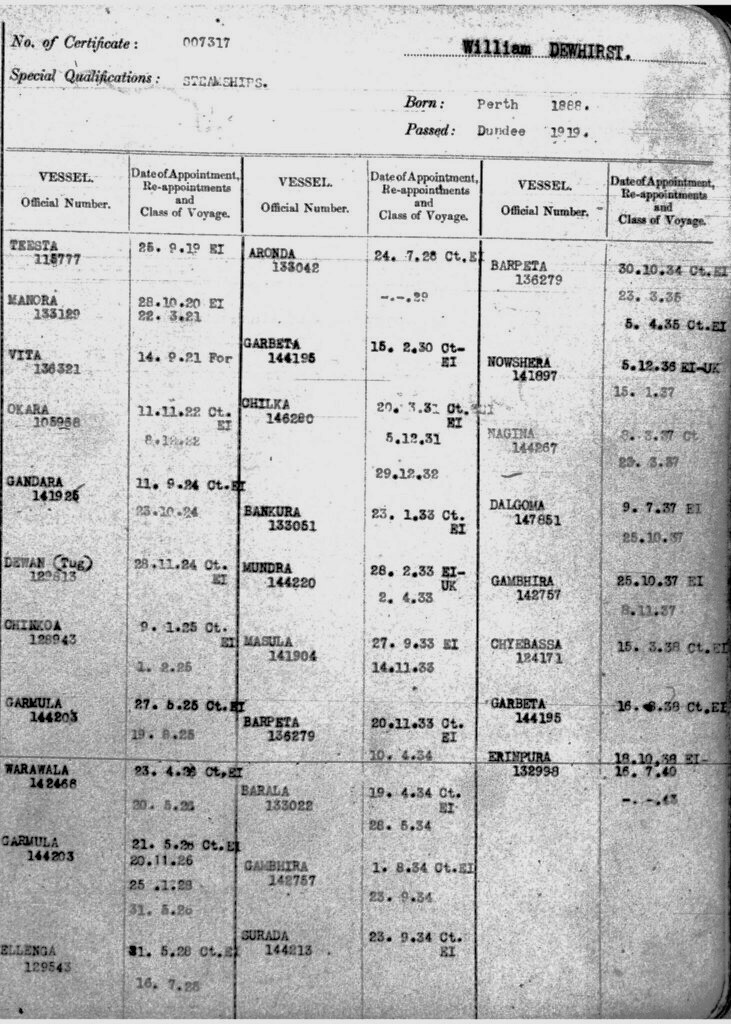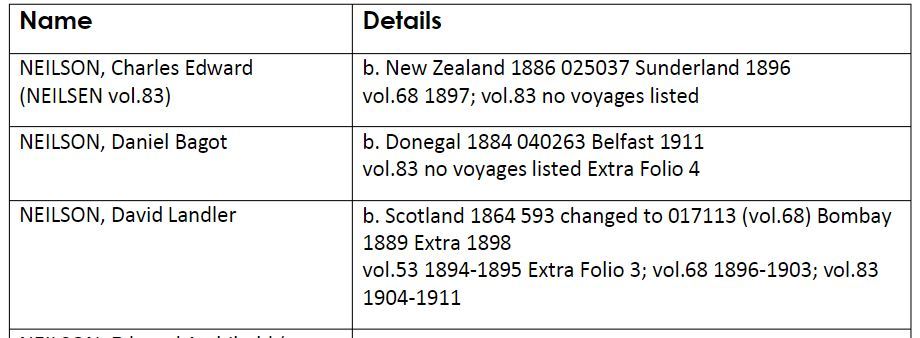




The Lloyd's Captains' Registers give details of the careers of captains and mates of foreign trade merchant ships, but only for those who held masters' certificates and operated actively between 1869 and 1947. In some cases, they also provide earlier career details after 1851 for masters' certificate holders still active in 1869.  For example, if a master's certificate was gained after 1851 but before 1869, the career details exist from the commencement of the certificate. The registers do not normally include details of the careers of masters of coasters or fishing vessels.

How the registers were compiled

Captains' Registers were compiled from information provided by the Registrar General of Shipping and Seamen. This information was initially used by Lloyds to assess insurance; however, you will not find any insurance details in the registers. Notwithstanding the limitations of the registers, you will be able to find the following:

  • Name
  • Place of birth
  • Year of birth
  • Details of the master's certificate including date and place of issue, certificate number
  • Special qualifications
  • Engagement details since the issue of a certificate
  • Name and official number of each ship where they were a master or mate. The name and official number were taken from the official Mercantile Navy List
  • Voyage destinations
  • Any event such as accidents, collisions, sinkings etc.
  • Awards and recognitions

Format of the registers

1851–1869

During this period the registers comprised published issues of Lloyd's Captains' Register. It lists active master mariners alphabetically by name, including those who held a master's certificate but did not command a ship. Masters had to be active in 1869 to be listed.

1869–1911

These are manuscripts with each volume covering around six or seven years. The names of masters are listed alphabetically. Extra pages were inserted if there was not enough space on the first page to cover all entries. Because the volumes became cumbersome, the system was not continued after 1911.

1911–1948

Loose leaf volumes were used during this time period. Details of newly qualified masters were kept on cards and information was only added after a master obtained his initial command. Masters who held earlier (pre-1911) certificates had their entries typed up from former volumes and added to the loose leaf volumes. Where a master retired or died during the period, the entries were placed in a supplementary sequence. There are accompanying card files of qualified masters who did not become captains but their service as mates was recorded, assuming Lloyds were aware of the circumstances.

Limitations of searches

Searches within the register may not always result in information for a particular individual being found for the following reasons:

  • The captain or mate held a master's certificate but was not in actual service between the dates of the register, particularly if he ceased service before 1869.
  • His service was not on a foreign-going British registered merchant ship.
  • Information was not transmitted by the Registrar General of Shipping and Seamen to Lloyd's.
  • The man only held a mate's certificate.
  • The man was not a captain or mate despite suggestions that he may have been.
  • The man held a master's certificate issued between 1912 and 1931, but never held such an appointment during that time so no information existed about him.
  • Persons purporting to be master mariners did not always hold a master's certificate as the term was often an enhancement used by ordinary merchant seamen.
  • The information provided by the Registrar General of Shipping and Seamen to Lloyd's to enable details to be included in the Captains' Registers has not been established and varied during the time period.

Abbreviations used within the registers.

Throughout the registers there are a number of abbreviations in use.

Master's certificate numbers:
  • C: before number denotes certificate of competency
  • S: before number denotes certificate of service
  • CHT: before number denotes certificate of competency for home trade passenger ships
  • SHT: before number denotes a certificate of service for home trade ships.
  • Col, Can etc: before number denotes that the certificate was obtained abroad (i.e. Colonial, Canada, etc.)
 
Special qualifications:
  • Ex: Extra Master- a person who has passed the Extra Master's examination and is qualified in higher navigation.
  • F & A: master for fore-and-aft rigged vessels only
  • Stm: qualified for steam.
  • Crown: inserted before a name denotes an officer in Royal Naval Reserve
 
Destinations:
  • A: West coast of Africa and adjacent islands
  • Aust: Australia, Tasmania or New Zealand
  • B: Baltic, Norway, White Sea, Gulf of Finland
  • C: China, Japan and oriental archipelago
  • Cp: Cape colonies, Ascension, St. Helena, Natal, Algoa Bay
  • Ct: Coastal trade, including the near continent.
  • EI: East Indies, Burma, Mauritius, Red Sea
  • FPS: France, Portugal, Spain (outside Straits of Gibraltar) Azores
  • M: Mediterranean, Black Sea, Adriatic
  • NA: British North America, Greenland, Iceland
  • NP: North Pacific and West coast of North America
  • NS: Denmark
  • SA: Brazil, River Plate
  • SP: South Pacific and West coast of South America
  • US: United States
  • WI: West Indies and Gulf of Mexico
  • For: Foreign

Indexes to the registers

There are also alphabetical indexes available for 1869–1911. A downloadable PDF is available for the index to the registers. The indexes list the following information:

  • Name of the captain (including variants)
  • Year and place of birth
  • Certificate number with place and year of issue including a note of any changes
  • Register volume
  •  

Dates of death, suspensions and cancellations of certificates can also be located in the original Registers but have not shown in the indexes.

Where to view the registers

Microfilms of the Lloyd's Captains' registers can be seen at the National Maritime Museum and at the London Metropolitan Archives. The registers can also be viewed at FamilySearch centres

This article was contributed by Ian Waller from Family History Federation.
Website by Beachshore