

Lacemaking was a cottage industry mainly carried out by women and older girls to supplement the family income However, for some women it was their main source of income. Lacemaking was a common cottage industry in the Hertfordshire and Buckinghamshire areas, Devon and Nottinghamshire although it occurred in other areas of the country as well.

Brief history of lace

In the days of the sixteenth century, Roman Catholic clergy used lace in religious ceremonies. The lace that they used was made of gold, silver, and silk. The upper classes and wealthier people also started to use lace as embellishments to clothing and soft furnishings.

In the mid-1400s lacemakers began taking the industry to other countries but the widespread use of lace did not really happen until the sixteenth century after which the cottage industry of lacemaking spread rapidly because both needle lace and bobbin lace dominated fashion and home décor. Lace became very popular for enhancing collars and cuffs.

The lace that was made in England before bobbin lace was a process known as drawn thread work. Queen Elizabeth I had close ties with the French court so French lace began to be seen in England.

There are two distinct areas of England where lacemaking was a significant industry - Devon and part of the south Midlands. But many migrant Belgian lacemakers settled in Honiton towards the end of the sixteenth century where they made pillow and other lace.  However, in the south midland counties, different groups of migrants who settled influenced new styles and processes of making lace.  These included Flemish people, Huguenots and some from France who escaped revolution.

Catherine of Aragon, the first wife of King Henry VIII, while exiled at Houghton House near Ampthill in Bedfordshire was known to have supported local lacemakers by commissioning new pieces. It is said she burnt all her existing lace. Traditionally on 25 November, known locally as Cattern's Day, all lacemakers took the day off and Cattern cakes, dough cakes with caraway seeds, were eaten in celebration.

Unfortunately the decline of the English lace industry started at the end of the 1700s, however, many women and girls were still involved until the beginning of the twentieth century as can be evidenced by the number recorded as having the occupation of lacemaker in the various Victorian census returns.

The Industrial Revolution resulted in changes with increased mechanisation affecting production. Machine lace became popular from the late eighteenth century followed in about 1810 when John Heathcoat from Nottingham developed a machine to make 'bobbin net', a type of fabric to be used for new, handmade lace. Technological developments meant that by 1870 virtually all types of handmade lace could be reproduced using machinery which put a nail in the coffin of the handmade lace industry in England by the start of the twentieth century.

Lacemaking

There were two principal methods of traditional lacemaking:

Needle lace using a needle and single thread.

Bobbin lace using multiple threads.

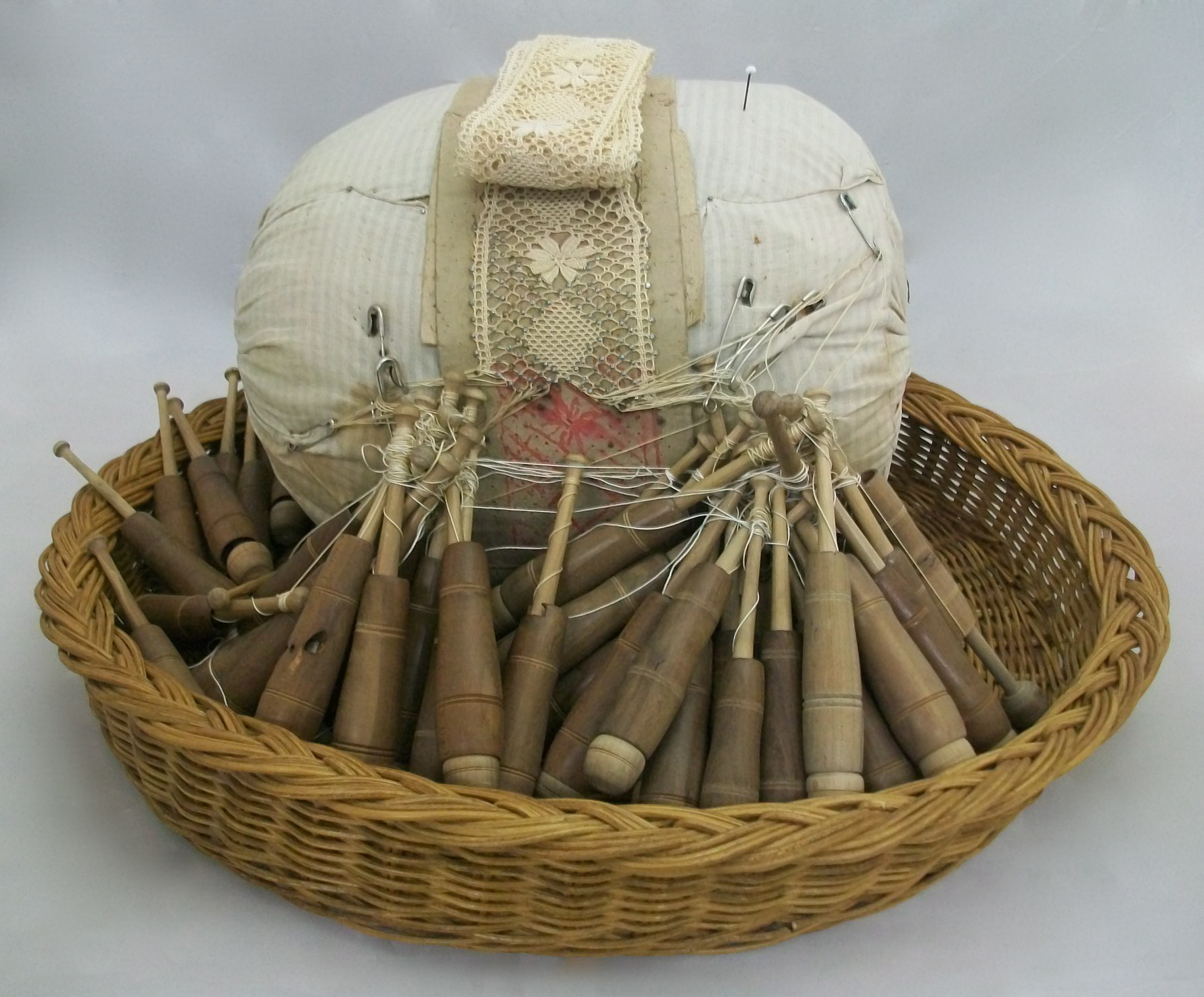
Bobbin lace was worked on a firm pillow using ornate bobbins to control multiple threads with pins used to hold the stitches in place. Bobbin lace was made in Honiton in Devon, Buckinghamshire and Bedfordshire, each having distinctive features.

Needle lace was made using a single needle and thread and is usually not as fine as bobbin lace. This was used mainly for button holes in the Victorian period.

The styles of the lace varied at different periods reflecting fashion. During the mid-1800s lacemakers mimicked Maltese lace introduced at the 1851 Great Exhibition but frequently adapted it to produce their own styles.

Lace schools

Since the advent of poorhouses, working 'bone lace' has been taught to poor children in poorhouses and workhouses so they could offset the cost of their keep. Lacemaking amongst the poor has since then been a recurrent theme.

So the lace schools developed where the Overseers of the Poor paid experienced lacemakers to teach the children of the poor. The system continued well into the nineteenth century although the schools were frequently seen as injurious to the health, education and moral discipline of the children rendering some girls unfit for household work. The system exploited children because once efficient at the work they were forced to fulfil orders from the lace dealers. It was also known that some actually beat the girls who produced substandard lace. Earnings were kept low and their education was neglected in favour of lacemaking. It was not unusual for these children to be referred to as “scholars” in the census returns.

To help relieve the monotony of the long hours which the children were expected to work at their lace, a form of chant/counting, known as lace tells, was used to keep up the momentum of the work. These tells which related to nineteen pins were repeated, changing the number of pins at each repetition until the last one was reached.

There were different kinds of lace schools:

Village lace schools were run commercially with the children earning money to contribute to the family income.

Parish schools were schools set up by parish officers to provide a trade for pauper children.

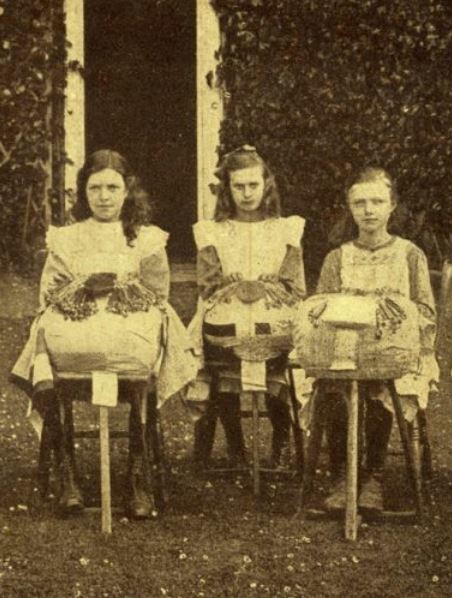
In some areas whole families would be involved in lacemaking with children from the age of five being sent to lace schools. The youngest would wind the bobbins and fetch and carry for the older workers working a full day. In 1843 work was five to eight hours for the youngest children and ten hours for children over ten years of age although some of the older ones were known to be working up to fifteen hours a day.

The school mistress ensured maximum productivity and was generally very strict. Some of the village schools were privately run or run by the church staffed by women who held religious status.

In most lace schools the lighting and heating conditions were poor. The only light provided was by a candle in the centre of a table and glass flasks filled with water, known as flashes, were placed around the table to reflect the candlelight onto the pillows of the lace-school pupils. In the small rooms within a typical cottage, strong daylight was often inadequate so lacemakers would have strained their eyes and sometimes ended up with long-term sight problems.

Open fires were not used as there was a chance that soot and smoke would discolour the lace, so young lacemakers would sit with a pot of hot ashes underneath their skirts or at their feet in an attempt to keep warm. Because of inadequate ventilation the pupils often suffered from breathing difficulties.

The cottage industry

Around the seventeenth and early eighteenth centuries English lace did not match the quality of continental lace and import duties were introduced making of interest to smugglers. By the time the import duties ended, the home-produced lace had established a popular market. Bedfordshire lacemakers produced 'Old Point' lace in their cottages throughout this period and fulfilled orders via the lace dealers who linked lace produced through a thriving cottage industry with the fashion trends of the day. Pillow lacemaking was a thriving cottage industry in Bedfordshire and Buckinghamshire villages.

Throughout the Victorian period the earnings of lacemakers fell. To try and counteract this and compete with the machine lace, they began to make Maltese and Torchon lace which was a coarser lace that could not be copied by machines although this only served to delay the inevitable demise of the handmade lace trade. By the time of the 1891 census, only 3,376 lacemakers existed in Bedfordshire whereas in 1851 there were recorded 26,670.

The tools and equipment of a lacemaker

Lace was produced using pillows which were firmly stuffed with straw. There were two shapes of pillow - square or bolster. In the 1880s a pillow would cost in the region of 1s 6d. The square pillow was hessian, folded and stitched into an envelope shape which sat on a tripod type horse; the bolster pillow was a rectangle stitched into a tube with drawstrings at each end resembling a tube that rested on a trestle 'horse'.

Lace designs were transferred on to parchment or strong cards and were known as prickings because pin holes were pricked through and the pattern markings were added using ink. The finished patterns/designs were attached to the pillow by pins to enable the lace to be made.

Various types and thicknesses thread were used to make the lace and could have been cotton, linen or silk.

Bobbins were the thread carriers. The pins were usually made of brass and varied in length and thickness depending upon the type of thread used.

In most areas the bobbins had a globular shank in order to keep the thread taut. However, in some East Midland locations they had slim shanks and were weighted by glass beads. Bobbins could be purchased by the dozen for about 6d. They were usually made from hardwood or bone some of which could be in celebration of an event and often inscribed with the lacemaker's name.

Lace dealers

Many lace dealers bought only specific designs and then sold the lace on. They supplied the raw materials and patterns to home-based lace workers and then sold the finished lace items to wholesalers and distributors, or in their own shops. Many were also hawkers. They either dealt with the lacemakers directly, travelling around the neighbourhood to visit them or through the local grocers and drapers in the villages to which lacemaking schools were sometimes attached.

Throughout your research you will come across family and business connections between individuals in the lace trade and the grocers and drapers. This link might have been through the truck system which meant that the lacemakers were paid partly in groceries. If a lacemaker lived in an outlying area, she would have had to go to the grocer's shop on a weekly basis in order to transact their business. The grocer/draper shops sold basic raw materials such as threads, pins etc. and in some cases their wages were paid in specified shops so a degree of exploitation may have occurred.

This article was contributed by Ian Waller from Family History Federation.
Website by Beachshore