The correct term for the study of old handwriting is palaeography.

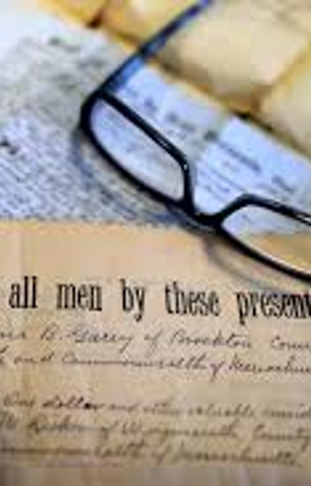
One of the challenges facing family historians is reading and understanding old documents. Handwriting styles have chaged so much over the centuries. Old documents can contain many archaic terms - old monetary terms, unfamiliar date forms - and the whole document in strange writing may appear unrecognisable to the inexperienced eye.

Documents produced since the mid-nineteenth century use words and letter formations similar to those used today.  But as you work back in time, the letter styles become increasingly strange, even though they are in English. This is where you need palaeographic skills. Gaining experience in reading older script and then analysing the documents written in those styles are the two skills most needed to interpret the information a record contains. Every family historian should try to gain some palaeography skills to enrich their understanding and interpretation of records.

Between 1500 and 1900 documents were written in a variety of handwriting styles. Not only that, the various styles were often  mixed up; in many cases, the styles depended on how the scribe was educated. For most family historians it should be straightforward to decipher documents written after 1750, but everyone will come across some older and difficult forms of writing perhaps as late as the 1850s. It is very much a case of practice makes perfect!

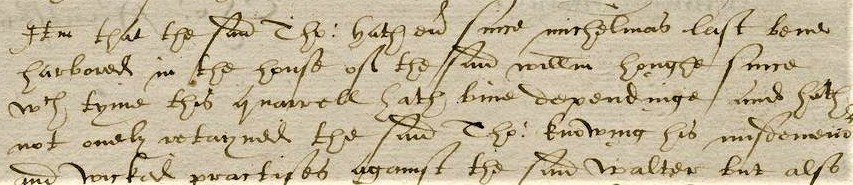
The dominant style of handwriting from the early modern period in England and Wales, was secretary hand. While English was the predominant language, Latin was the official ecclesiastical and legal language until 1733; but Latin phrases lingered in various documents, sometimes until the nineteenth century. Some Catholic registers still use Latin even today. Documents from the Channel Islands will contain French words.

Handwriting styles

DEPARTMENTAL STYLE – This was used in the courts and government departments.

SCHOLASTIC TEACHING – Different types of schools taught different styles.

SCRIVENERS' COMPANY – They had a unique style to indicate that the scribes were members.

Most scribes belonged to either the legal or religious professions. Although there was style, individuals all wrote in a unique way. In general terms the further back in history, the more precise the style of writing.

Secretary hand

Secretary hand was used from the 1400s to mid-1800s (though it became mostly obsolete by 1750). At first glance it may appear archaic and hardly look like English at all.


Chancery hand

Chancery hand was initially the handwriting used for business transactions that developed in England after 1350. This early chancery hand is a form of blackletter script, a sort of calligraphy. Versions of it were adopted by royal and ducal chanceries which were often staffed by clerics who had taken minor orders. Chancery hand will be encountered mostly in the PCC wills and other court records.


Italic hand

Italic hand was used from the 1500s to mid-1800s; it was also known as chancery cursive. It was a slightly sloping style of handwriting and is one of the most popular styles used in contemporary records. It tended to exist alongside secretary hand and was often used to write words which needed to stand out in a document. It was a popular style of writing with ladies. Italic hand should not be confused with modern style italics. Italic hand is very similar to English Round Hand but contains some older letter forms - the long "s" that looks like an "f" to modern readers - and doesn't always include modern letter forms - "j" as a separate structure from "i". Italic hand was the most common hand in the eighteenth century and came to dominate legal and personal writings.


Legal hand

Legal hand has been used since the early 1800s and is closest to the handwriting in use today. It was used consistently in mid-nineteenth century although elements of it were often used long before that. Legal hand is often referred to as Round Hand.


Cursive hand

Cursive hand is any style of writing in which the characters are joined in a flowing manner, for the purpose of making writing faster. It varies in functionality and usage; cursive hand is used in both formal documents and for private communication. Formal cursive has letters generally joined at the bottom which make it easier to read and interpret.


Simple tips for transcribing an old document

Try reading the document out loud to get the meaning of the content. It also helps with interpretation.

Scan the document. This will give you a working copy and enable you to mark it up, number the lines and transcribe it.

Transcribe the document accurately – don’t try to translate it into modern English.

Number the lines at each end to avoid confusion and cross-working between lines.

Transcribe the document line-by-line, writing out the text exactly as it is written.

Miss out any words you cannot read. (The word may repeat itself more clearly later in the document.)

Making sense of the document as you transcribe

Try and establish what any abbreviations or contractions mean..

Use a dictionary to check on archaic words or those you do not understand. Many words were used to describe goods etc. that are not commonly used today. For example:

YELDING – brewing

TOFT – messuage or homestead

LANDIRON – gate to field

PALLIAS – straw or horse-hair mattress

COFFER – lockable box or chest

COD – pillow or cushion

BARROW – boar or pig

Try to understand the way the scribe used abbreviations. Transcribe them accurately.

Take your time reading the document. Compile your own alphabet for the style of script used or keep an alphabet reference guide with you.

  1. 1

    In most old documents there are two aspects which usually present challenges for family historians - names and capital letters. 

       Capital letters do not stand alone. They are often preceded by flourishes which can be confusing.  Different scribes have different styles.

  2. 2

    Know what type of document you are transcribing. This can be identified by knowing the formulary -  a fixed form or pattern of words usually at the beginning of a document; but in some documents, standard phrases may appear throughout.

  3. 3

    Learn to recognise tricky letters; read the document carefully. Compare similar letters in different words.

    Note any word or name variations. The same word in the same document can be written differently!

  4. 4

    For words which are difficult to read, try tracing them and then break down each letter as you do so. Use a magnifying glass to enlarge them - this can help decipher the strange letters. 

  5. 5

    If you are really stuck, ask for a second opinion; how does someone else interpret a particular tricky word.

    There are various people who advertise in the specialist magazines that they will interpret/transcribe a document on payment of a fee. It will be up to you to establish who to use.

  6. 6

    Most numbers are likely to be written in Roman numerals, but unlike today, they will have been written in lower rather than uppercase.

    You will see viii - but today that would be written VIII.

Confusing and tricky letters

The most confusing letters are those which are often joined at the top in old documents instead of at the bottom as in modern styles.

A, c, e and r are particularly confusing as they may all look the same.

Interchangeable i and j. Use of y for i

A single consonant in a word is often seen in old documents but in modern English, you would find two - such as al - all.

An s can look like an f if the long form is used. Where ss is used in a word, it can also be fs or sf or ff.  A capital F is also ff.

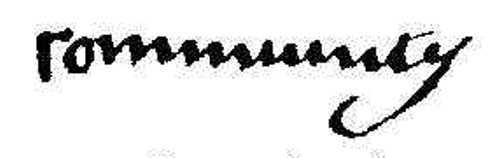
The letters i, m, n, u, v and w can be confusing where used as minims as in community. In palaeography, a minim is a short, vertical stroke used in handwriting.

Incomplete words

Old documents will contain strange squiggles and dashes above or in between letters. These are actually abbreviation marks included by the scribe to show the deliberate omission of one or more letters. They did this either for speed of writing or to save space on the page. It is worth noting that the location of the dash or wavy line may not always follow this rule.

Abbreviations were standard and forms of abbreviation have been in common use since 1500.

CONTRACTIONS  A contraction means the omission of one or more letters in the middle of a word.

SUPERIOR LETTERS  Some letters mnay be raised above the line (some may also be omitted).

SUSPENSIONS  Suspension refers to when the end few letters of a word are omitted (abbreviations).


Punctuation

/ A forward slash was used instead of a full stop – known as a VIRGULE.

“ ( ) Inverted commas were not used as we use them today. Inverted commas and brackets were fully interchangeable.

‘ Apostrophes were generally not used. If they were, they denoted a plural rather than a missing letter.

= Equal signs were generally used as we would use hyphens today.

Various marks - usually curls or waves - were used at the end of lines as space-fillers, particularly in legal documents. These are often confused with minims.

BE CAREFUL

The more familiar you become with the the style and terminology of various documents, the easier your transcription task will be. Learn more in another article in this section - Manuscript Interpretation.

Practise as much as you can looking at handwriting styles and letter formations. 

REMEMBER - an incorrect transcription of a document can change its meaning drastically! 

So do pay attention to every little detail. It could make a huge difference to the outcome of your research.

This article was contributed by Ian Waller from Family History Federation.
Website by Beachshore