



The archive of the British Insurance Industry is one of the largest collection of records in the United Kingdom. By their very nature, they are incribly detailed documents and therefore of significant value to family historians.

Insurance has been around for centuries in different forms and in the Victorian era. Insurance was not restricted to the wealthy upper classes because people like drovers, servants, artisans and skilled craftsmen all insured their property and themselves so there is a good chance that you will find information about an ancestor in insurance records. Insurance records are a very reliable source of economic and personal information; the earliest policy dates back to around 1690.

There are four aspects of insurance which can be researched for vital family history information. 

Fire insurance...Life assurance...accident insurance...and marine and boiler insurance.

Fire insurance is considered to be the only class of insurance which has been given serious attention from family historians but there is value in pursuing the records of life assurance, accident insurance and to some extent marine and boiler insurance. The reason for considering these documents is because insurers required detailed information about each type of risk. Knowing this, you will be able to find out about the businesses, buildings and more importantly the people who owned or ran them by looking at policy registers and other associated records.

The structure and finance of in excess of 300 different insurance companies has been a major factor in the development of insurance business since the early 1700s with alliances of the companies affecting the type of insurance business conducted and their survival. Many of the smaller and specialist companies have now amalgamated or been subsumed into larger groups such as Aviva, AXA, Legal and General and Sun Alliance Star to mention but a few.

Many insurance companies were originally based in London and their archives are deposited with the City of London Joint Archive Service. Some insurance companies maintain their own archives, including those of their constituent companies and their records including policy holders, staff, agents and administration are available, usually by appointment with the various company archivists.

Fire insurance

It was inevitable that the 1666 Great Fire of London was a turning point in the establishment of fire insurance, and from the late seventeenth century onwards London-based insurance companies offered this type of insurance; they later began expanding into provincial towns and cities. Companies such as the Sun, Royal Exchange, Phoenix, Hand-in-Hand and Westminster developed substantially, often working through a network of provincial and local agents.

These records are an absolute goldmine of information and form the largest series of insurance records. They reveal details of full names of the person taking out the insurance, trade and status, information about the premises insured, name of tenant or occupier, value of plant and machinery, stock, materials etc together with the name of the agent and any other information that the company required.

Buildings and contents insurance was frequently offered so this concept is nothing new. Every type of building from domestic to industrial could be insured - but some risks were uninsurable because of hazardous trades, types of construction and so on. Personal effects as well as property were also insured. Details of items insured were recorded in policy registers so a wealth of information can be found about your ancestor.

Here is a policy register example.

In 1845 Eleanor Rumball and Robert Rogers, as executors for her father Thomas Rumball, are shown in the registers of Sun Insurance as holding two policies.

One was insuring a house at 10 Pancras Lane, Queen St, Cheapside in the tenure of Walsh, wholesale draper; it was of brick construction and insured for the sum of £1200.

The other policy insured a house at 43 Bishopsgate, in the tenure of an unnamed  dealer in umbrellas; it was of brick and timber construction and insured for £800.

Thomas Rumballs’ will mentions other property which may be insured elsewhere. His executors had taken out new policies based on the fact that Thomas’ properties were already insured. The dates of the policies and the date of grant of probate coincide.

The value of fire insurance policies

There are many joint policies held where the first named person is usually the more “senior” of the policy holders.  If a policy holder was referred to as “gent”, the policy was usually about a private dwelling rather than a place of work. If the insured was engaged in more than one occupation, then the policy may only record the principal trade. When estates, farms or factories were being insured, most were valued separately and then described in “inventory style” with separate descriptions of the valuable items. Items which had less value were often lumped together.

Perhaps the most valuable insight that insurance records show is the frequency with which people moved.  It is often thought that the wealthy were fairly static, but many moved as frequently as twice a year. In order to discover these changes, you should look at the endorsements books as these give changes of address which link policies together. Endoresments form a valuable part of research and are contained in endorsement books as opposed to policy registers. It is easier to work from policy register to endorsement book as many policy register entries give endorsement numbers.

The City of London Joint Archive Service hold policy registers from about eighty London-based insurers. Accompanying indexes are a valuable finding aid. The Hand-in-Hand company registers are indexed by name. The early Sun registers are indexed from 1714 to 1839 some of which are online. There is a numerical index to Sun registers for the period 1723-1863 which relates policy numbers to individual registers. Some Royal Exchange registers are indexed up to about 1787. However, like all indexes, there are limitations and peculiarities such as contemporary spelling of personal, street and place names.  Street numbers appearing in a policy may have changed over time. Some policies covering multiple properties may not be indexed under all addresses.

It should be remembered that the information which appears in the records is only as good as that provided by the policy holder. It is important to realise that the Inland Revenue did not have access to the policy records, so any values given of real property, personal goods, chattels and stock were at best estimated by the policy holder rather than as a result of a professional valuation.  There is a strong supposition that policy information is accurate and this is particularly true of change of addresses because prudent insurers would always transfer their policy when they moved. Such information can therefore be crucial in tracing major family events and is certainly more accurate than finding an entry in an out-of-date trade directory.

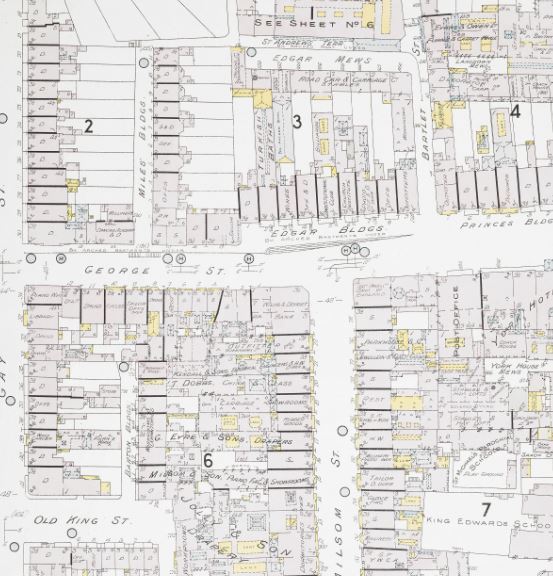
As with all family history research it is essential to refer to contemporary maps. Fire insurance maps and plans are available which record in detail the location, type and use of any property. In 1886 Charles Goad began to produce insurance maps for the larger towns and cities which were updated every five years or so until well into the mid-twentieth century. Most insurance companies paid a “subscription to borrow” with access restricted to subscribing companies.  A complete collection of Goad's Fire Insurance Maps is held at the British Library and some are held by the London Metropolitan Archives, the Guildhall Library and are available in many local archives.

There are some research constraints. The extent of the records means your research will take time, especially if you cannot match the policy number to a name. Some registers may not be available due to conservation issues. Other associated records such as minutes and account books may also be stored in a different depository elsewhere because they are used less often.

In provincial areas, insurance business was conducted by the company agents who normally kept their own records. Such records where they survive may well have ended up in county record offices although some insurance company archives do hold their agents' records. The best way to find agents is by using local directories which normally list them as “insurance agents” and name the company.

Fire marks

Policy holders purchased a unique metal fire mark to display on the insured premises; this was done to indicate to the company fire brigade that their property was insured with that company.

The fire marks included the policy number so if they appear on a photograph or exist within the family archive, that can be an easy way of finding details in a policy register.

Before municipal fire brigades became established, each insurance company had its own brigade in most towns and these were administered by the company agent. Lists of firemen and records of calls are often found amongst the agents' records. It is also useful to search local newspapers to find reports of the fires.

Information in a policy document

This policy relates to one of my ancestors, Elizabeth Harrison of Eastbourne, but is typical of the information that can be obtained from a policy document.

Policy provider – Each insurance company had a unique identity and logo forming an integral part of the policy document. Companies also showed its office locations including the branch which issued the policy.

Policy number and first payment – Every document shows the policy number which is the same as that recorded in the company’s or agents' policy register. The date and amount of first payment is also shown, usually based on an annual renewal.

Sum insured and renewal payment – The amount insured initially is recorded at the top of the policy and also in the main body of the document. The policy would remain operative as long as the premiums renewed. Premiums frequently stayed the same for years.

Policy holder – Full details of the name of the person insured are recorded as the document is in effect a contract. Where a woman is a policy holder, they will usually show marital status. Some idea of their status can be deduced from the address.

Insured property – The bulk of the policy document will detail those properties or items of household and personal effects which are included in the policy.  The construction and use of the premises where items are held is also given.

Legal jargon – The “small print” sections of the policy document are common to all, and besides the agreement, they also give basic details of the insurance company and their overall liability. There is little genealogical value to this section.

Company officials and agents – A policy is signed and witnessed by company officials as it is a legal document. This policy was initiated by an agent, W. A. Watson whose number is 9286 rather than the company.  The agent’s records and registers may well be where the policy details are given rather than the insurance company records.

Fire insurance maps

Charles Edward Goad 1848-1910 was a renowned Canadian cartographer and civil engineer. He is known for his insurance surveys of cities.

Fire insurance companies needed to know every little detail about the property and area they were being asked to insure - building size, width of streets, construction, building materials and most imprtantly the nearest water supply.

Goad’s street maps were specifically created for insurance companies to underwrite the risk of urban fires. They dominated the insurance map sector from 1885. His fire insurance plans focussed on commercial, warehousing and transport properties and his maps and plans were generally to a fairly large scale of 1:480. The maps would normally be bound together in a book which was then leased to an insurance company, accompanied by a key plan, so that they could calculate estimated appropriate premiums.

Insurance companies would then send the leased plans back for any revisions to be overlaid or for major revisions and have them replaced. Alternatively revisions would be sent out to the insurance company for them to add to or replace existing maps.

It is therefore necessary to make sure that you are viewing the correct map for the time period. The maps would include environmental information and note structural particulars of the building as well as the availability of water-supplies. 

Life assurance

There are two ways to approach research of life assurance; you can either research the company registers or look for actual life assurance policies and any correspondence that might be in family or estate papers. If you cannot find a policy, it is often a mammoth task to find out which company insured the person. Each policy holder had to give details of his address, occupation, date of birth and often statements relating to health and habits. This information was summarised in policy registers maintained by the life offices and may not be available on the policy itself.  

An early entry in the London Assurance Corporation's policy register provides some important military information that can be used in other research. Susanna Hartley of London a spinster insured the life of Capt. Charles Scott of Brig. Tyrrell’s Regiment of Foot for the sum of £360 if he died before a certain date, £270 if he died within six months of the policy date.

Policy registers often included soldiers, particularly officers and travellers as well as speculative investors.

In many cases policy registers are supported by evidence of death such as a death, burial or undertaker’s certificate or declarations by executors summarising age, occupation and cause of death. In some cases wills have been lodged with claims, particularly if the insurance company acted in an executor role; there may be a company register containing will extracts. The distribution of wealth and savings is often revealed in the records.

Most policy holders were men. The time lapse between the first premium payment and the dates of deaths of the insured shows that most people only insured themselves for the last twenty years or so of their lives. Most policies were taken out by people in their thirties or forties. 

Interest in life policies was a financial security for many investors. Specialist auction sales of policies were common in the late 1800s and early 1900s; these sales of policies came about because the policy holders defaulted as a result of bankruptcy or insolvency. Records of such sales can be found in surviving auctioneers' catalogues and solicitors' business records, usually held by local record offices or still in private archives.

Marine and boiler insurance

Britain has a proud nautical history going back years; we are a sea-faring nation! Marine insurance risk books are a valuable resource. Records of marine insurance relate mainly to names of a shipper (the person who insured the cargo), the name of the vessel and its master and ports of call on its voyage. Most will not specify the type of cargo or name the owner of the vessel. If the policy was underwritten by a broker, than it may well fall within the auspices of Lloyds' Underwriters which is a completely separate subject. Merchants and others travellers such as civil servants, diplomats and missionaries going to foreign lands to live, usually insured their own belongings.

Boiler insurance is closely connected with the advent of steam ships and high-pressure boilers from c1800. Although not many family historians will have direct ancestors who are connected with this type of business, the results of accidents from explosions may well have affected your ancestors, so you could find reports from insurers or their engineers in the accident records. Documents usually lodged in local archives sometimes contain a copy of the policy which could be in the name of an individual or a company.

Accident insurance

The term accident insurance denotes all types of commercial insurance other than marine, fire and life businesses. The risks of accidents at work, while on journeys, possibilties of breakages and the threats of theft gave rise to a class of insurance which is comparatively recent in the British insurance business; it began around 1840.

Policies are normally quite mixed and short-term.  Perhaps the most important type of policy was railway passenger insurance; unfortunately there were no such insurance schemes in place for disasters such as the Dee Bridge (1847) and Shrivenham train crash (1848).

Accidental death schemes, which even insured officers travelling to the Crimea War, developed after 1850. The policy registers provide only basic details such as name and date and are normally held in insurance archives.

This article was contributed by Ian Waller from Family History Federation.
Website by Beachshore