


From 1668 and the voyage of the Nonsuch until 1970, London was the centre of Hudson Bay Company’s business. Administrative offices, warehouses, suppliers, bankers, customers, shareholders and auction rooms were all located in London. 

Brief history

The Hudson Bay Company was established in early May 1670 after King Charles granted a charter to his cousin Prince Rupert. Several supplementary charters modifying the original one were granted over the years, the last being in 1970. The correct name of the company is Governor and Company of Adventurers of England trading into Hudson's Bay. The governor was the chairman and the adventurers were the investing stockholders. The stockholders were also known as proprietors and their meetings were called general courts. The governor, deputy governor and committee were elected at the general court. The original company was set up as a joint-stock company and the permission of the governor and committee was needed for any sales of stock. In 1863 the company shares were publicly traded.

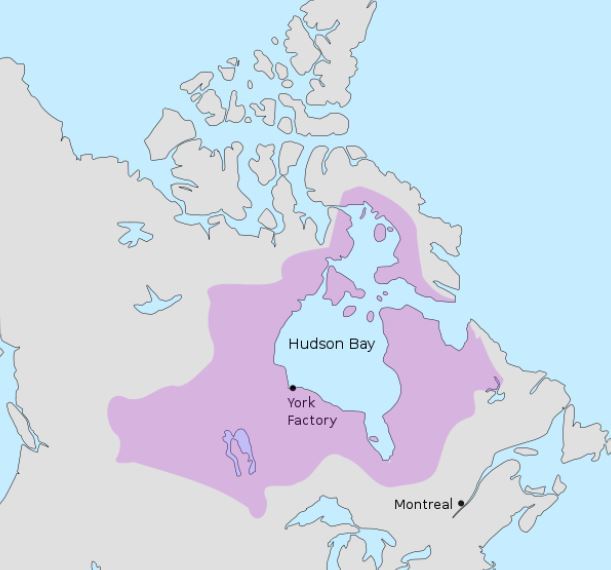
The original charter made the Hudson Bay Company the proprietors’ of Rupert's Land which was around a million and a half square miles of western and northern Canada surrounding the Hudson Bay basin (around forty per cent of Canada). Charles decreed that the land was his to give because no other monarch had claimed it.

By a Deed of Surrender in 1869, the company transferred Rupert's Land back to the crown and in 1870 the land was incorporated into the Dominion of Canada. As compensation the company received a large amount of money and extensive landholdings. For the first two hundred years of its existence, the fur trade was the chief trade of the company. Later it diversified and took advantage of other opportunities becoming involved in the oil industry and as a general retailer.

The fur trade meant the company interacted with many different people including the indigenous people of North America. Many of the fur traders had native indigenous wives and families. The basis of the fur trade was simply the exchange of goods for furs. This trade also enabled the company to develop contacts with suppliers of goods and the fur buyers. The company had the most significant fur auction houses in the world.

When Rupert's Land became part of the Dominion of Canada, the company had to adapt as agricultural settlements transformed Canada. Retail outlets were established in towns and cities across the prairies and throughout British Columbia. Because of this the company was heavily involved in the sale of farmland and urban building plots, and from the early twentieth century its mineral rights formed the basis of its oil business. During the First World War, the Bay Steamship Co. Ltd. was created to manage the company’s expanding merchant fleet.

How British was the Hudson Bay Company?

Throughout its history the company employed nearly 20,00 people many working in the United Kingdom as well as many British people living and working in Canada or on the ships.

Hudson Bay Company’s shareholders typically met at Prince Rupert’s residence or one of the coffee houses in London in order to conduct business. However, the company had its own premises and their head office was Hudson's Bay House dating back to 1682 when they leased premises at the Scriveners’ Hall, Noble Street. They later moved to offices at 3-4 Fenchurch Street and 1 Lime Street, London.

In 1925 the Company opened Beaver House in Great Trinity Lane on Garlick Hill. containing administrative offices, fur auction rooms and a warehouse; and in 1940 their Head Office also relocated to Beaver House from Hudson's Bay House. Beaver House was the official headquarters until the company relocated to Canada in 1970.
Company archives

Since its establishment in 1670, the company has kept a careful and detailed record of its staff, activities, growth and expansion many of which have survived. In the 1920s the company’s head office in London, began to organise its records to make them available for research use and in 1974, after it transferred its head office to Canada, made its records available through the Archives of Manitoba.

Records include the following:

Governor and Committee records:

Governor and Committee fur sales books, 1763 - 1810, 1858 - 1923

Fur trade importation books, 1799 - 1913

Hudson’s Bay Company farm land agreements, 1879 - 1961

Officers’ and servants’ ledgers and account books 1719 - 1922

Lists of servants 1774 - 1841

Servants’ contracts 1776 - c 1926

Servants’ character and staff records 1822 - 1832, 1851 - 1905

Northern Department servants' engagement registers 1823 - 1895

Confidential reports on clerks and postmasters 1873 - 1894

Departmental and district staff records 1871 - 1915

Fur Trade Department general personnel dossiers 1896 - 1976

London staff salary books and records of service (1901-1972)

Management personnel files 1903 - 1977

Ex-long service employees files 1903 - 1973

Company names' index and biographical sheets

You can also search the Hudson Bay Company Archives Name Indexes and Biographical Sheets but please be aware that these do not include every employee. They include biographical sheets for individuals who worked for both the Hudson’s Bay Company and/or the North West Company. The employee biographical sheets are organized alphabetically by surname but be aware that some spelling variations exist. These are available online.

Information includes:

  • Name
  • Place or origin
  • Date entered service.
  • Date of birth/death
  • Appointments – including years, occupation/position, location, regional district.
  • Document reference within the archive for more information

Occupations within the company

The following are some of the occupational terms used by the company and listed on the biographical sheets.

  • Boute - skilled bowsman (the crewman in the bow of a canoe or boat) and steersman in a canoe or boat.
  •  
  • Chief Factor - the highest ranking Commissioned Officer, usually in charge of districts with the right to sit at the annual meeting of the council and to vote on promotions for clerks and chief traders. They were also entitled to just under one per cent of the fur trade profits in each outfit.
  •  
  • Chief Trader - the lower rank of Commissioned Officer with a share of profits equal to half that of a Chief Factor. They could take charge of districts.
  •  
  • Clerk - employees one step below the Officers. Salaries varied dependent upon responsibility.
  •  
  • Factor - a man in charge of a company post; under the 1871 were the third rank of Commissioned Officers.
  •  
  • Freeman - an employee who had completed his contract and was free of any obligation to the company. Many continued to trade with the company or work as casual labourers.
  •  
  • General Charges - Those employees not yet assigned to a particular post.
  •  
  • Guide - an employee who conducted people through unfamiliar territory and usually presided over and commanded two to five craft.
  •  
  • Inland Trader - This was an early term for a man in charge of an inland post.
  •  
  • Interpreter - an employee who could speak the local language, often their mother-tongue, to help the man in charge of a post conduct the trade.
  •  
  • Labourer - an unskilled employee.
  •  
  • Master and Trader - an early term for the man in charge of a post.
  •  
  • Master of Schooner - person in charge of a sloop or schooner.
  •  
  • Middleman - a crewman in the middle of a boat or canoe.
  •  
  • Postmaster - Most were Scottish, Canadian or Métis labourers and tradesmen who had risen to clerical or junior managerial posts.
  •  
  • Servant - general term for a company employee.
  •  
  • Slooper - a crewmen on company decked vessels or schooners on Hudson Bay.
  •  
  • Steersman - the crewman in the steer of a canoe or boat, responsible for guiding the boat.
  •  
  • Trader - employees stationed in outposts who undertook negotiations and dealings with Indians in their camps. Many were not classed as permanent servants.
  •  
  • Tradesman - men skilled in a particular trade such as carpenter, joiner, blacksmith, stonemason, boatbuilder etc.
  •  
  • Writer - an early term for a clerk

Records available in England

The National Archives at Kew have microfilm copies of some of the Hudson Bay Company records in series BH1 including:

Headquarters records

Records concerning posts in North America

Logs, books and papers relating to company ships.

Governors' papers and records from the Commissioner's Office.

Miscellaneous records, which include correspondence and journals of various individuals, as well as records of the Red River Settlement 1811-1890, Vancouver Island colony 1848-1861, Arctic expeditions 1824-1866.

Records of allied and subsidiary companies.

Manuscript and published maps, charts and plans of Hudson's Bay Company forts, coal mines, etc.

This article was contributed by Ian Waller from Family History Federation.
Website by Beachshore