The Gazette is therefore a valuable resource for family historians because it provided information on paupers from all over the country who had deserted their wives and families, leaving them chargeable to the Poor Law Unions. Leaving a family chargeable to the Union was a criminal offence - but it did not stop there. To have deserted the workhouse meant most did so in workhouse clothing, also technically a criminal offence. Having deserted maybe they went on to establish another family elsewhere or even commit bigamy if they subsequently married whilst their “former” wife was still living.
The authorities did not want to have the responsibility for providing financial relief for deserted families so they issued descriptions or mini biographies of the deserters to help facilitate their apprehension.
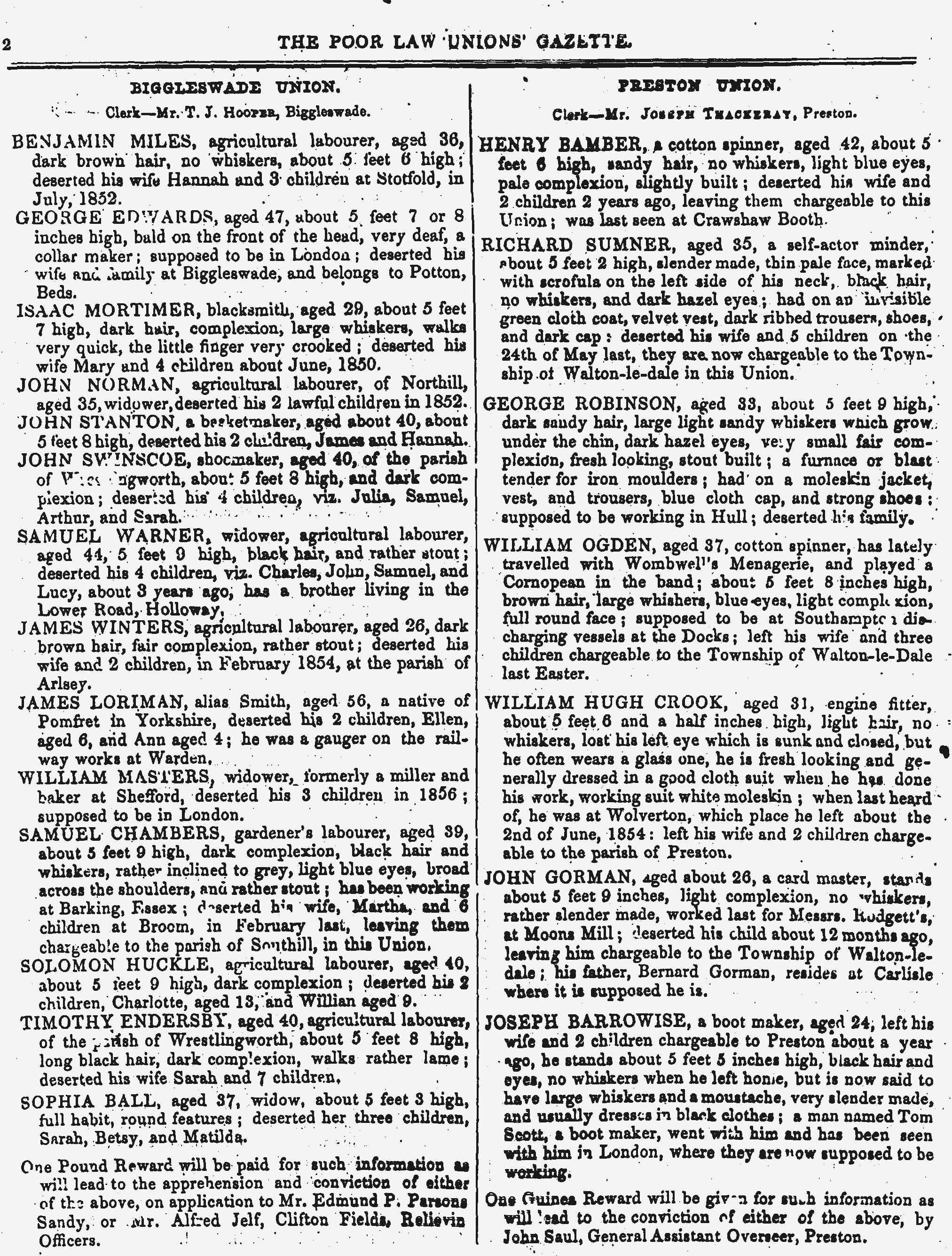
Although the majority of deserters were men, it was also easy for women to desert although few ever did where children were involved. Information about men and women who deserted their families was published each week. Descriptions of the deserters appeared under the listing submitted by the Poor Law Union from whose workhouse they had deserted. The descriptions would include their last known address, their age, height, build, facial features and occupation; it would also include any information about known associates. These descriptions in the Gazette are usually a rich and fascinating source for family historians and may be the only descriptions given about an ancestor. Some of the descriptions were very detailed. Valuable information to aid research often existed as in the following example.
SAMUEL CHAMBERS, gardener's labourer, aged 39, about 5ft 9 high, dark complexion, black hair and whiskers rather inclined to grey, light blue eyes, broad across the shoulders and rather stout, has been working at Barking, Essex; deserted his wife Martha and six children at Broom in February last leaving them chargeable to the parish of Southill in this union.