



Death duties were taxes in England and Wales levied on estates left either by wills or letters of administration.

Death Duties

Death duties comprise three different taxes:

  • Estate Duty
  • Legacy Duty
  • Succession Duty
  •  

Registers which contain details of the estate left and the beneficiaries are held at The National Archives in series IR26 and cover the period from 1796 to 1903 but some records for the 1890s have not survived.

After 1857 you should find information for estates valued at over £20 although it is known that taxes were not always collected on estates with a value of under £1500; so any information in the register may appear incomplete.

Death duties were not levied on estates of those who died serving their country in the military or navy; nor was duty levied on British subjects residing abroad or having property in another country. However, duty was charged on personal estates if people living abroad died in England or Wales - but only after 1894. Death duty registers were discontinued after 1903.

This information relates only to England and Wales.

A shortcut to wills and administrations

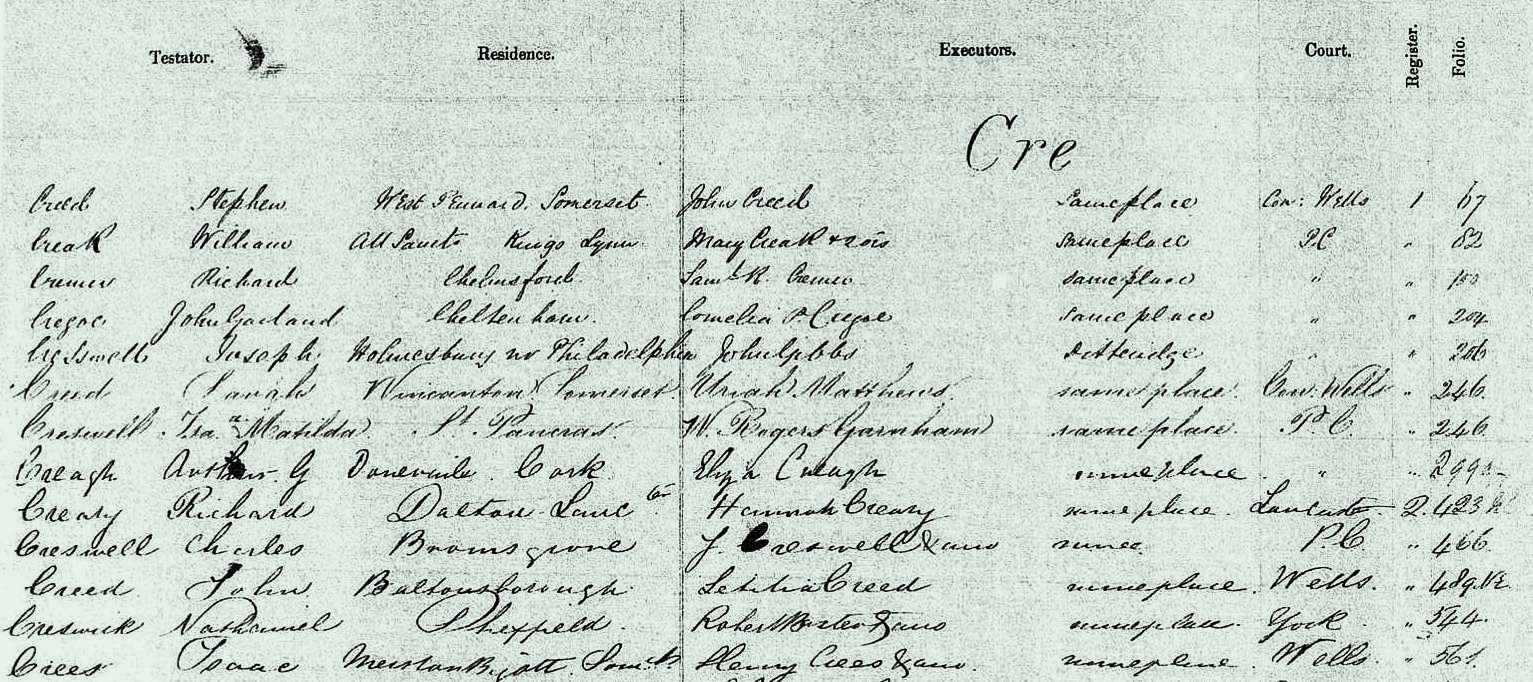
Before the centralisation of probate administration when wills were proved in the ecclesiastical courts, the indexes to death duty registers in series IR27 show in which ecclesiastical court the will was proved or administration granted. These indexes are available digitally online on Findmypast and can be searched by name.

The indexes to the death duty registers

The indexes to the death duty registers contain over 3.3 million transcripts and digitised images of the originals created by the Estate Duty Office (which later became part of the Inland Revenue) of all wills and administrations attracting death duties from all the probate courts in England and Wales.

The information in the death duty registers index includes information about your ancestor, namely:

  • Name and address of testator
  • Date of death
  • Name and address of administrator
  •  

This information in the indexes is very helpful to family historians. If an entry is located in the indexes, it will enable you to quickly locate the appropriate entry in the death duty registers which contain information not found in any other probate-related document.

The registers were created by the office responsible for collecting taxes on personal estates. The registers could be annotated for many years after the first entry and therefore can include information such as the date of death for a spouse, dates of death or marriage of beneficiaries and grandchildren, and further residential addresses.

The index effectively becomes a national index to all wills and administrations which attracted death duties from 1796 to 1903 thus  expanding the usefulness of the post-1858 national probate calendars. Not every will or administration is included but post-1815 you will be unlucky if a will cannot be traced using the index.

The different duties

Legacy Duty

In 1796, legacy duty was payable on money left in wills or as a result of an administration of a personal estate. Next of kin including wives and children were exempt from duty but beneficiaries who were more distant relatives were taxed at different levels depending on the relationship between the deceased and the beneficiary.

From 1805, legacy duty included closer relatives and money received from the sale of real estate. The Stamp Act of 1815 resulted in duty being paid by all beneficiaries except spouses.

Succession Duty

Succession duty was imposed after 1853 as an addition to legacy duty which meant that a tax was payable on any sort of property transfer at death with or without a will or administration.

Estate Duty

In 1881 probate duty was introduced and taxed all personal property bequeathed at death but this was replaced in 1894 by estate duty which taxed all property bequeathed at death.

Between 1796 and 1812 abstracts of wills and administrations were deposited with the legacy duty department of the stamp duty office, but after 1812 actual copies of all wills and administrations were deposited. Until 1812 a separate index for each court existed. The office evolved to become the Estate Duty Office and registers were compiled with details of all estates liable to duty and it is these that are known as the Death Duty Registers (DDRs). To find an individual entry in the death duty registers you need to consult the indexes.

A tip when searching for a pre-1857 entry

Searching the indexes is more straightforward if you are aware of the system of proving wills or issuing administration grants. Essentially this was the responsibility of the church before 1857.

The jurisdiction of an ecclesiastical court could mean it had jurisdiction over several parishes in more than one county; for this reason, between 1796 and 1811, the estate duty office created a separate index for each court which are not indexed by county but by the court name.

It was usually the location of property that determined at which court the will was proved meaning that sometimes the court was not geographically near where the deceased lived or died. Sometimes it was more convenient or the executors' choice for wills to be proved in a higher court than necessary. More wealthy people tended to utilise the higher courts as a status symbol.

Don’t forget that the PCC was also the preferred court for many nonconformists who were opposed to dealing with the Established Church anyway. All serving military and naval personnel, people who died abroad and foreign resident people who died in England and Wales had to have their wills proved at the PCC. During the Commonwealth, 1653-1660, the PCC was the only court in existence at which wills could be proved.

Death duty registers

Information in the registers is not the same as that contained in other probate records. The registers come into their own where an administration exists as they contain more details than the scant information found in an administration grant because they detail all those entitled to any distribution of an estate.

The registers often remain “active” for around fifty years meaning that subsequent generations of a family may well be included. Each entry can and frequently does provide the following information:

  • Name, address and last occupation of the deceased
  • Date of the will
  • Date of death after 1889
  • Date of probate and where proved/granted
  • Names, addresses and occupations of all the executors and trustees
  • Information about the estate, legacies, trusts etc
  • The amount of duty paid
  • Details about the beneficiaries including their relationship to the deceased.
  •  

A valuable resource contained within the registers is the fact that they can be annotated with details of later generations and can include:

  • Date of death of a spouse
  • Deaths or marriage information of any beneficiary
  • Births of children or grandchildren occurring after the death of the testator
  • Changes of address for beneficiaries
  • Any reference to litigation arising from probate
  • If an estate was left in trust you should also research the reversionary registers which also form part of the series.
  •  

In some cases it may be necessary to look at two different registers - one for personal estate (legacy duty) and one for real estate (succession duty). This applies particularly for the period 1853-1894.

In some sections of the register abbreviations are used to denote either consanguinity or contingency; there are also other general abbreviations which require an understanding. Don’t let this put you off!

Value of an estate

Another important aspect of the registers is the valuation of an estate. This can be “hit and miss” because it will not include a deduction for the payment of debts and funerary expenses and sometimes part of a personal estate may not have been considered. The value placed on bequests may be inaccurate and the value may be assessed depending upon the tax bands in force at the time.

This article was contributed by Ian Waller from Family History Federation.
Website by Beachshore