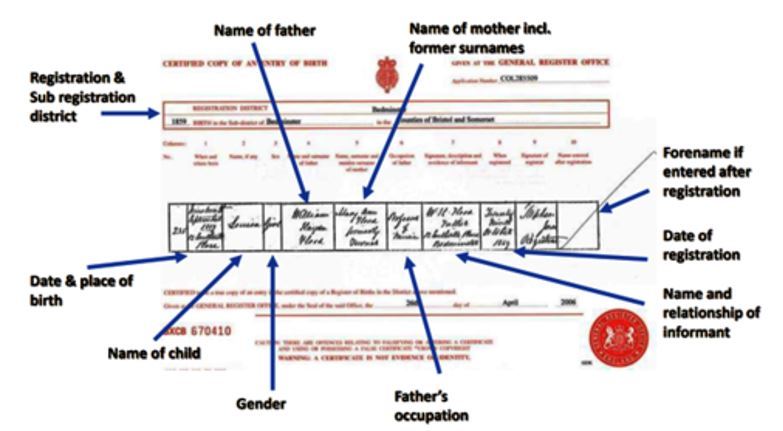
The information contained on a birth certificate is shown in the following illustration.





Birth certificates are the foundation of family history research into an individual. They will help take you back to the next generation, usually providing the father's name and occupation, and the mother's maiden name. Having these details allows you to find a marriage for the parents, therefore it follows that the information given will confirm the correct marriage has been found. Many family historians ignore information in death certificates, but such detail is useful in locating other various records generated after death.
The information contained on a birth certificate is shown in the following illustration.
Always search birth indexes for a period of years either side of the assumed event date rather than a single year.
Only use family information as a guide - there is usually an element of truth in it.
Keep an accurate record of the years searched in the indexes
A child may have been born in a different place from where the family was resident. The mother would often give birth at her parent’s home or an institution away from her normal residence which may have been in a different registration district.
If no father is given, do not assume illegitimacy – go out to prove it.
The mother’s name column should show if she was married more than once as former surnames should be shown.
An occupation may be “enhanced” or inaccurate depending upon the knowledge of the informant.
Note the registration district as this may be useful in locating other information about a family such as workhouse admissions, other family events etc.
Some births prior to 1875 may not be registered, however, most children were baptised. Around twenty per cent of births occurring between 1837 and 1875 were never registered; even after 1875 some births were not registered or were missed off the registration indexes.
Surnames were sometimes indexed under unexpected spellings.
A child born before the marriage of the parents may have been registered under the mother’s maiden surname.
A child initially registered without a forename will be indexed at the end of the surname listing as either “male” or female”. This could be a clue to nonconformity or Catholic ancestry. In such cases forenames may have been entered on the certificate later.
Be sure to note the mother’s maiden surname when shown in the indexes as this will help to identify the correct certificate. All birth index entries on the GRO search include this information.
If you cannot locate a birth in the national indexes, try an application to the local registrar.
Sometimes births are registered using a different name from that by which the child is subsequently known. The use of nicknames and pet names in later life was very common. There may also have been a change of name formally by deed poll or use of alias names later in life.
There may be a mis-transcription of surnames in various online indexes. Gender mix-ups of forenames were also quite common and confusing. For example, Francis for female and Frances for male. This is wrong; Francis is male and Frances is female.
Original indexes were also hand-produced giving rise to possible copying errors.
A parent or other person present at the birth was required by law to register a birth within forty-two days. The legislation introduced in 1874 imposed a fee for late registration which in any case had to be within six months of the birth. This penalty sometimes forced parents to "adjust" their child's birth date to avoid paying the fee.
If you cannot find a birth, either through the GRO or by application to a local registration office, then the birth may never have been registered or may have been registered under a different jurisdiction, including events registered abroad.
Marriages could take place in Anglican churches and in local register offices after 1 July 1837.
Nonconformist chapels initially were not registered for marriages and any marriage was recorded in the register of the local registrar and not in a dedicated chapel register, although mention may be made in the denomination minute book or other record. After 1898 nonconformist chapels were able to solemnise marriages and kept their own marriage registers.

Ages of both parties may be given as “full” usually meaning over the age of majority. Sometimes ages are inaccurate, particularly that of a bride. If the bride was actually older than the groom, it may not be accurate because it was Victorian convention for the bride to appear younger than the groom.
Marital status is not always correct – widows might be shown as spinsters and widowers might appear bachelors. If the status refers to a divorced individual, it normally states “previous marriage dissolved” or similar.
Some marriages may have been bigamous with no sign of a divorce, in which case marital status usually refers to parties as bachelor or spinster.
Widows usually re-marry using their married surname.
Residence may be same for both parties as these are often accommodation addresses or the same address was used so that only one set of banns was called.
There is no legal requirement for the name of the father to be included. The father’s name may be fictitious or could be the name of a guardian or grandfather. Where no father’s name is given, don’t assume illegitimacy. The true father may be deceased.
Certificates do not always indicate if father is deceased. If the question about father living or dead was not asked at the time, then the father may be deceased but appear to still be living.
Note the method of marriage, banns, licence, certificate as this will enable research to be undertaken in banns books or for a marriage licence bond and allegation.
The method of signature is a good clue of literacy as parties needed to sign the register. The fact that someone could write their name does not mean they could read or write.
Note the names of all witnesses as they may be family members.
Marriages sometimes happened AFTER the birth of some or all of the children.
Information contained on a death certificate can be very important, particularly cause of death as this may lead to other records such as coroner's records, inquests, workhouse admission etc.

Deaths were registered where the death took place - not always at home or in the known locality.
Married women will be registered using their current married surname – may be a clue to a remarriage . If a husband dies, it is always worth looking for a subesequent marriage of a wife to establish the "new" surname before searching for a death.
Ages can be notoriously inaccurate so consider an age discrepancy of at least five years from calculated age.
Death certificates will usually indicate “wife of” if husband is still living or "widow of" if the woman never remarried. In the case of a married female, this is usually shown in the occupation column.
Cause of death can reveal inquests, accidents etc. but can aslo be vague particualrly in the early days of registration before formal medical certification was required.
Causes of death may use generic terms such as old age or natural causes rather than specific medical terms.
If there is more than one cause listed, then the first cause mentioned was the actual cause of death, and subsequent illnesses, ailments etc were contributory to the cause.
Informant information (those who had to be present at death) will provide a clue of death place or relationship to the deceased.






Registered Office: 2 Primrose Avenue, Urmston, Manchester M41 OTY
Email: admin@familyhistoryfederation.com
©2026 Explore Your Genealogy