




Before the introduction of civil registration in 1837, records to key events in people’s lives were recorded in the parishes registers and nonconformist records.

Since the sixteenth century, religion was on the decline. Nonconformity continued to grow in popularity but society generally was becoming more secular and as a result, some events were never recorded in the parish registers.

The poor living conditions and short life expectancy, particularly in northern industrial towns, became a major concern for the government in matters of health, infant mortality, and literacy. Part of the reforms which took place included the establishment of a civil registration system in England and Wales. A General Register Office was set up in London and the office of the Registrar General was established on the 1st of July 1837.

Registration districts

England and Wales were originally divided into 619 registration districts. These were based upon the poor law unions which had been established in 1834 and which were loosely based on the early administrative hundreds. In 1851 they were slightly reorganized and increased to 623 districts, each under the supervision of a Superintendent Registrar. These districts were further divided into sub-districts administered by local registrars.

Civil registration districts consisted of a group of towns or parishes, or parts of towns within a close distance of each other. If you know the parish, you will find the civil registration district. Knowing a specific civil registration district is particularly helpful when your ancestor has a common name.

Organisation of the civil registration system

The registrars of each district were responsible for recording all births and deaths which were recorded in registers. Each quarter -  March, June, September and December - the registrars would copy out the registers onto forms and send that form to the Registrar General along with similar information about marriages for indexing purposes.

Marriages solemnised in churches were recorded by the officiating incumbent in the parish marriage register. Marriages conducted in register offices by the superintendent registrars were also recorded in their registers. Every quarter the incumbents sent a return of all marriages performed in their churches to the superintendent registrar who in turn forwarded copies to the Registrar General.

Parish registers recording baptisms and burials (not births and deaths) continue to be used as do marriage registers. The beauty of using parish marriage registers is that they were completed at the time of the event and carry actual signatures or marks of the parties concerned.

When applying for a certificate from the Registrar General’s office (GRO) it is a copy of the returns made, NOT the original registers which are provided. Local register offices still retain the original registers if they have not deposited them with local archives which is increasingly the case. It is important to remember that with the making of copies, errors may have occurred.

If you cannot find a record by looking at the GRO indexes, then an application to the local register office is frequently successful.

The GRO holds comprehensive records of all births recorded in England and Wales from 1837 onwards plus records for some British Nationals born overseas; and it produces the indexes which need to be searched to locate a possible certificate.

To order the appropriate certificate from the GRO, you need to note details from the index entry:.

Locating an index entry prior to obtaining a certificate

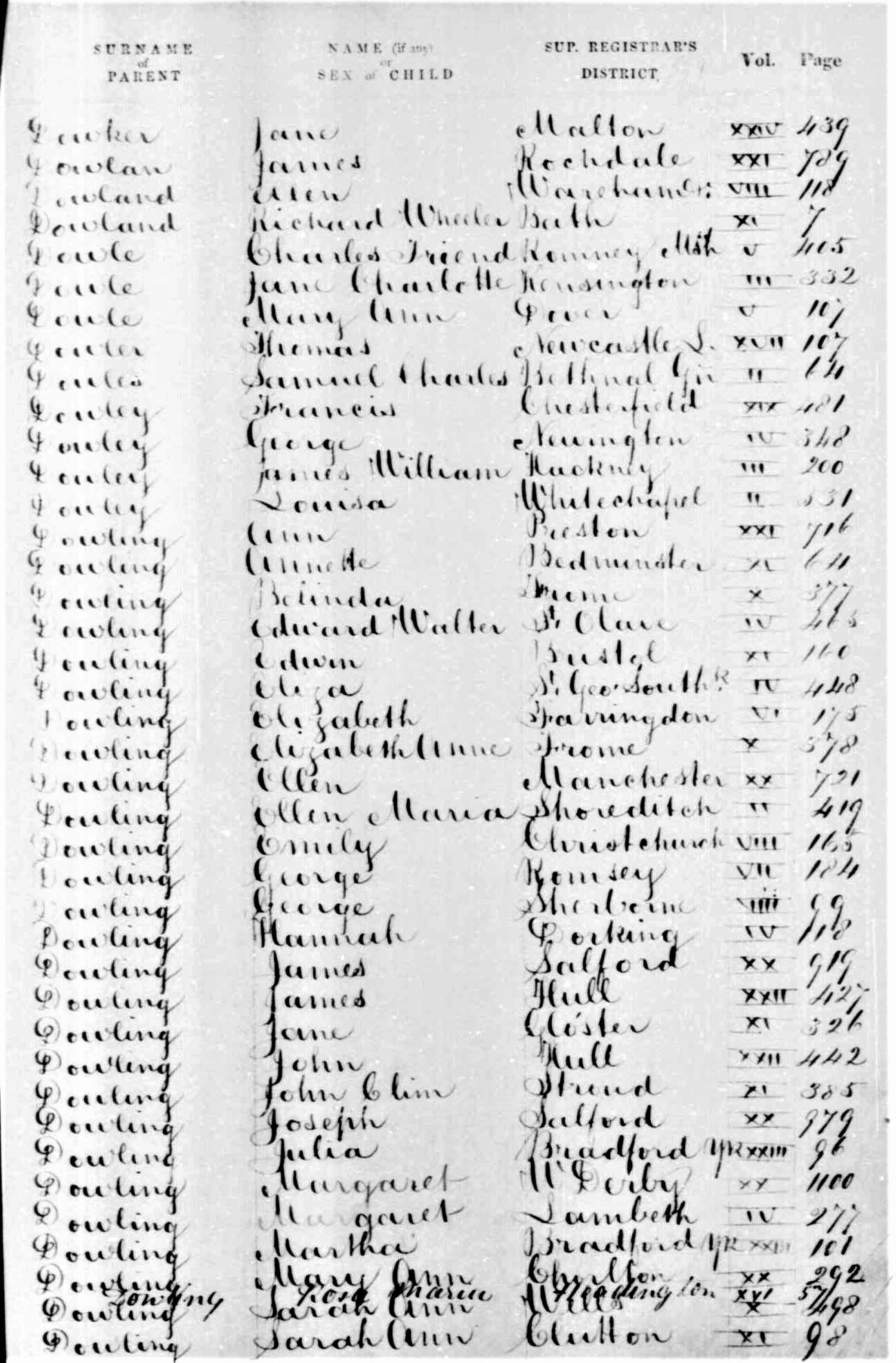
Events are indexed by the date of registration which is not always the actual date the event occurred. Indexes are organised into quarters of the year, identified by the last month of the quarter.

MARCH QUARTER- Jan, Feb, Mar registrations

JUNE QUARTER- Apr, May, Jun registrations

SEPT QUARTER- July, Aug, Sept registrations

DEC QUARTER- Oct, Nov, Dec registrations

You will need to confirm the following information to order a certificate using the GRO online service:

NAME

YEAR and QUARTER of the registration

REGISTRATION DISTRICT

VOL NO

PAGE NO

This applies whether you require a certified copy of the entry or if you just require a PDF or digital image of the original entry taken from the returns.

Digital images are only available for births between 1837 and 1922 and deaths between 1837 and 1887.

PDFs can only be obtained via the GRO website. This option does not include marriages and some years of births and deaths cannot be provided in PDF format.

Application for a certificate of birth and death can also be made to the local registry office where the event was registered. You can also apply to the local registry office for marriages IF you know the parish or chapel in which the event occurred. If you choose the PDF or digital options the base information given is exactly the same as that given on an official certificate.

Different legislation and records exist for births at sea and those which took place overseas or under military jurisdiction.

General tips on using civil registration.

Information on a civil registration record is dependent on the informant’s knowledge. You cannot guarantee that the information given is correct.

Use the system to find certificates of other relatives in the parish where your ancestor lived. Finding cousins can also lead to grandparents.

The indexes are clinically alphabetical so search variations with names such as “Mc” or “Mac” or drop the “Mc” or “Mac”.

If the forename was not included on a registered birth entry, then the entry will show as just male or female followed by the surname listed at the end of the appropriate alphabet listing. You will need to have some idea of the place of birth in order to identify the correct registration district.

Obtain all available certificates to help build the full picture of the family; birth and marriage certificates are particularly helpful for finding or confirming information about the parents.

Middle names do not always appear on the indexes or the certificates. Many indexes only give middle forename initials.

The GRO online search now includes ages at death on death indexes and mother’s maiden name on birth indexes.

Remember that indexes can have omissions or errors.

Search within a range of years - plus or minus five/ten years of the estimated dates. Birth dates may have been adjusted and regarding deaths, the informant may not have known the exact date particularly at death. Some ages are known to be twenty years adrift.

  1. 1

    Establish correct parentage of a child.

  2. 2

    Find out the maiden name of a mother.

  3. 3

    Verify the information gained from family relatives.

  4. 4

    Establish places of residence.

  5. 5

    Reveal actual birth, marriage, and death dates and places.

  6. 6

    Find the occupation of an ancestor.

This article was contributed by Ian Waller from Family History Federation.
Website by Beachshore