


Records generated by the many different types of schools which existed through the ages are a valuable resource to any family historian. Research into education, particularly during the nineteenth century, shows many different types of school that our ancestors could have attended. Even after the advent of compulsory education, many children did not receive a full education because the economicnecessicity of supporting a family still required them to work for a living rather than gain go to school.  However, attitudes began to change for everyone’s benefit.

Board schools

After compulsory education was introduced in Britain, there were a number of different schools including voluntary schools which were funded or supported by Anglican and nonconformist religious denominations..

The 1870 Education Act, (Forster's Act) allowed voluntary schools to continue but also instigated the election of school boards with powers to build and operate schools in areas not covered by the British and National Society schools. The school boards were also charged with establishing the number of school places in their areas with the number of school-age children. If there were insufficient places, the boards had to provide new schools to meet the need.

The main responsibility of the board was to compel the attendance of children at their non-denominational board schools which were funded partly from fees and the local rates and partly by government grants. Many new schools were built as well as improvements made to the existing National Schools by local benefactors and clergy to avoid state intervention. If any school was funded by grants, then it was subject to inspection.

In order to pave the way for compulsory education, the employment of children under the age of eight in any form of handicraft had been prohibited in 1867 - and this restriction later applied to those employed in agriculture. The 1873 Education Act stated that if a child aged eight to ten years had attended school for 250 days a year, they could be employed for the rest of the year; and any child aged ten to twelve had to have attended for at least 150 days before being available for employment. if a child left school before the age of twelve, they had to pass a Standard IV annual examination and obtain a Labour Certificate.

In 1876 school attendance committees were established. These committees had the powers to demand school attendance although there were no powers of enforcement until the Education Act of 1880. This Act imposed compulsory school attendance on all children aged from five to fourteen, unless they lived more than two miles from a school.

However, in the early years of the Act, compulsory attendance was often ignored and in many areas enforcement was virtually non-existent. But in some areas the school attendance committees were active and  prosecuted parents in the petty sessions. These records give details of truancy fines, normally 2s 6d, per child. If the minutes of the attendance committees survive, they may also provide an additional information on specific cases.

School fees of a penny or tuppence a week for each child were often a major problem for many families. Sometimes the boards of guardians assisted the poorest families. By 1891 fees were abolished in the majority of schools because a government grant of ten shillings per child per year was given.

British and National Schools

The British and Foreign School Society was established In 1808 by a group of Quakers to create non-denominational day schools. In 1811 the Society for the Promotion of Christian Knowledge formed the National Society for Promoting the Education of the Poor in the Principles of the Church of England. This society built many additional schools, especially in urban industrial areas.

Many schools came under the jurisdiction and control of the Anglican National Society for Promoting the Education of the Poor in the Principles of the Established Church in England and Wales, with the aim that the mainstream Anglican religion should be the foundation of education and should be the priority subject taught to the poor. Those schools managed by the society were called National Schools.

The British Schools were originally established in 1808 by Joseph Fox, William Allen and Samuel Whitbread, supported by other nonconformist Christians, but from 1814 they were under the auspices of the British and Foreign School Society for the Education of the Labouring and Manufacturing Classes of Society of Every Religious Persuasion. This society supported a number of non-sectarian establishments known as British Schools.

The records of individual "British" and "National" schools are often retained by the schools themselves or have been deposited with the local archives. The administrative records of the British and Foreign School Society are held within the archives of Brunel University.. There is also a museum housed in the former Hitchin British School at Hitchin, Hertfordshire, which is well worth a visit.

The administrative records of the National Society are held by the Church of England Record Centre, in Bermondsey, London. The collections include the surviving admission records and logbooks of those Church of England schools functioning within the diocese of London and of Southwark.

By the nineteenth century, schools were eligible to receive grants from central government, provided they were inspected by HM Inspectors. The 1870 Education Act introduced a series of conditions; if a school was designated as a Public Elementary School,. children could not be forced to attend Sunday school or participate in religious worship. Under the Elementary Education Act 1876’ schools had to be available for inspection. Schools would be ‘certified efficient’ if they agreed to be inspected, even if they refused to abide by the religious restrictions.

Dame schools

Dame schools had been around since the sixteenth century and lasted until the introduction of compulsory education although their origin is unknown. They seem to have evolved from the demand for early childhood education and cheap childcare

During the seventeenth century they were elementary schools run by widows. Dame schools seem to have been widely spread across England by the eighteenth century. They were small, privately run schools for children aged two to five. These schools were taught by a “school dame” who was a local woman caring for children and teaching them the alphabet for a small fee.

Whilst attending the dame schools, pupils were expected to learn reading and arithmetic, and sometimes writing. Girls were often taught knitting and sewing. They were considered the precursor to nursery and primary schools.

In many situations dame schools existed in the teacher’s home. They were were independently run usually by middle-class widows or mature spinsters, although some young, unmarried women also ran them.

Dame school pupils were normally the children of tradesmen and labouring people, and for many, a dame school education was the only form of education these children received. As more and more parents worked in factories, dame schools offered a form of cheap day care. Some only offered child care.

During the early and mid-nineteenth century, educational reform had a heavy impact on the dame schools. Private philanthropists set up free schools to educate lower-class children. Dame schools seem to have survived because some parents did not want to send their children to the free schools and remained happy to pay for their care and education. Later on the Dame schools were viewed as being incapable of teaching children anything useful because they were more informal, run in the kinds of homes their pupils were already familiar with and gave parents more control over their children's schooling.

Grammar schools

The start of the grammar schools dates back to the days of monasteries, cathedrals and other religious houses. Originally every cathedral had a school because cathedrals had to provide teaching for clergy and local children. They mainly taught Latin grammar which remained the basis of their teaching until the end of the seventeenth century. By the middle of the nineteenth century, two-thirds of of grammar schools were teaching ancient languages. Their name derived from what they taught.

In 1840, the Grammar Schools Act expanded the grammar school curriculum from just classical studies to include science and literature.

Industrial schools

Technically these were “schools of industry” established in the latter part of the eighteenth century with the aim of providing work for unemployed children; but they also provided an elementary education. By the nineteenth century after a series of Acts of Parliament, they set up residential schools for vagrant and destitute children where they would receive training to prepare them for work in shoemaking, tailoring, printing and other trades as well as a basic education.

Ragged schools

John Pounds of Portsmouth began providing education for poor children in the early 1840s and the system rapidly caught on. By 1844 the Ragged School Union was established with the aim of converting incipient criminals and to cultivate the minds and hearts of vagrant children and to raise their physical and social state.

It was relatively common for ragged schools to provide industrial training for children and then help them to get jobs or to emigrate when they left school. Teaching in ragged schools was undertaken by both paid and voluntary teachers and initially funded by voluntary contributions.. Some towns set up charity schools in the 1830s for outcast and destitute children which were the forerunners of the ragged schools. By the mid-1850s there were around 150 schools, providing a free elementary education and some practical training for work.

The ragged schools really came into their own in the 1860s and 1870s and were eventually superseded by board schools. There is a Ragged School Museum in Bow, London but it does not hold any records for pupils.

Workhouse and factory schools

Since the introduction of the new poor law in 1834, the boards of guardians had powers to employ schoolmasters and schoolmistresses for the children in their care in the workhouse. The education of inmate children was taken seriously because workhouse children who were sent to “outside” local schools were often taunted.

The Factory Acts of 1833 and 1842 required factory and colliery owners to employ masters to teach their child workers for two hours each day if they were between eight and thirteen years. This fulfilled the education component of the "half-time" system of work for children and was not abolished until 1917. However, the minimum age for child employees was increased to ten years in the 1870s.

Levels of literacy in England and Wales

The existence of a local school is likely to reflect the literacy of the population. Generally the ability to read gave rise to the ability to write. Only a small number of women could sign their names, so it suggests that they perhaps had not atteneded a school.. The proportion of those able to sign their name was generally lower in rural areas; however, literacy was much higher amongst tradesmen and craftsmen than it was amongst servants and labourers. There was a perception that education would eliminate pauperism. The expansion in the number of schools could not keep pace with the growth of the population. It is thought that in the 1850s, half of all children did not receive an education.

School Leaving Ages


The minimum school leaving age

11 in 1893

12 in 1899

14 in 1918,

15 in 1947

16 in 1972.

School records of value to the family historian

School records are more likely to survive where a school was incorporated into the local education authorities in 1902, but the records of the national schools are an exception. Nearly every school kept an admission register after 1870, but not all have survived.

Schools admission registers

School records are one of the primary sources of information for family historians. The most prolific are the admission registers of local authority schools dating from around the 1870s, although those from the early twentieth century are more informative.

The registers will show:

  • date of entry to the school
  • name and address
  • date of birth (or age)
  • name and occupation of parent/guardian
  • previous school attended
  • reason for leaving.

Where immigrant children are concerned, these records may show the name of the previous school in their country of origin. The admission registers may enable the identification of any siblings attending the same school.

School logbooks

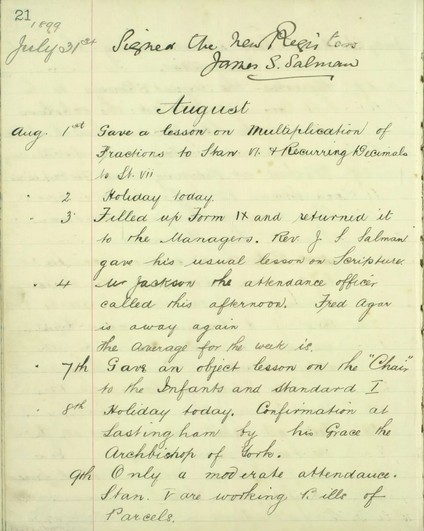
After 1862 the elementary schools which were government grant-aided were required to maintain daily or weekly logbooks in which the head teacher recorded the progress of the school. However, schools without a head teacher that did not qualify for a grant,  or if the buildings fell below government standards, there was no requirement to keep logbooks.

Although content would have varied, most contained the following:

  • comments on attendance, behaviour and discipline, often mentioning pupils by name
  • the curriculum and education standards achieved
  • effect of bad weather
  • pupils who left school mid-term
  • epidemics and illnesses affecting attendance
  • seasonal work in the community such as harvest, potato picking etc.
  • names of individual pupils for other reasons
  • names and status of teachers recorded after the annual inspection
  • summary of the inspector's report.

Punishments administered were sometimes recorded, mainly in early logbooks. Post-1901 separate punishment books were maintained giving the pupil's name, the offense and punishment. Survival of these books is patchy..

School magazines, newsletter etc.

School magazines and yearbooks may survive alongside other promotional literature but they are secondary sources. They may list examination results, those in school sports teams and sometimes information on those who have left. It is not unusual to find an obituary notice for former pupils in the more modern magazines for schools. Generally the magazines are usually held by the school or in local studies libraries.

Online school records

The fact that schools existed means that there are various records available, many of which are online and included amongst the collections are:

  • National Board School Admission Registers and Logbooks 1870-1914
  • Grammar and Public school records
  • Poor Law schools
  • University registers
  • Online resources
  • British Army Schoolchildren and Schoolmasters 1803-1932
  • UK and Commonwealth, Law Examination Records, 1836-1946
  • England and Wales, Girls' Day School Trust Records, 1873-1950.
  •  

From a research viewpoint, there is no general right of access to school records, so even if they have been deposited with local archives, there could be restrictions imposed on access.

This article was contributed by Ian Waller from Family History Federation.
Website by Beachshore