

Couples from all over England took advantage of the Scottish marriage laws and the convenience of getting married just across the border. The border marriages were officiated by “priests” who also provided the couples with their witnesses. Marriage by declaration in front of two witnesses remained legal in Scotland, whereas in England Hardwicke’s Act 1753 banned such irregular marriages.

- Home
- Contribute
-
Browse topics
- Civil Registration
- Parish Registers
- Family Heirlooms
- DNA
- Wills
- Graveyards
- Military
- Archives
- Poor Law Records
- Census Records
- Nonconformist Records
- Occupations
- Old Handwriting
- Names
- Research Challenges
- Leisure and Pastimes
- Both sides of the law
- Maps & Gazetteers
- Society Records
- Education Records
- Genealogical Records
- Newspapers
- Property, Manorial and Land records
- Accidents, Illness and medical records
- Medieval Records
- Relationships
- Scottish Records
- Irish Records
- Resources
- Podcast
- Find a Society
- Subscribe
- Search
- News & Events
- Surname interests
BORDER MARRIAGES
Were these marriages shotgun weddings?
For many English couples the area just over the English border in Scotland was where they could marry without the necessity of going through the process of reading of banns or obtaining a licence. The only formality required by Scottish law to validate a marriage was a mutual declaration of consent made by both parties before witnesses. Therefore places such as Gretna Green, Coldstream Mordington, Sark Toll Bar and Lamberton Toll were very convenient for English couples. The use of these destinations - particularly Gretna Green - up to 1856 was pretty substantial. However, legislation introduced by Lord Brougham in the form of an Act for Amending the Law of Marriage in Scotland 1856 declared marriages illegal unless the couple had been resident in the location for three weeks prior to their marriage.
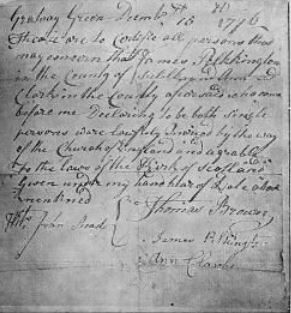
The Scottish venues for marriages
It is thought that there were some two thousand marriages celebrated each year at the various border venues in Scotland. The average number of marriages at Lamberton was only about three hundred and at Mordington around two hundred suggesting most were celebrated in the Gretna area.
Gretna Green
Gretna Green is the place usually referred to as the place for runaway matches because it was the most popular place but it was by no means the only one. The Scottish/English border extended for around seventy miles and Lamberton Toll to the north of Berwick and Coldstream were convenient particularly for the north eastern English towns of Tyneside and Yorkshire. Sark Toll Bar on what was then the main Manchester to Glasgow Road and Springfield were situated just over the Scottish border half a mile south of Gretna Green and for many runaway couples it was the first place they came across where they could marry.
Sark Toll Bar
Sark Toll Bar, sometimes referred to as Alison’s Toll Bar, was an old toll house just on the Scottish side of the border. Its location made it the first place on Scottish soil and often meant the difference between a successful or failed adventure into marriage. It was here that many pursuing fathers were too late to prevent a marriage taking place because many did not realise the venue was used and most were heading for Gretna. Simon Beattie, the toll house keeper, was conducting the quick ceremony which was over before the pursuing father arrived.
In November 1842 Simon Beattie the Sark Toll Bar “priest” had, between late afternoon on a Saturday and the following Sunday evening, married forty-five couples and his successor, John Murray in one evening was said to have married sixty-one.
Cross-border marriages
While the notion of cross-border marriages is that of couples crossing the border to marry against family wishes, many marriages were between nonconformists who chose to marry in Scotland rather than in the Anglican Church which after 1754 was the only legal place to be married in England. Those who met at Hirings Fairs, particularly at Berwick, often desired a quick marriage and also took advantage of the situation because agricultural labourers were only hired for one year and may have to move the following year to obtain work.
Civil Registration in England meant that civil ceremonies could be performed in a register office as opposed to a church but the traditional irregular marriages continued in Scotland until the 1857 Act although this did not completely put a stop to the border marriages. These marriages did not finally cease until the Marriage (Scotland) Act 1939 aligned with England through the establishment of Register Offices in Scotland.
Gretna Green wedding venues
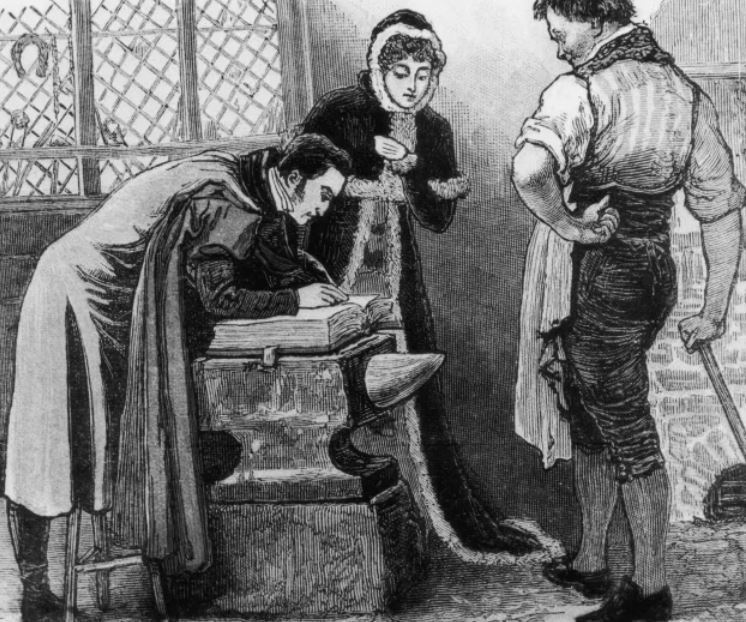
Synonymous with Gretna Green is the symbolic gesture to confirm a marriage - that of striking a hammer on an anvil, so much so that all the wedding venues in and near to Gretna have used the anvil to seal a wedding ceremony. Within Gretna village there were three main venues offering the marriage ceremony. Gretna Green was located on a regular coaching route between London and Edinburgh making it a frequently used venue.
The blacksmith's shop - Today the Blacksmith's Shop is probably the best known of the three venues which is probably attributable to the many 'Blacksmith Priests' who were known to be of a colourful character.
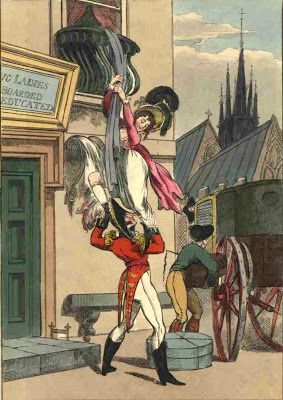
Gretna Hall - Gretna Hall was originally a coaching inn and became a wedding venue notably for the more socially prominent and upper-class men and women. The inn gained a reputation of being a safe and dignified sanctuary for upper-class runaway couples.
Allison’s Bank Toll Bar - Gretna Green was bypassed in the 1830s which resulted in the marriage trade in the village dwindling. The new route took traffic over Sark Bridge and the Allison's Bank Toll was the first in Scotland. It was the tollhouse keeper who for a fee performed the marriage ceremony at the house.
Marriages also took place at other venues in and around Gretna Green but often without an anvil, although always with two witnesses. The ceremony never needed any pre-planning, other than the fact the couple decided to run away; the only vital factor was to be in Scotland.
Where to find the surviving records of the border marriages
Some of the records do not survive or are in private hands. Some of the “priests” kept duplicate certificates or register volumes. There is a pdf containing information on the Irregular Border and Scottish Runaway Marriages which can be downloaded at:
https://www.nrscotland.gov.uk/files/research/irregular-border-and-scottish-runaway-marriages.pdf
The pdf shows:
- Dates of coverage
- Place
- Name of the “priest”
- Where registers etc are located
- Owners and custodians.
This article was contributed by
Ian Waller from Family History Federation.


Registered Office: 2 Primrose Avenue, Urmston, Manchester M41 OTY
Email: admin@familyhistoryfederation.com
©2026 Explore Your Genealogy
Website by Beachshore