


Few people probaby realise the extent of the Charles Booth Surveys; they will just associate it with the well-known poverty maps. But there is so much more to the survey that can be of value to any family historian with an ancestor living in London around the end of the nineteenth and early twentieth centuries.

Charles Booth's Life and Labour of the People in London survey was undertaken between 1886 and 1903 and was one of a number of other surveys of working-class life carried out in the nineteenth century but is believed to be the only one where the original survey notes are available in their entirety.

Who was Charles Booth?

Charles Booth was a successful businessman involved with the leather industry and he also ran a successful steam shipping line. Charles Booth was fully aware of the many social problems which existed at the time. Of his own volition he organised and funded the most comprehensive surveys of London life that had ever been undertaken.

The degree of poverty in the Victorian cities, particularly London, was well known to most people and was the subject of reports in the newspapers of the day to the extent that they aroused conjecture and prejudice that sometimes resulted in social unrest. Booth’s survey was committed to providing a true reflection of the social landscape.

From his analysis of the earlier censuses, he became aware of the unsatisfactory nature of the content, so much so, that he became a member of the official committee which made recommendations for improvements in the forthcoming 1891 census. An inquiry published in 1885 suggested that around twenty-five per cent of the population of London lived in extreme poverty. In early 1886 Booth decided that he was going to undertake a survey into the condition of workers in London; this took until 1903 to complete. Charles had a team of investigators to assist with the survey.

The survey of London life and labour

The survey covered three important aspects:

  • Poverty
  • Industry
  • Religious influences
  •  

Initial information gained from the School Board Visitors helped with determining levels of poverty and type of occupations among the families. Studies into the trades related to poverty, housing, migration, the Jewish community and education; these were all part of the survey. They investigated every conceivable trade in London to establish wages and conditions of employment. Investigations also covered the inmates of institutions including workhouses and resultant pauperism. When looking at the religious influences, they considered both social and moral influences on the lives of the people.

The survey notes and data form a valuable resource for researching living and working conditions; the lives and employment of women; organisation of trade and industry; the effects of population migration; leisure activities, and the religious life of the capital. These all occurred at a time when many of our ancestors would have ventured into London for a more stable lifestyle.

The survey investigators accompanied policemen on their beats and interviewed factory owners, workers and trade unionists in their work places or at home. They also visited churches to interview the clergy and congregations. The notebooks record these interviews which include data used to generate statistics.

The survey maps

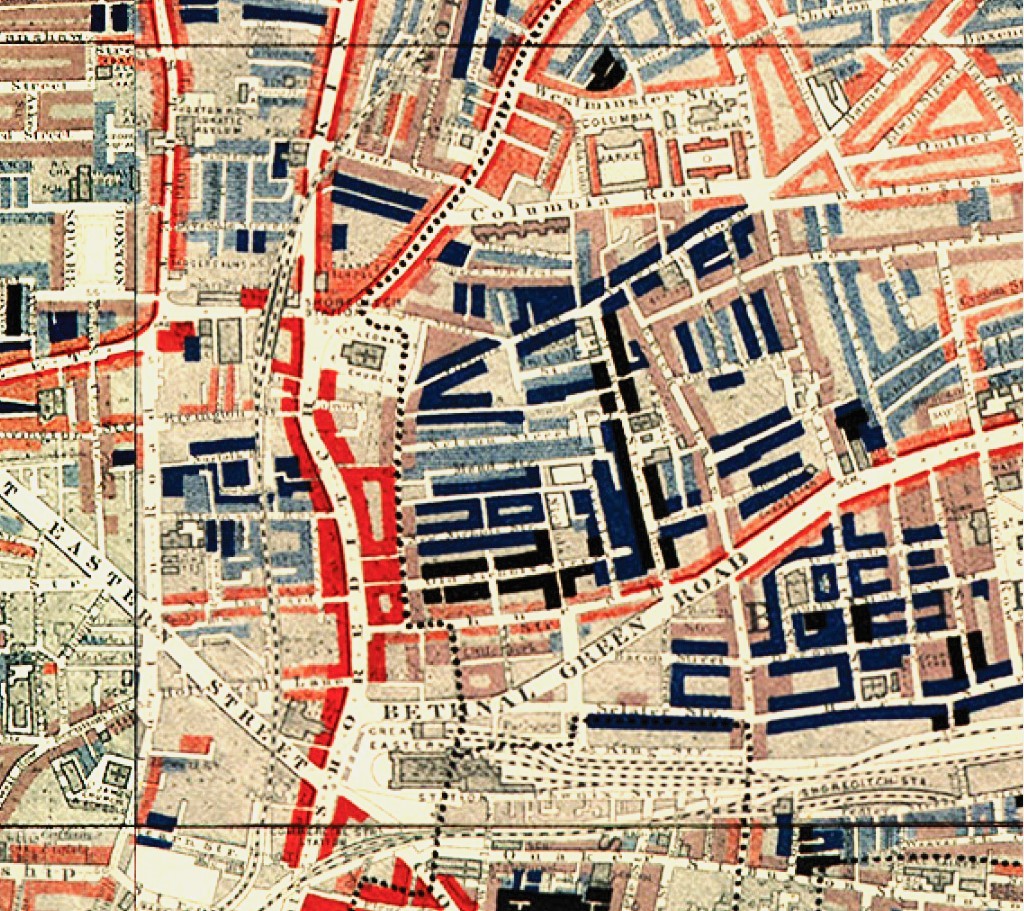
Perhaps the most well-used results of the survey were the Maps of London Poverty where the levels of poverty and wealth found by the survey investigators was mapped out street by street and colour coded.

There were seven classes shown on the maps represented by different colours:

Black - Lowest class including both vicious and semi-criminal.

Dark Blue - Very poor, casual, in chronic want.             

Light Blue – Poor with an income of 18s. to 21s. a week for a moderate family.

Purple – Mixed, some poor others comfortable.

Pink - Fairly comfortable with good ordinary earnings. 

Red - Middle class and well-to-do.           

Yellow - Upper-middle and upper classes who were generally wealthy.

Streets identified with a combination of colours indicates that it contained a proportion of each of the represented classes; however, the colour codes on the maps do not always correspond with the poverty classification in the published survey. It can sometimes be difficult to interpret the map colours because the colours do not emphasise distinction because similar classes have colours which are not different enough so identification on individual streets more difficult.

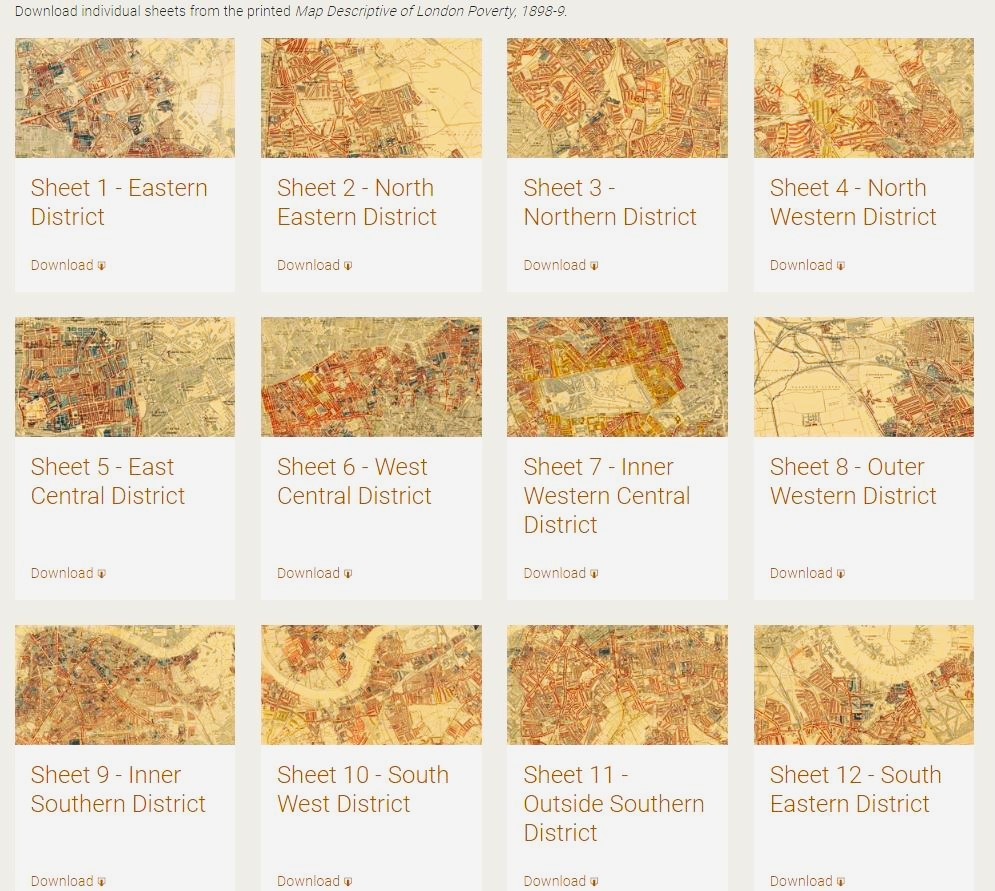
Twelve poverty maps cover from Greenwich to Hammersmith, east/west and from Hampstead to Clapham, north/south. However, the City of London was not included in the survey so the City of London remains uncoloured and unclassified on the maps.

The 1889 edition of the poverty maps was based on information gathered from the School Board visitors. They used Stanford's 6 inches to 1 mile scale map of London and suburbs. The original working maps from this edition are held by the Museum of London which are hand-coloured and use the 1869 Ordnance Survey 1:2500 maps.

The 1898-9 edition of the maps, a comprehensive revision of the first series, were published in 1902 and 1903. The survey investigators who accompanied policemen on their beats also recorded their own impressions of each street and the comments put forward by the policemen. This information was used in updating the street classification used in 1889.
The notebooks

Not many family historians realise there are various series of notebooks which are of significant value to anyone with London ancestry around the time of the survey.

Police notebooks

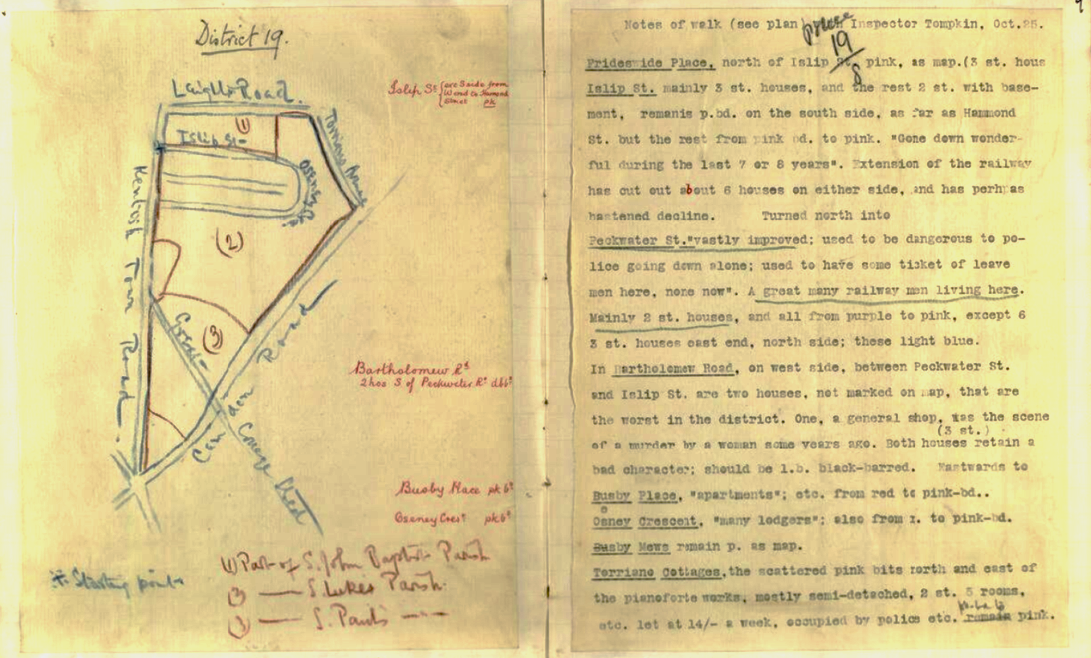
The investigators in London produced reports of their walks round London and which happened during 1898-99; these reports became known as the police notebooks. They contain descriptions and characterisations of London streets, their inhabitants and the industry that existed. All these notebooks have been digitised and can be viewed online. The route of the walks for each district is also shown in the notebooks. They are organised by districts which follow the administrative organisation of the County of London which existed from 1889 until the formation of the GLC in 1965.

The police notebooks provide an insight into the various communities originating from different places that settled in London; but more importantly, they show how such communities were perceived by the authorities. Around the time of the survey, London was undergoing expansion and population growth despite the fact that towards the latter part of the nineteenth century the waves of emigration were a dominant force throughout the country. Emigration to other areas of the British empire was common; a move to the USA was the most popular destination for Londoners who emigrated.

Other notebooks

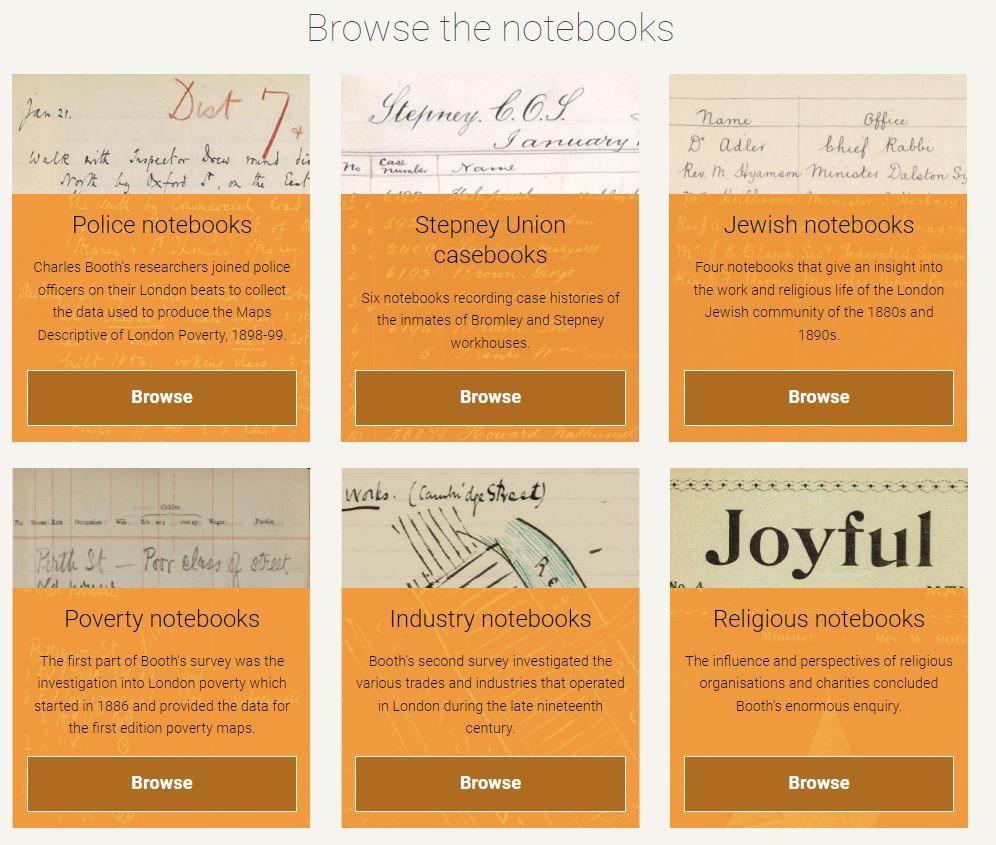
Stepney Union casebooks

There are six notebooks which contain transcriptions of the Stepney Union casebooks between 1889-1890. They detail case histories of both the Stepney and Bromley workhouses and information about both inmates and people who were in receipt of outdoor relief from that Union. This information will be particularly useful to family historians because you can also search the notebooks for names, birthdates or ages of individuals recorded.

Jewish notebooks

There are four notebooks relating to the Jewish community in London in the 1880s and 1890s. Jewish communities were of particular interest to the survey teams. During the late nineteenth century, London was home to a large Jewish population, principally from Eastern Europe, who had fled persecution to seek a new life in the capital. The Jewish population of London was second only to Irish settlers at the time.

Poverty notebooks

The poverty notebooks focus on occupations, household information including households with children, the streets, their inhabitants and classifications of levels of poverty, together with other useful genealogical information for some cases.

Industry notebooks

In order to provide a picture of labour in London many interviews with people connected with the trades of London took place. These notebooks are organised by trade and cover most occupations of the working-class people of late Victorian London.

Religious influences notebooks

The religious influences notebooks look at the role religion played in the lives of London residents. Religious leaders in communities across London were interviewed. Again they are organised by district with 1800 interviews recorded in notebooks; the majority were Anglicans in the diocese of London, but there were also some Roman Catholic priests and nonconformist ministers. Anglican ministers in the diocese of Southwark were also interviewed although they are listed for some reason under the diocese of Rochester.

These interviews can help locate individual London clergymen. The interviews were reckoned to have lasted for  about two and half hours and include the interviewer's comments on the character, reliability and appearance of each clergyman. The reports included name, status, age, length of service, previous experience and date and location of the interview; but the majority of questions were about the involvement of the church within the local population.

Drink, drugs and prostitution

Booth’s survey importantly also looked at such moral traits as drink, drugs and prostitution; much is included about Londoner’s drinking habits which shows that the rate of drinking had increased in the time period although there appeared to be less drunkenness than before - and the increase in drinking was surprisingly mainly amongst women.

The police notebooks also contain references to prostitution in various areas of London. Within the notebooks there is information on the nationalities of the prostitutes and pimps showing details of the charges made by those involved, which included the rents for the lodging houses or brothels from which they operated. Some legislative attempts had been made to curtail the trade with the passing of the Criminal Law Amendment Act 1885, which raised the age of consent to sixteen years and included clauses preventing girls being abducted for prostitution and the running of brothels punishable by fines and imprisonment.

Where can the survey be seen?

The original notebooks are held at the London School of Economics Archives. These originals are valuable because some of the interviews and personal comments were not transcribed and published.

Online material including the maps and notebooks can be found by visiting the website::

https://booth.lse.ac.uk/learn-more/the-booth-archive-at-lse-library

This website includes 450 original survey notebooks recording information about households, as well as notebooks of observations and interviews carried out on police 'walks' in the forty-seven districts of the capital. The online survey and notebooks relate to metropolitan London.

Using the survey

The Charles Booth Online Archive is a key resource for family historians and looks at the social and economic history of late nineteenth century London. It has to be the earliest example of a comprehensive social survey. It provides a mass of data and observations on living and working conditions; the lives and employment of the working-classes; the organisation of trade and industry; the effects of national and international migration; leisure activities, and the religious life of the capital. The 450 police notebooks provided the statistical information for the well-known Booth poverty maps. Additionally, the notebooks contain a huge amount of incidental detail and observations, as well as interviews with individuals.

This article was contributed by Ian Waller from Family History Federation.
Website by Beachshore