One aspect of research which is not always obvious is that ancestors may have been bankrupts. The word b ankruptcy derives from an Italian word meaning broken bench and derived from the old custom where tables and benches were broken when ancient bankers and money lenders were unable to meet their financial liabilities. Sometimes you will hear the phrase insolvent debtors, but there are obvious differences between bankruptcy and insolvent debtors.

Bankruptcy is either voluntary where a person declares himself bankrupt or involuntary where a creditor petitions for a debtor’s bankruptcy. It is a process whereby the courts administer affairs and is not a criminal offence unless accompanied by fraud. The act of bankruptcy discharges debts once and for all.

Insolvency on the other hand means that a person is unable to pay their debts when they are called in, and a person who is insolvent always has the liability to discharge their debts. Imprisonment was a common remedy for insolvency but very few bankrupts ever went to prison. (See article Was your ancestor and insolvent debtor on this website.)

A brief history of bankruptcy

The 1542 Statute of Bankrupts allowed an insolvent person’s possessions to be distributed amongst their creditors in proportion to the debts which were owed to them. The cases of bankruptcy were originally dealt with by the Courts of King's Bench and Common Pleas.

A further Bankrupts Act in 1571 passed the administration of bankruptcy to the Court of Chancery and the Act was restricted to those engaged in trade and business. Under the Bankrupts Act 1571, commissioners of bankrupts were appointed under the Lord Chancellor. Nothing much changed until the introduction of the Bankruptcy Court Act 1831 which established a special court in London to hear bankruptcy cases with District Courts hearing cases between 1842 and 1869. In 1883 central government took over responsibility under the office of the Official Receiver.

The legal status of a bankrupt was slightly complex. Until 1841 the legal status of a bankrupt was confined to traders owing creditors more than one hundred pounds, but in 1842 this amount was reduced to fifty pounds. Debtors who were not traders were considered to be insolvent debtors. So, who were the traders? All those who made a living by buying and selling including those who bought materials, those who worked on them and resold them including skilled craftsmen but not farmers.

The Bankruptcy Court Act 1831 replaced the jurisdiction of the commissioners in bankruptcy and consisted of four judges and six commissioners. To deal with country bankruptcies, district courts were established under the Bankruptcy Act 1842. Also, from 1842 any person who was not a trader or was a trader owing less than £300, could apply for a protection order from the Court of Bankruptcy or a District Court on condition that he entrusted all his property in an official assignee.

As a result of further legislation in 1861, there was no distinction between bankrupts and insolvent debtors as both were dealt with by the Court of Bankruptcy. The Bankruptcy Court Act 1831 also established a Court of Review which was empowered to hear appeals from decisions of the Bankruptcy Court.

The Court of Review was short-lived and abolished under the Bankruptcy Act 1847 from when Its jurisdiction passed to the Court of Chancery, and in 1849 the supervision of bankruptcy work was taken over by the Court of Bankruptcy leaving the Court of Chancery to deal with appeals. After some administrative changes this passed to the Court of Appeal in 1875.

Under a further Act in 1883, the courts having jurisdiction in bankruptcy can only be the County Courts and the High Court. The County Courts had the same powers and jurisdiction as the High Court. At the same time the London Bankruptcy Court formed part of the Supreme Court of Judicature.


Bankruptcy proceedings

Since the Middle Ages bankruptcy proceedings have been conducted as follows:

  • From 1571 to 1831, conducted by commissioners of bankrupts, appointed by the Lord Chancellor. No Court, sat, as necessary, in various locations in England and Wales.
  • After 1831 London bankruptcies were conducted by different courts.
  • 1831-1869, Court of Bankruptcy in London, acting through commissioners.
  • 1869-1883, London Court of Bankruptcy in Lincoln’s Inn Fields.
  • 1883-date, High Court of Justice in Bankruptcy
  • After 1831 country bankruptcies were conducted as follows.
  • 1831-1842, Court of Bankruptcy in London, acting through country commissioners.
  • 1842-1869, District Bankruptcy courts, at Birmingham, Bristol, Exeter, Leeds, Liverpool, Manchester and Newcastle-upon-Tyne.
  • 1861-date, County Courts.

Early records of bankruptcy

The records of the bankruptcy commissioners and their courts do not exist before 1710.

Between 1571 and 1848 the Close Rolls contain copies of conveyances of bankrupts’ estates and the entries usually give details of the prior bankruptcy proceedings. Most of these records are indexed.

The State Papers Domestic and the Proceedings of the Privy Council between 1571 and the early 1640s contain various references to bankruptcy proceedings but these are normally in connection with petitions made to the crown by bankrupts alleging injustice in the system.

The Patent Rolls and the Supplementary Patent Rolls covering the late 1590s up to around 1654 contain records of the appointment of bankruptcy commissioners. The Patent Rolls also include details of proceedings although it is not known how complete they are.

The bankruptcy court

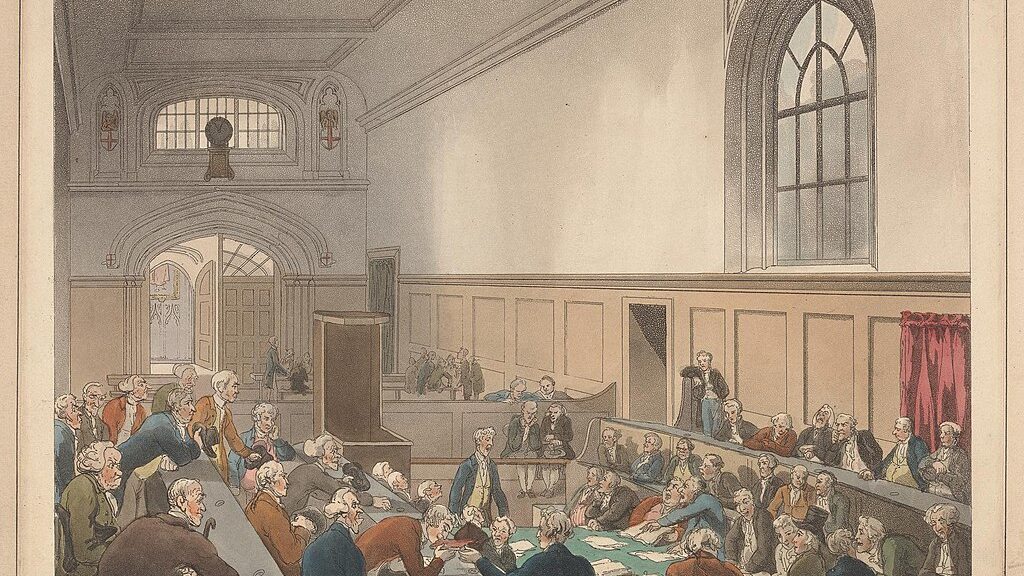
The Bankrupt's Court in Basinghall Street falls under the auspices of the Court of Chancery. The court itself consists of fourteen rooms and is entirely devoted to bankruptcy matters including a separate office for the registry of all business.

After 1869, the London Court of Bankruptcy was established and the definition of London was as follows.

It became the area within the jurisdiction of the City of London and of the metropolitan county courts of Bloomsbury, Bow, Brompton, Clerkenwell, Lambeth, Marylebone, Southwark, Shoreditch, Westminster and Whitechapel.

It later extended to include the London County Council and subsequently Greater London. Clearly therefore Country related to the rest of England and Wales.

There is a distinction between proceedings for either London or the country which in reality was not clear; this was because proceedings that related to country bankruptcies were often heard in London and in some cases London proceedings were heard in the country.

Before 1869, London included all areas within a twenty-mile radius from the city centre thus included most of the metropolitan areas surrounding the city.

Publication of bankruptcy

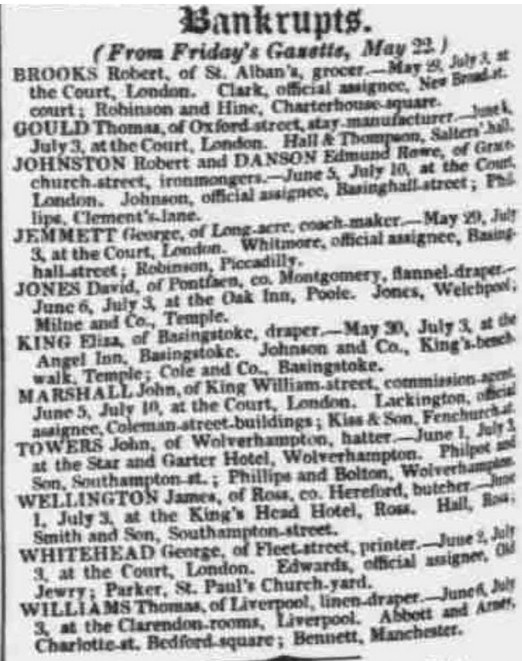
All notices of bankruptcy cases were published in the London Gazette; this was the official government news journal. Notices were also frequently in local provincial newspapers although the latter was not a legal requirement.

The main reason for these notices was to notify any creditors of how they should prove their debts thus securing their rightful proportion of the bankrupt's assets upon distribution. The Gazette has a statutory duty to publish bankruptcy notices. It also publishes notices relating to discharge from bankruptcy and annulments or rescindments.

Bankruptcy was also published to warn creditors to be cautious when dealing with the individual. The process has been recorded in the public domain using the London Gazette since the eighteenth century.  By 1712 meetings of creditors were detailed, and since 1750 the dissolutions of business partnerships have also been recorded.

Bankruptcy proceedings

Most case files are available at The National Archives. It can be complex to follow through on a case but well worthwhile if your ancestor was a bankrupt. They are mainly contained within series B where the records have survived. Case files between 1759 and 1911 for London are in series B9.

The indexes include:

  • name

description (occupation, profession, calling)

residence

solicitor or agent

date of order and date of certificate.

  •  
  • There are also various other main documents and registers, as follows:
  •  
  • Certificates of conformity / discharges 1815 to 1856
  • Registers of Petitions for Bankruptcy 1870 to 1883
  • Declarations of inability to pay 1825 to 1925
  • Deeds of Arrangements 1888 to 1947
  • Register of London Bankruptcy to 1886
  • Publication of notices of Bankruptcy - London Gazette.
  •  
  • Case Files include commissions and fiats. Case Files can include:
  •  
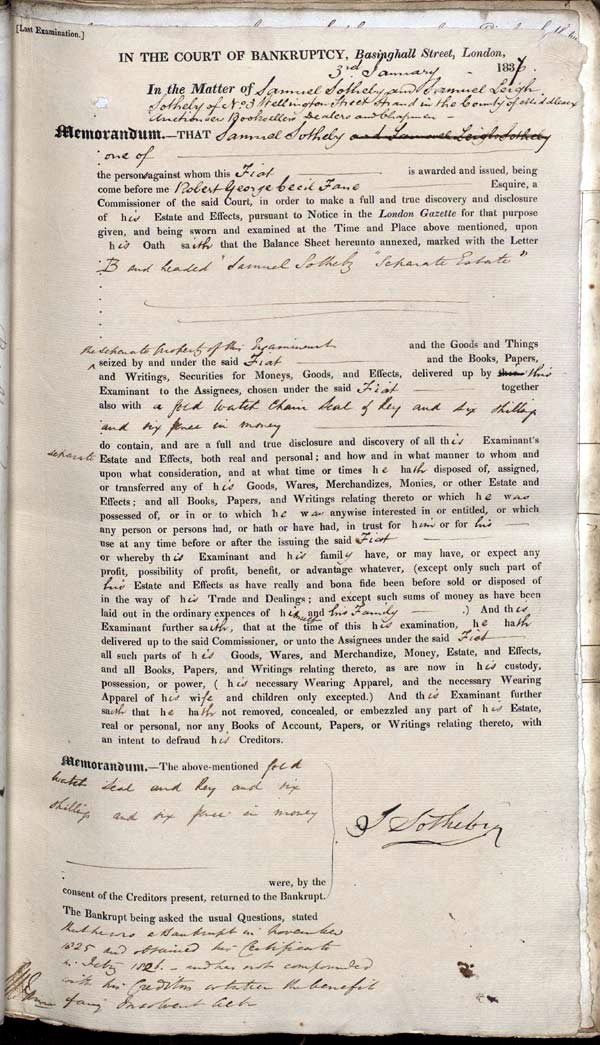
  • Fiats – warrant requiring some act to be done.
  • Examinations and depositions - Statements were taken from creditors about the circumstances of the debts
  • Accounts of bankrupts - Balance sheet of debts.
  • Commissioners also took statements about debts from the bankrupt and his creditors which were used to arrive at the outstanding debt and formed part of the proceedings.

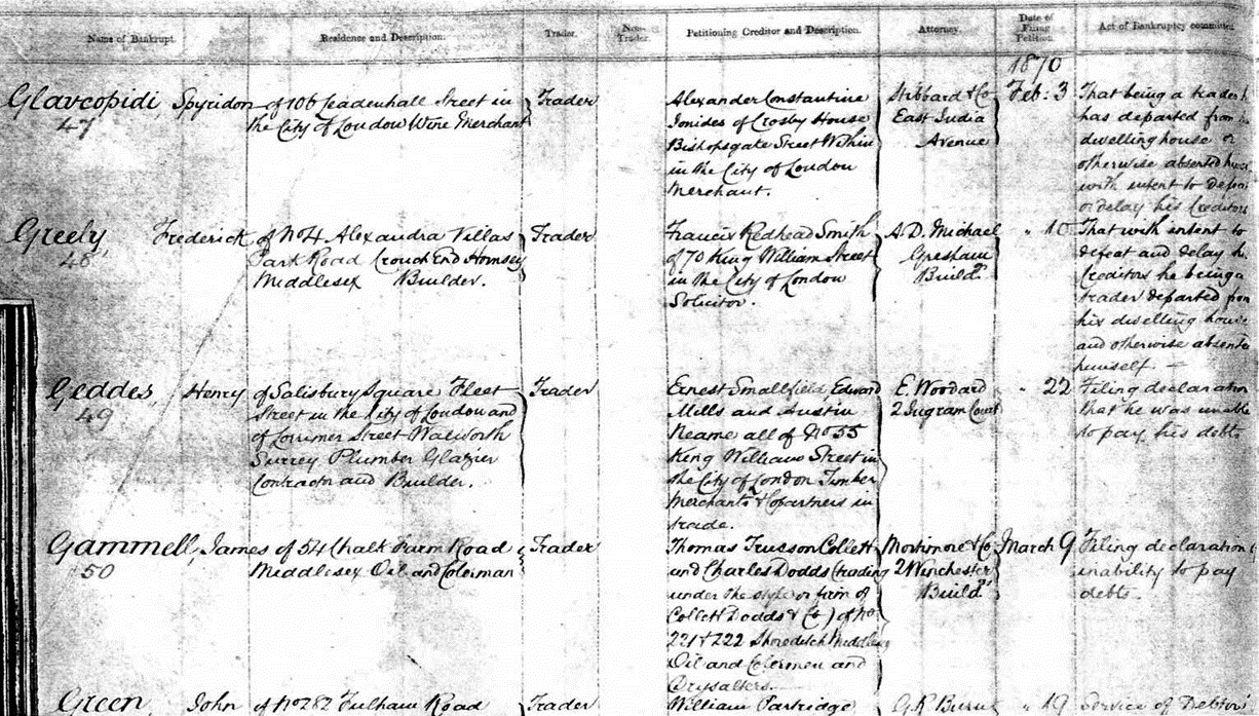
Registers of petitions

These are also a valuable resource and can serve as a finding aid. They include:

  • name of bankrupt
  • residence and description
  • trader or non-trader
  • petitioning creditor
  • attorney
  • date of petition
  • bankruptcy act committed
  • date of adjudication
  • when advertised
  • trustees
  • dividends
  • proceedings
  • wWhen annulled
  • discharge.

Research advice

It is important to research all the records in series B as they include records of companies and individual petitions from the Court of Relief as well as records of the Board of Trade covering the Official Receiver from 1891 in series BT 226. Patent Rolls in series C66 and C67 also cover the early proceedings for bankruptcy.

Remember that insolvent debtors and bankrupts are different and were treated differently. Be aware that people sometimes gave false or misleading general descriptions of their occupations so they could qualify as a trader. The term chapman was often used. Although farmers were specifically excluded, they occasionally appear in records. Creditors could also petition for a bankruptcy order to be made against an individual.

To find more information, the best place to start is to search the London Gazette website using the name of bankrupt. When found, notices were published in sequence. Once you have located information in the London Gazette, you can research bankruptcy case files at the National Archives but be aware that not all survive. If you are unsuccessful you will need to research the various register and enrolment records which will provide brief information and confirm if a bankruptcy resulted.

From 1842 district bankruptcy courts heard cases outside London. In such cases the files and bankruptcy registers may well be held by local archives. It should be possible to identify district court records by using archive online catalogues or by using Discovery.

It is a good idea to refer to The National Archives research guide for bankrupts and follow the sequence meticulously to gain the most benefit from your research.

Further litigation about bankruptcy may be in Chancery pleadings before 1832. To locate any such information, you will need to search Discovery using the series refence C together with name of the individual and the keyword bankrupt.

Bankruptcy post-1844

The Board of Trade controlled the work of the official receivers who were court officials who held meetings of creditors, investigated circumstances of bankruptcy and acted as administrators of the bankrupt’s assets. The registers of the official receivers are in series BT 293 which include entries for all those served with petitions for bankruptcy. Official receivers’ estate ledgers in series BT 294 show the distribution of assets for bankrupts.

This article was contributed by Ian Waller from Family History Federation.
Website by Beachshore