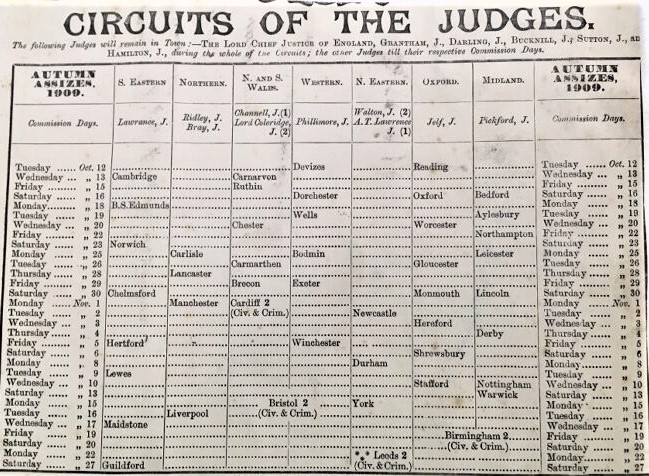





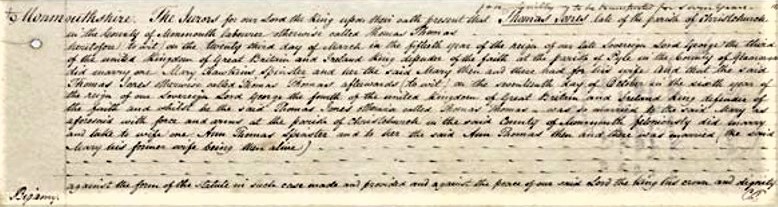
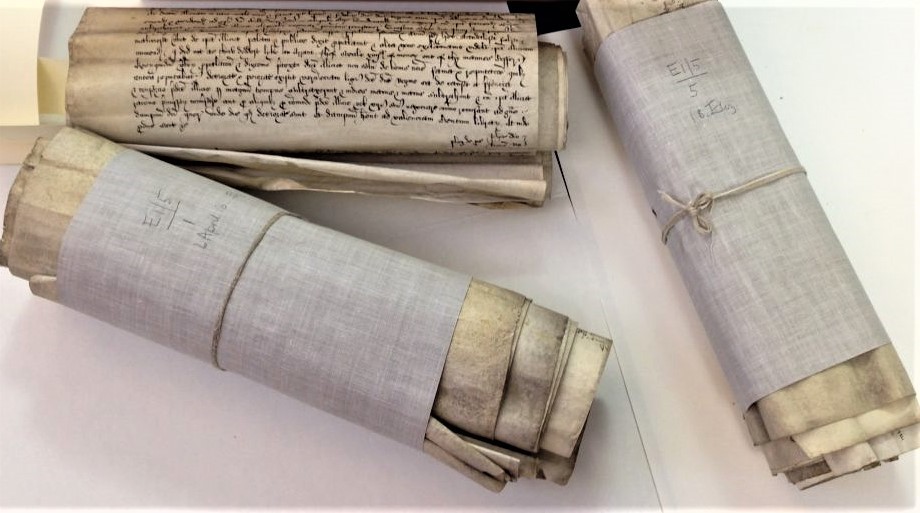
From the thirteenth century, judges appointed by the monarchy went in pairs on a circuit to deal with both criminal and civil law. They were able to administer the law more accurately than local justices. They also had to report the political feeling of the area. By the fifteenth century, criminal cases became the majority business of the assize.
The country was divided into judicial circuits with each circuit covered by a series of visiting judges. Prior to 1876 when some circuits were re-arranged, there were six circuits. They were essentially a travelling court, meeting in town halls, guildhalls and other suitable premises. You will need to be aware of the circuits and the changes made as all records are organised as such.
Home, Norfolk and South-eastern circuits
The Home circuit comprised Essex, Surrey, Hertfordshire, Sussex and Kent. Prior to 1876, the Norfolk circuit comprised Bedfordshire, Norfolk, Buckinghamshire, Northamptonshire, Cambridgeshire, Rutland, Huntingdonshire, Suffolk and Leicestershire. In 1876 the Home circuit and some of the Norfolk circuit were combined to create the south-eastern circuit which then comprised Cambridgeshire, Norfolk, Essex, Suffolk Hertfordshire, Surrey, Huntingdonshire, Sussex and Kent. The jurisdiction of the Central Criminal Court (Old Bailey) also extended over parts of Essex, Kent and Surrey from 1834.
Midland circuit
Up to 1863 the circuit included Nottinghamshire, Derbyshire, Warwickshire, Lincolnshire, Leicestershire, Northamptonshire and Rutland. In 1863 Leicestershire, Northamptonshire, and Rutland were transferred to the Norfolk circuit, and Yorkshire was transferred to the Midland circuit from the old Northern circuit. A reversal took place in 1876 when Leicestershire, Northamptonshire, Rutland plus Bedfordshire and Buckinghamshire were transferred back from the former Norfolk circuit. Yorkshire was transferred to the North-eastern Circuit.
Northern circuit
This circuit comprised Cumberland, Northumberland, Durham, Westmorland and Lancashire. Yorkshire was part of the circuit until 1863, when it transferred to the Midland circuit. The jurisdiction of the courts in the Palatinates of Durham and Lancaster passed to the High Court of Justice under the Supreme Court of Judicature Act 1873. In 1876 the Northern circuit was split into the Northern and North-eastern circuits. The North-eastern circuit then comprised Northumberland, Yorkshire and Durham.
Oxford circuit
This circuit remained unaltered during its jurisdiction and comprised Oxfordshire, Berkshire, Gloucestershire, Shropshire, Herefordshire, Staffordshire, Monmouthshire and Worcestershire.
Western circuit
From 1541 this circuit also remained unaltered and comprised Cornwall, Somerset, Devon, Southampton (later Hampshire), Dorset and Wiltshire.
Welsh circuit
Up to 1945, there were two divisions of the Welsh circuit: the North Wales Division comprised Anglesey, Flint, Caernarvon, Merioneth, Chester, Montgomery and Denbigh, and the South Wales Division comprised Brecon, Glamorgan, Cardigan, Pembroke, Carmarthen and Radnor. The Wales and Chester circuit was not created until 1945 and then comprised Anglesey, Flint, Brecon, Glamorgan, Caernarvon, Merioneth, Cardigan, Montgomery, Carmarthen, Pembroke, Chester, Radnor and Denbigh.