Many family historians will find an agricultural labourer or “ag lab” in their ancestry, especially if their ancestors lived in the countryside. It was a common occupation but also had many different guises. You will quickly discover their existence as your research progresses because the occupation was recorded in birth, marriage and death certificates, on census returns and in parish register entries.

Ag Lab and the 1841 census

The term ag lab did not exist before the 1841 census returns. It began because census enumerators were instructed to it as an abbreviated occupational term. Before 1841 these workers were referred to as labourers, farm servants, servants of husbandry or other more descriptive and specific terms such as shepherd, ploughman, hedger and many more. Despite their speciality being named, they were certainly identifiable as those who were employed on the land. Family historians still perpetuate the term “ag lab”.

A variety of records

Unlike many other occupational groups, there is no single set of records which enable us to find out about their lives; but the very nature of the variety of tasks done by ag labs can lead to a large number of different records. These in turn will all help you to build a picture of your ancestor and give an insight into their daily life.

The agricultural industry was both labour-intensive and seasonal. Not all of those employed had a secure job with many only employed on an annual basis which meant they often had to supplement their family income by being involved in cottage industries such as lacemaking or strawplaiting. Even the very young children attended the “plait schools” and became adept at their craft.

Up until the end of the First World War, working-class people in rural communities were subject to the controls of those who owned the land. Landowners, besides being their employers, were also local magistrates before whom they would appear if caught poaching. Landlords would also reproach them if they fell into rent arrears; churchwardens who questioned them if they missed church or overseers of the poor to whom they applied for parish poor relief in times of hardship.

Records of the courts, particularly the Quarter Sessions, will detail proceedings against them for petty crimes such as poaching and civil matters such as breaches of licensing and gaming laws. In this respect local newspapers can reveal a wealth of information about the agricultural labourer, including court appearances, often in more detail than the official records; they ca also reveal details of local union meetings, unrest, bad harvests, epidemics, social conditions and other issues relating to their way of life.


Farm and estate records

Local farmers, landowners and large agricultural estates kept records and diaries about the operation of their farms. 

These would include information about wages, cottage rents and transfers of workers to other areas. 

These facts in turn provide clues about the many farm workers who moved significant distances whilst working for the same employer.


Records of the parish

Records of the overseer need to be consulted as virtually every family would have regularly claimed parish relief. Charities, resulting from bequests and administered locally, also doled out money or goods to the poor

The village economy

When Queen Victoria ascended the throne in 1837, more than half her subjects were reliant upon agriculture for their livelihood despite England being one of the world’s prominent industrial societies at the time. Typically, the majority of the population of any village were involved with agriculture in one capacity or another. If they were not directly employed on the farm, then their skills supported the farming system - people like the blacksmith, the carpenter, the wheelwright, the miller, the saddler and cordwainer. They were all reliant upon the prosperity of the community for their own wellbeing.

Commercially, farms were linked by a network of markets ranging from the weekly cattle markets to the annual hiring fairs and later the corn exchanges. The market towns became social places as well as the main centre for business frequented by farm workers and their families as well as the farmers themselves.


The Swing Riots and the Agricultural Labourers' Union

In the 1830s and 1840s, the calm nature of daily life rural communities was completely shattered by the Swing Riots. Gangs of men caused uproar and unrest, burned hayricks and even rioted because of low wages and the constant threat of unemployment. Eventually after years of continuous disruptions, the National Agricultural Labourers' Union. was ultimately  established in 1872.

National Agricultural Labourers' Union

In 1833 a group of farm labourers in Tolpuddle, Dorset attempted to form the Agricultural Labourers' Union. Its leaders were arrested and charged under the Unlawful Oaths Act of 1797, found guilty and transported to Australia. Three years later, they were pardoned and returned to England.

Some thirty years later, another attempt was made in Kent with the formation of the Agricultural Labourers' Protection Association. In 1866 they succeeded in securing higher wages as labour at that time was scarce. Following this success, similar organisations were formed in Hertfordshire, Buckinghamshire and Herefordshire.

In March 1872 a meeting of delegates at Wellesbourne in Warwickshire decided to amalgamate all these associations. Joseph Arch, himself an agricultural labourer, became their leader. He was born in 1826 and started work in 1835 scaring birds on a local farm. He later became a Methodist lay-preacher in 1848, a Liberal MP in 1885 and died in 1922.


Cottage industries

Agricultural labourers supplemented their incomes with home-based crafts, such as strawplaiting, lacemaking and many other tasks depending upon the locality. Many male ag labs became adept at lace-making and in Bedfordshire over a third of the girls aged ten to fifteen years old were both strawplaiters and farm workers.


The clanger - a meal in one

The clanger was a savoury and sweet suet pasty that the labourers took for lunch. One end was stuffed with pork and onions and the other with jam or apple. It was very substantial and easy to cook - usually made on Monday from the leftovers of the Sunday meal.

Ploughmans' lunches were also eaten regularly which consisted of chunks of bread, cheese and pickles.

Living and working conditions

Most agricultural labourers had upwards of six or eight children and would be living in a small “two up two down” rented or tied cottages.

Upstairs the farmer and his wife and the younger children slept in one bedroom and the older children slept in the other with male and female areas divided by curtains. Sometimes children would sleep downstairs or were boarded out with elderly people in the village who had some space.

Downstairs, was the parlour which was the centre of family activities. To the rear was a workroom where tools were stored and boots repaired. Most cottages also had a small allotment or garden attached where the family could grow their own vegetables or perhaps keep a pig. Girls often moved into domestic service or boys served an apprenticeship to ease overcrowding and contribute more to the family income.

In an endeavour to improve the life of the agricultural labourer, Alfred Austin, an assistant Poor Law Commissioner in 1834, visited cottages nationwide and as a result stated... Everywhere the cottages were old and frequently in a state of decay, and consequently ill-adapted for the increases in family numbers. The floor of the room in which the family live is usually of stone or brick, damp and usually below the level of the outside soil so rainwater will penetrate. Behind the cottages are pig sty’s [sic], privies etc. where matter can also escape.  

Even as a result of subsequent legislation many improvements did not occur until well into the twentieth century. 

There have been many enquiries by Royal Commissions and by the Poor Law authorities into conditions experienced by agricultural labourers since the 1820s. In any one village a good proportion of inhabitants would have been questioned. The reports are specific and give the name of the interviewee. Topics covered include employment conditions, cottage accommodation, wages, rents, costs of living, unions and estate administration. Some topics were specific to the locality.

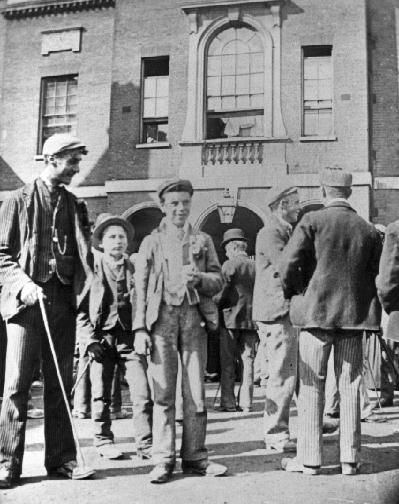
Depending upon his speciality, the ag lab wore the same style of clothing each day. The traditional smock became both unfashionable and unserviceable by the mid-1850s and was replaced by a more serviceable fustian jacket and corduroy trousers. When worn, the pattern of the smocking on the front of the jacket often denoted his calling. Most men wore hats to protect themselves from rain and sun with many senior labourers wearing a billycock which resembled a top hat that traditionally “grew in height”. The taller the hat - the longer they had been employed.

An ag labs' working day began at about 5am with breakfast and then a two- or three-mile walk to the farmyard. Work began at about 6am when everyone would gather to receive instructions on the days’ work from either the farmer or the bailiff. Some labourers would had arrived much earlier - the cowman may have been around since 3am to milk the cows, so would the horseman who prepared the horses for the days’ work. The shepherd was rarely seen during lambing as he would live in the fields with his flock.

Most labourers began working on the farms from the age of seven or eight years old - sometimes younger. Young boys and girls would be employed on light duties such as scaring birds, picking up stones and weeding; they woud progress to more skilled jobs as they grew older.

When ag labs became “senior” – usually over sixty years of age, they would revert to lighter and more menial tasks. Many labourers were employed on an annual basis but some were lucky to have stayed with the same farm or estate for many years.


 

The hiring fairs

The labourers who were employed on an annual basis were regular visitors at the hiring fairs in order to find both work and a home for the next year.

They often wore an emblem representing their skills so that farmers could recognise their speciality. If they did not find work at the fair then they could end up in receipt of parish relief.

The hiring fairs were also social gatherings where extended family members would meet, catch up on news and even develop romances.

A hiring fair would probably draw in many farmers and those looking for work over a twenty or thirty mile radius of the town where the fair was being held. 


Women agricultural labourers

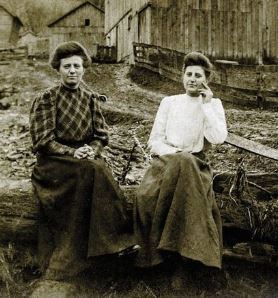
Women also worked as ag labs. Besides working in the dairy or brewhouse, they often performed similar tasks to the boys or older men or even the more strenuous tasks such as ploughing.

It is therefore not unusual to find a female with an occupation of ag lab recorded on a census. In the late Victorian era about half the labour force on farms were women.

Women were heavily employed on the land in both World Wars forming the Land Army to keep our economy on track.


Social life

Socially the village pub or inn was the main place where an ag lab could enjoy a drink with others, a game of skittles or listen to a travelling “penny reader”. Benefit societies were also established to provide benevolence in return for a subscription which ensured payouts in the event of death or long term illness which prevented work. These societies also contributed to the social scene by organising dinners, fetes etc. which were frequented by their members and their families. Many minute books and ledgers survive.

Photographs

Hundreds of photographs are held by record offices and specialist museums depicting many different aspects of rural life and may show your ancestor at work or in a leisure environment. His name may even appear in the catalogue.


Education

Until the advent of the national board schools, few ag labs were fully educated, and even when compulsory education was introduced, the children were often taken out of school to attend fairs, participate in the harvest or other work. They left school as soon as the law allowed because a child's income was essential for family survival.

Literacy was generally achieved through Sunday school attendance or by the limited schooling that they had. Some were taught by older siblings and when children worked to supplement the family income by attending plait schools, they were sometimes taught the basic rudiments of reading and writing as part of their “school day”. Many children recorded as scholars on the census returns were in this type of environment.

Besides being a record of pupil admission and attendance, the local school registers and logbooks detailed conditions and circumstances relating to farming and inevitably affected school attendance. In periods around the harvest or hiring fairs, school attendance dropped and this would be recorded. Pupils are often mentioned by name.

Migration and emigration

Being itinerant by nature of the job, many agricultural labourers sought alternative employment on the railways and in industrial areas.

Migration was at its highest from the middle to end of the nineteenth century. There was the lure to the new industrial areas of the north.

Whole families packed up and left for a new life in these areas - some even emigrated. Land grants in America were very attractive at that time and assistance from the Poor Law authorities meant emigration to Australia was virtually free for those who wanted to take the chance of a new life in a different country.


The abundance of documentary evidence

The fact that agricultural labourers existed means that they are documented, so how do you find out about their lives?  Building a picture of your labouring ancestor is more than possible, provided you take time to delve into the many contemporary records and realise that their lives would have been affected by the social and economic conditions of the time. If you don’t look, you will never know if your ancestor is mentioned.

Which records wold help?

As there are various records to search, local archives and local studies libraries are the starting places for the area in which your ancestors originated.

The following records should be available:

  • Quarter session records
  • Records of the Overseers of the poor and parish charities
  • Farmers' diaries and estate record
  • Local newspapers
  • Census returns
  • Parish registers
  • Photographic collections
  • Friendly and Benefit Society records.
  •  
  •  

At The National Archives in Kew, researchers can expand their basic knowledge by researching the following.

  • Manorial Documents Register 
  • This will enable you to find the location of manorial records. Some may be in private hands or with solicitors. The register will tell you what is available and where the records are.
  •  
  • Poor Law Commission Records
  • These are records of commission reports, correspondence between the Commissioners and Board of Guardians for the local union.
  •  
  • Estate records
  • Records of the Duchy of Cornwall, Duchy of Lancaster and other large estates are housed at Kew.
  •  
  • Maps
  • The collection of maps from earliest times up to the National Farm Survey will help pinpoint where your ag lab was based.
  •  
  • Assize and civil court records
  • Records of the cases for more serious crimes and for cases in the civil courts such as disputes.
  •  
  • Emigration records 
  • Records of assisted passage, emigration and land grants in various participating countries for those ag labs who wated a new life abroad.
  •  

The Museum of English Rural Life, Reading, Berks is THE research centre for all things connected with agriculture. Most of its records are organised on a county basis covering the whole of England. There are also objects, artefacts and a reference library. Their record holdings include the following.

  • Business records of organisations connected with agriculture
  • Farm and estate records throughout the country
  • Agricultural organisations
  • The National Agricultural Labourers' Union records and its successors
  • Agricultural cooperatives
  • Document collections and photographs
  • Friendly Society and Benefit Society records. 
This article was contributed by Ian Waller from Family History Federation.

Did you enjoy reading Ian Waller's article about Agricultural Labourers?

Good news - Ian has written a whole book on the subject!

Follow this hyperlink to learn more:  

https://www.familyhistorybooksonline.com/my-ancestor-was-an-agricultural-labourer-by-ian-waller-2nd-edition-272

Website by Beachshore