




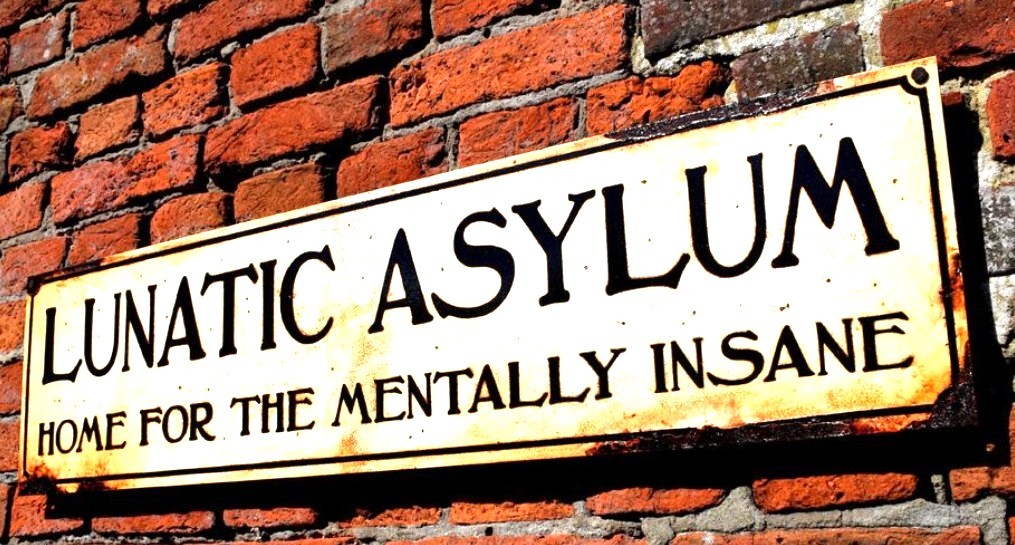
When conducting your research, you may frequently reveal unexpected information or clues about our ancestors' lives which require you to delve deeper. Ancestors who suffered from mental illness were quite common; in the last column of some census returns, they were usually indicated by a word such as idiot or imbecile. You may even find records showing when patients were in a hospital situation. Even members of the military and navy could have been subject to mental illnessl both divisions of the services had specialist asylums to treat their personnel.

An index to the possible records of more than 840,000 patients committed to 300 mental institutions and asylums during the nineteenth and early twentieth century can be searched. This number may be the tip of the iceberg because many others with such illness would also have been cared for at home by family or in other institutions such as workhouse infirmaries. Identifying a patient admitted to an asylum can lead to you finding more information about any of your ancestors from patient diaries and records or from asylum administration records.

Historical background

Control of lunacy began with the Madhouse Act 1774. The predecessor of the Lunacy Commission was the Metropolitan Commissioners in Lunacy dating from the Madhouses Act 1774, By 1842, their remit had been extended from London to cover the whole of the country. The Lord Chancellor's jurisdiction over lunatics was delegated to two Masters-in-Chancery and under the Lunacy Act 1842, these were established as the Commissioners in Lunacy and, subsequent to the Lunacy Act 1845, became the Masters in Lunacy.

The 1774 Madhouse Act made it an offence for anyone to keep a house for more than one lunatic without a licence. This requirement existed until 1959. In the provincial counties, licences were granted in Quarter Sessions. However, in London these were granted by the commission. The licensing authorities also had to inspect all the houses they licensed. Within the counties inspections were carried out by those appointed by Quarter Sessions and in London by the commission. From 1842 county houses were also visited by commissioners as national inspectors.

Until the start of the nineteenth century the custody of idiots and lunatics, as well as the ownership of their land and property, fell to the Crown. Before the establishment of lunatic asylums, pauper lunatics were dealt with under poor law, vagrancy law or criminal law with many ending up in parish poorhouses, houses of correction or even prisons.

Before 1808, asylums were privately ran but an Act of Parliament in 1808 provided for the funding of asylums on a county basis. Initially counties were slow to provide such facilities and the poor with mental illness and the criminally insane were still kept within workhouse infirmaries and prisons. Those who could afford to do so usually arranged for mentally ill family members to be housed in private asylums, usually designated “madhouses.” Private ‘madhouses’ were licensed by theJustices of the Peace and were subject to examination by various government commissioners.

However, in 1845 the Lunacy Act and County Asylum Act compulsorily required every county to build asylums for the poor and criminally insane. The Lunacy Commission also came into existence to regulate and oversee both private and public asylums. County asylums and hospitals were administered by the county, but at the time Metropolitan licensed houses were private institutions in cities and provincial licensed houses were private institutions outside cities. The 1890 Lunacy Act gave asylums a wider role, and wealthier patients began to be admitted.

The Lunacy Commission

The Lunacy Commission was a public body established by the Lunacy Act 1845 to oversee asylums and the welfare of mentally ill people in England and Wales. It succeeded the Metropolitan Commissioners in Lunacy. The commission was renamed the Board of Control in 1913. Since the Second World War, most of its functions have been absorbed by the Ministry of Health.

The Lunacy Commission consisted of eleven Metropolitan Commissioners: three medical, three legal and five laymen. Six members of the commission were salaried, namely the three legal system members and the three medical members. The Lunacy Commission was a Victorian "Ministry of Mental Health" but without a "Minister of Mental Health". It was responsible both to the Lord Chancellor and Home Secretary.

The Lunacy Commission had national authority over all asylums except Bedlam until 1853. It shared the responsibility with the Poor Law Commission for pauper lunatics outside asylums. All hospitals receiving lunatics were required to be registered with the Lunacy Commission, have printed regulations and a resident medical attendant.

Detailed instructions existed for inspections for the Commission and County Visitors. The Commissioners visited London licensed houses at least four times a year, county houses at least twice a year and registered hospitals at least once annually. They also visited the county and borough asylums and any prison in which there was a lunatic at least annually.

The results of the visits were recorded in the institutions' visitors' book following which the proprietor or superintendent had to send a copy to the Commission and the County authorities within three days of the visit. Where these exist, they form a valuable resource about what life in the asylum was like.

Workhouses Commissioners visited any workhouse in which there was a lunatic at least once a year. The visiting commissioners reported to the Poor Law Commission on whether the provisions of the law respecting the treatment of lunatics was being followed. 

The function of the Lunacy Commission

The principal functions of the Lunacy Commission were as follows: 

  • Monitor provision of asylum accommodation for pauper lunatics under the County Asylums Act
  • The transfer of pauper lunatics from workhouses and outdoor relief to asylums
  • Regulate the treatment of pauper lunatics in licensed houses and hospitals
  • Alongside the Poor Law Commission to monitor the treatment of pauper lunatics remaining in workhouses or on outdoor relief
  • To monitor the regulation of county houses by Justices of the Peace
  • To regulate the conduct of hospitals except for Bethlem Hospital
  • Act as the authority monitoring admission to all types of asylums with respect to the preservation of civil liberties
  • Monitor discharges with respect to the protection of the public.
  • Collect and utilise data on the treatment of lunacy throughout England and Wales
  • Advise on the development of law and public policy on the treatment of lunacy.
  • License and visit madhouses in the London area.

Patients' admission registers

In the form of an index, the registers are held in series MH 94 at The National Archives and can also be searched up to 1921 on Ancestry.

This series contains registers kept by the Lunacy Commission between 1846 and 1913, and their successors the Board of Control from 1913 to 1960. of asylum patients in both public and private asylums. They record the following information:

name and sex of the patient

the name of hospital, asylum or licensed house

the date of admission

date of discharge or death of each patient (indicated in various columns).

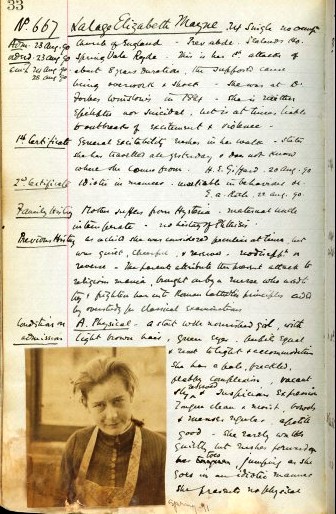
Further information on the medical and legal circumstances of each patient was entered in the patients' diaries which can also be searched at The National Archives and are also included in series MH94. The patient diaries note the receipt of medical statements and action to be taken, the receipt of a patient's right to see a judicial authority, the urgency of the case, and further remarks.

Local archives will invariably have an archive collection of records for the locally based asylums which can add to further research. These records are normally subject to a statutory closure period of at least thirty years. Records of the lunatic asylums may not held in the same place and not all records may have survived. Many records of asylums and prisons will be held in county record offices especially those of the patients and inmates. Some patient files however may have been destroyed.

Records held at The National Archives mainly relate to the administration of the institutions but some include information about inmates. They also hold records relating to the administration of the estates of people who were considered incapable of managing their own affairs.

Asylum registers

Originally all asylum registers and medical records had to be kept in a specified manner and annual statements of admissions and discharges had to be submitted.

The Lunacy Commission had to receive notices from all the County Asylums, hospitals and licensed houses on the admission, removal or death of every patient as well as any escapes or recaptures. A Patients' Book had to be maintained by every asylum with this information for every inmate.

Before the end of seven days from an admission, the clerk of every County Asylum and proprietor or superintendent of every licensed house or hospital had to send a copy of the commitment certificate and order to the commission. Similarly, within two days of the removal, discharge or death of any patient event, the same officer had to send notice to that effect together with information relating to a cause of death.

Register of Patients included:

  1. date of last or previous admission
  2. number in order of admission
  3. date of admission
  4. full name - Christian names and surname
  5. gender
  6. class - private or pauper
  7. age
  8. marital status
  9. previous occupation
  10. normal place of abode
  11. county, union or parish to which chargeable
  12. by whose authority were they sent for admission
  13. dates of medical certificate and who signed it
  14. bodily condition including name of any physical disorder or form of mental disorder
  15. supposed cause of insanity
  16. number of any previous attacks
  17. age on first attack
  18. date of discharge or death.

Pauper lunatics

Every pauper lunatic not in a county asylum, hospital or licensed house was visited quarterly by the poor law medical officer, who kept a list showing who he considered fit to be at large and properly taken care of. Similarly, a list was also kept of those who were not. After the county asylum existed, no pauper who subsequently became a lunatic was allowed to be kept outside a county asylum, hospital or licensed house longer than was necessary to obtain an order for confinement. Poor law medical officers entering false particulars about an individual were liable to fines of between £10 to £50 for every such offence.

Any two Lunacy Commissioners could order an asylum committee to transfer any lunatic from the principal to a chronic county asylum or vice versa

Under the terms of the 1845 Lunacy Act, patients confined lost the right of access to the courts to challenge their confinement. The commissioners and visitors were the sole arbiters on such matters. The statutory requirements stated that anyone authorised to take charge of a lunatic as a result of a medical certification had the authority to detain the patient until he died was removed or discharged by the appropriate authority. If a lunatic escaped, they could be recaptured within fourteen days and returned to the asylum. An inmate could not be discharged from a licensed house or hospital if the medical superintendent objected on the grounds that the patient was dangerous or unfit to be at large. The commission could overrule this if there was sufficient evidence placed before them.

The Crown's law officers considered that section 48 of the 1845 County Asylums Act did not allow JPs any discretion about sending a pauper lunatic to an asylum, but a year later they were granted powers of discretion.
Determining lunacy and administering the property of lunatics and idiots

Pauper lunatics were generally dealt with locally but the care of both idiots and lunatics when they owned significant property was dealt with by the Crown who would automatically take charge of the administration of both real property and their possessions.

The responsibility was that of the Lord Chancellor although the Court of Wards was responsible for a century from 1540 to 1646. These people were referred to as ‘Chancery lunatics’. The monarch would administer the property of an idiot until death, but for a lunatic the monarch’s administration was only for the duration of their insanity. In reality such administration was in the hands of committees consisting of those to whose care the lunatic or their estate was committed. These could have been the next of kin.

On declaration of a person being of unsound mind, a Chancery inquisition removed their power of independent legal action in the administration of their estate. Chancery was not involved with the committal to an asylum. The only requirement for such a committal was for two doctors to issue a certificate. In reality the lunatic was already an asylum inmate when the Chancery inquisition took place.

It was normal for both lunatics and idiots to be brought to the Chancellor’s attention by relatives, solicitors or anyone that had an interest in their estate including executors of a will or where one of the beneficiaries was a supposed lunatic. The Lunacy Commissioners may also have been involved if they considered that the finances of an asylum inmate were being misused. Any creditors of the lunatic could also inform the Chancellor, because they could claim recompense from the Master in Lunacy after the debtor had been declared of unsound mind.

Commissions and inquisitions to determine lunacy 1627-1932

Requests for a commission of inquiry had to be supported with at least two sworn affidavits which supported the requestor's opinion of the state of mind of a suspected lunatic. It was then the responsibility of the Lord Chancellor to establish whether or not a person was of unsound mind. This was established by the commissioners holding an inquisition. If they determined that the person was of unsound mind, then the Chancellor committed the custody of the lunatic and his estate to suitable committees and then examined the accounts of the committees. Most of the affidavits do not survive, but abstracts of the petitions do exist for the period 1627-1932. They can be found in series C 211 some of which are searchable by name after c1853. Commissions and inquisitions are in Latin until 1733 apart from the interregnum and after 1733 when they are in English.

This article was contributed by Ian Waller from Family History Federation.
Website by Beachshore