



In theory anyone over the age of sixteen can call themselves by whatever name they wish. However, over the past two hundred years or so, formal procedures have become more common and are usually needed in order to be recognised by government, commerce and many other organisations. But, approximately less than fifteen per cent of those who changed their names did so through official channels.

Why a change of name?

There are various reasons why someone would change their name. The majority of people had no desire to draw attention to their name change so it just happened and it was the easiest way to fade into oblivion within society or to formalise a relationship.

People might have  changed their name because of illiteracy, simplification, necessity, mispronunciation or they simply disliked their name. Other, perhaps more legitimate reasons, include fear of discrimination or persecution, to escape officialdom, to integrate as an immigrant, to cover up illegitimacy, marriage breakdown and even to hide bigamy or avoid detection as a result of desertion from military service.

In days when it was too expensive or restrictive to divorce and in order to escape possible detection where bigamy was involved, a man who deserted his wife may have changed his name and the woman usually took their partner’s new name to give the appearance of being married but alas no record of the event.

Illegitimate children often took the surname of their mother’s husband although he was only a stepfather. This tended to formalise the family relationship to the public face and is fairly easy to detect.

People also changed their name when entering the military if they had done so underage or without parental consent; these were common occurrences for First World War enlistments. Military records are sometimes annotated with an alias name, particularly the pension records.

Some people had little choice and were directed to change their names on succeeding to property under the terms of a bequest in a will or a settlement; this would have been to perpetuate the memory of a family in which a male line has become extinct. The only way of finding this out is to trace all the wills proved for all members of the family where you know a change has occurred but do not know why.
Name changes on English and Welsh birth certificates.

The registration of a birth is a historic record. It is intended to record the facts as they were at the time at which the registration took place. 

Name changes were not usually recorded on civil registration certificates but an application to the Registrar General enabled changes to be detailed or annotated on birth or marriage certificates. Often these changes were subtle or purely by way of clarification but become very important when researching. The Christian name of any child can be changed within one year of the original registration, usually entered in column 10 of the original certificate. This column was also used to add a name after initial registration. If a name was added after the initial registration, it is often a clue to a nonconformist allegiance. The original and subsequent entries both appear in the indexes.

Anybody with parental responsibility for the child - usually the father, mother or guardian - can apply for a child’s change of forename to be recorded. The law allows for a change to a child’s forenames, providing the new forenames are as a result of baptism or regular use within a year of the original birth registration.

Depending on the marital status of the child’s parents, it is sometimes possible to change the child’s surname on their birth certificate. If the parents were not married at time of the birth registration and the father did not attend the registration, it is possible to amend the birth certificate.  It can be altered to show the father’s details and the child’s surname can also be altered. However, if the father’s details were added to the birth certificate and his surname was taken by the child, then the birth certificate cannot be changed.

If the parents of the child married after the child's birth registration, the birth needs to be re-registered because this then legally shows the child as a child of the parent’s marriage; otherwise the child remains illegitimate which could have an impact in their later life.  One important aspect within the re-registration system is that the change of the mother’s name is properly recorded if she took her husband’s surname upon marriage. If the child’s parents double-barrelled their surnames, or combined them in some way upon marriage, this name can be entered on the child’s birth certificate.

Known by…

Think about how many people you know who are known throughout their life by a completely different Christian name from that which they were given by their parents. They go through life, marry and die using that different name thus appearing in all manner of officialdom with the “other” nam; so how do you link it back to the original birth certificate which is a completely different name. Simply obtain all documentation and fully examine the facts found in census returns, baptism records and occupational sources to clarify a connection. Sometimes conjecture even plays a role!

In England and Wales, (the law is slightly different for Scotland,) you may call yourself what you like unless it is for criminal or fraudulent purposes. Many criminals used an alias name in an attempt to avoid detection. No legal documentation or public notice is needed to do so irrespective of motive. The situation was slightly different during the Second World War when a name change was only made after a statutory notice in the London, Edinburgh or Belfast Gazettes. Such entries can be found by searching www.gazettes-online.co.uk.

Name change by deed poll or Royal Licence.

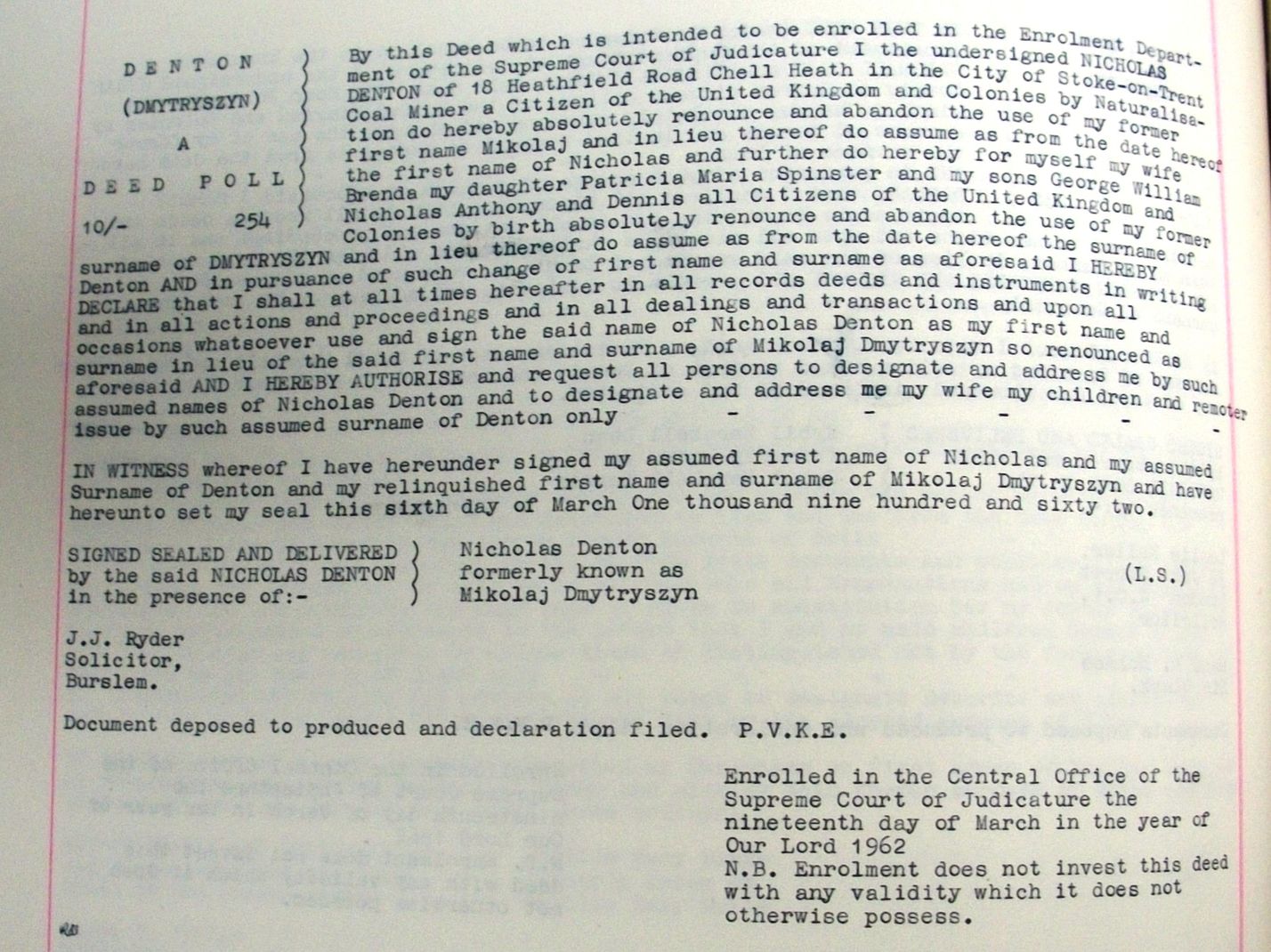
The most common type of document regarding the formal change to a person’s name is a Deed Poll. A deed poll is a general term meaning a single legal document involving only one party and can also relate to other aspects of common law. Deed Polls could be “enrolled” in the Close Rolls or the Enrolment books of the Supreme Court, but as it was not a legal obligation, many were not. If an enrolled deed cannot be found, the best place to try and find it is in family or estate papers privately held or within collections at local record offices as they were regarded as personal deeds.

From 1914, if a deed was enrolled, you will be able to find a notice to that effect in the London Gazette. The easiest way of finding these is using the indexed online Gazettes; finding the notice as well as the enrolled deed should provide a full picture. Name changes can frustrate research but are not always detectable.

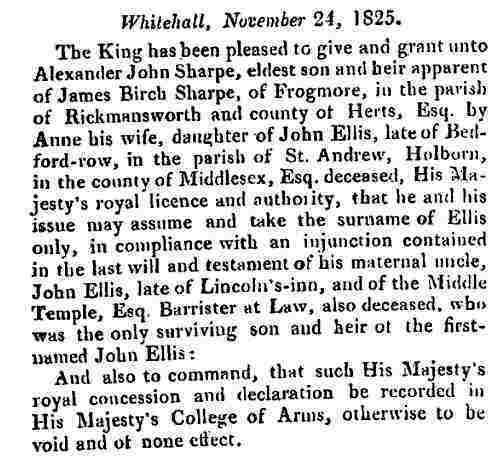
A surname may also be altered or changed by Royal Licence which was common during the eighteenth and nineteenth centuries. They were mainly issued where an inheritance depended upon someone taking the deceased testator's name. Marriage settlements sometimes required the husband to adopt his wife’s name.

For armorial families, a change of name required a change to a coat of arms. Arms granted to one family can only be transferred to another person not in the legitimate male line of descent from the original grantee by means of a Royal Licence, followed by an exemplification of the arms. A petition for a Royal Licence was drafted by an officer of arms for signature by the petitioner. It was then submitted on his or her behalf by the officer of arms to the Home Office. A resulting Royal Licence and any subsequent exemplification of arms must be recorded in the official registers of the College of Arms in order for it to be valid. A Royal Licence is usually granted after consultation with the Home Secretary. Following this procedure generates correspondence which can often be found in the Home Office files at The National Archives in series HO45 for the period 1841-1871 and HO44 for the period 1868-1959.

Change of name by Act of Parliament

Some changes of name were made by a private Act of Parliament, usually for the same reasons as those made by Royal licence. This system was more common in the eighteenth and early nineteenth centuries, but since 1907 there has only been one Act. These Acts of Parliament are published in printed volumes arranged by year so you will need to search through the list of Private Acts of Parliament which changed a person’s name covering the period from 1539 to date. Confirm if an Act was passed and in which year and then consult the original documents at the Parliamentary Archives.

Discovering a name change

There is a wide variety of government, military and occupational records which may mention both real, changed and alias names. Some of the more common ones show both names because maybe the family could not decide what to call a child at baptism. Maybe the person had been exposed as a criminal who had committed various offences using different names and the crimes had been linked, in which case the records usually give both real and all known alias names. Documents may exist in family papers relating to both names.

There was also a series of ways in which a formal name change could occur. A statutory declaration, before a Justice of the Peace or a Commissioner for Oaths, was sometimes enrolled in Close Rolls and these can be researched at The National Archives. Such documents serve only as written evidence that a change of name has occurred; they do not operate to change a person’s name. An “official” notice in a national or provincial newspaper was also made.

The Phillimore and Fry index 1760-1901 - A composite index to name changes

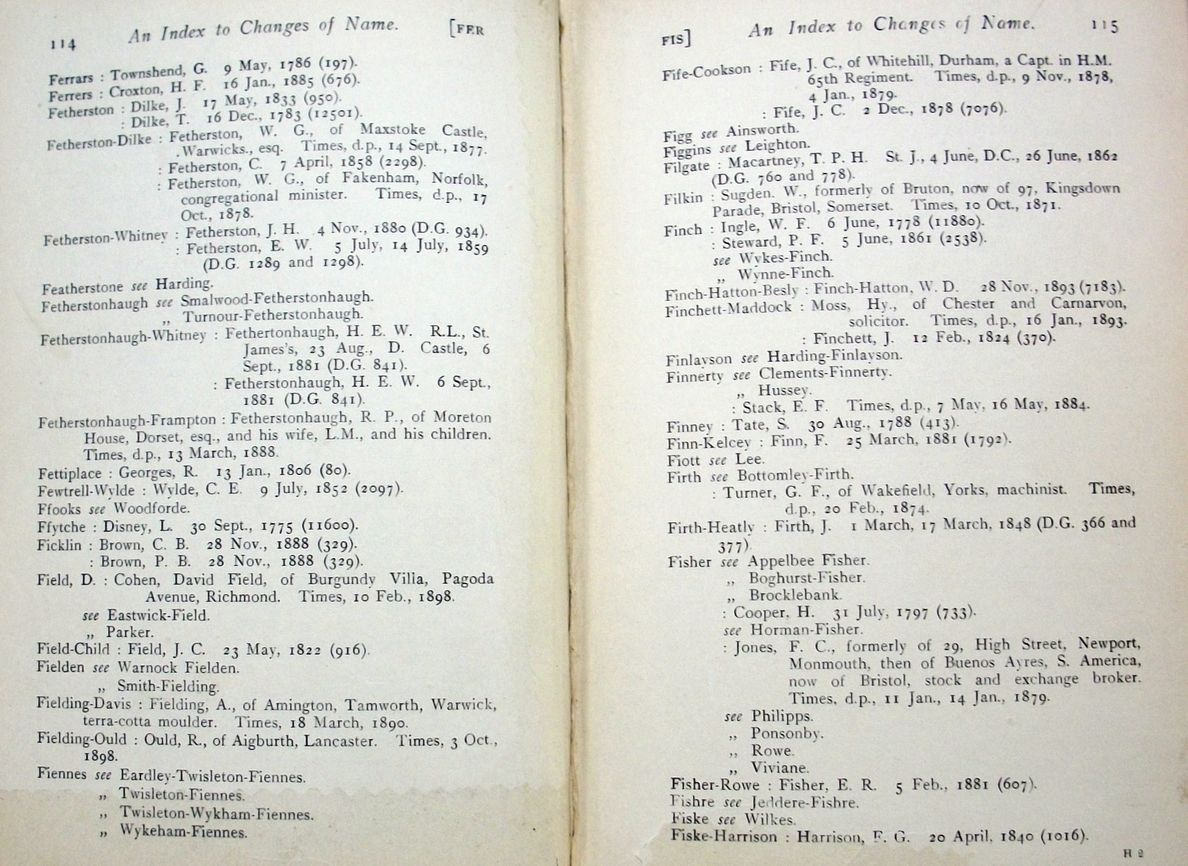
The Phillimore and Fry Index to Changes of Name it is a comprehensive index of information from various sources such as Private Acts of Parliament and Royal Licences published in the London and Dublin Gazettes. It covers the period between 1760 and 1901 This index is invaluable to see if your ancestor changed his or her name formally. It was compiled from various sources and does not purport to be complete but it is all that you have to quickly find information. It includes information on notices in The Times from 1861 as well as those in the Gazettes and the College of Arms records. Some of the Close Rolls records, unless reported in The Times are not included so there are limitations. The index is a printed publication which can be searched online at:

https://archive.org/details/indextochangesof00philrich/page/n1/mode/2up

It also contains a comprehensive introduction on the history of the law surrounding name changes.

Other research aspects suggesting a name change – or not!

Before the advent of standardised spelling, names were spelt phonetically as suggested in these examples.

ALBONE – Alban, Owlbon, Auburn, Holborn, Holbone, Awlbun

SHOULER – Shewler, Shoulder, Showler, Soueller, Sheweller.

This is something to be aware of when using alphabetical indexes as finding aids. Names had not changed but spelling had!

It is possible that a record could be indexed under a nickname, such as someone named Robert Baker using Bob or Robbie. Hyphenated surnames are another variable along the same lines - Linda Peters, Linda Peters-Sullivan or just Linda Sullivan. Using a second forename prominently and converting that to a nickname was also common as was the use of alias names for no other reason than choice, particularly into the 1800s in the southern areas of the country. Then of course there is the complete misinterpretation of a name.

Consider guardianship too. Guardians could be assigned under old poor laws for orphans or for children who had been deserted. Very often family members took over the care of children who had lost their parents without a formal recognition of the change of care or responsibility. Guardianship was also bequeathed under terms of wills and often the children took on the surname of the guardian nominated by the testator. Usually guardianship only applied until a child was aged twenty-one so thereafter a name change could occur.

Since 1741 the names of foundlings were changed upon entry to the Foundling hospital. Foundling is an historic term applied to children, usually babies, that have been abandoned by parents and discovered and cared for by others. Approximately 270,000 children were part of the hospital system up to the Second World War. Children under twelve months were admitted after a petition from the mother explaining background. After admission they were renamed on baptism and identified by an admission number and the mother’s token.

Clean break or mystery

For the family historian, going back and finding someone has changed their family surname can very extremely frustrating. In many cases the break between old and new surnames is a clean one, so it may prove very difficult to find the original name, leaving you with a brick wall that can prove complex to resolve. When you break that barrier, you might never discover exactly why that ancestor chose to make a name change - it all adds to the mystery!

This article was contributed by Ian Waller from Family History Federation.
Website by Beachshore